29Longevity· 2026 edition
Goodbye mortals
// A story from 2051
Marianne is packing eagerly. Trousers, shorts, t-shirts, a light jacket for cool evenings. Two bikinis, a slinky cocktail dress, her favourite heels. Abseiling kit — check. Cycling kit — check. And, most important of all, her Rejuva supplements and nanomedicine, sealed in a temperature-controlled case for the three-week trip. She is flying to her old university in California, to an open day for a degree in mind-transfer technology; since backing up her own mind to the cloud, she has become obsessed with the field.
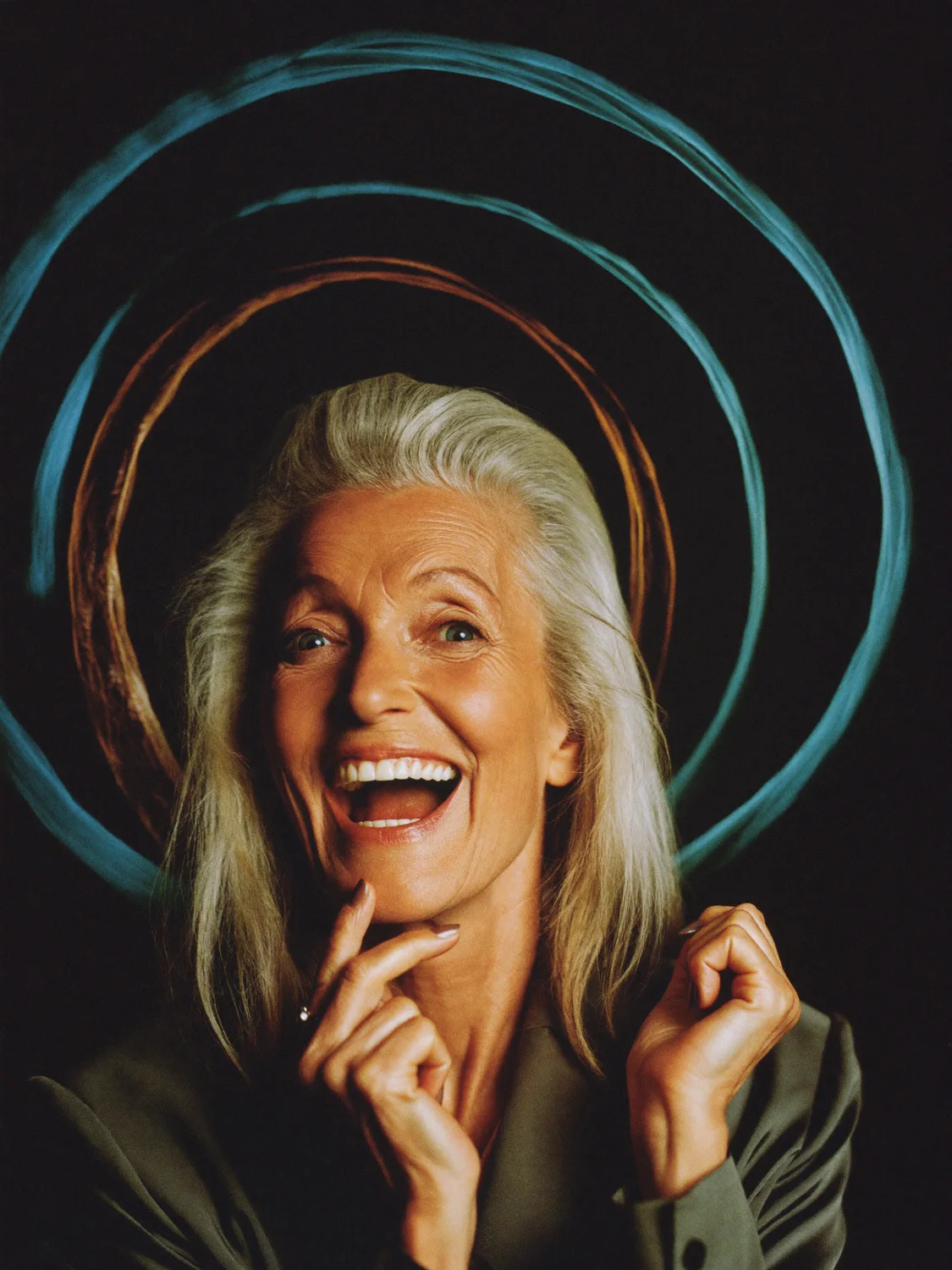
Before hailing a flight-taxi she checks herself in the smart mirror. Blonde hair freshly tinted and bouncy after a treat of 4D-printed follicles; eyes bright and clear; face only lightly lined, thanks to a lifetime of religious sun protection. She spritzes pheromone perfume, dabs algae gloss on her lips, and flashes a full smile — the canines she was always self-conscious about regrown now, seamless, from a wonder gel. Not bad, she thinks, for eighty-five. Tonight she is meeting Frank, seventy-six, from the dating app Octo. They have had plenty of fun in virtual bars and hotels — don't tell the grandchildren — but this will be their first meeting in the flesh. After LA she will drive out to Joshua Tree and climb the boulders she last conquered at twenty. In her sixties a rare motor-neuron disease should have put her in a wheelchair for good; a gene-therapy trial halted the paralysis, and years of walking with difficulty and a helper robot followed. The doctors called her a miracle. For the fit, restless Marianne, a miracle that left her limping was not enough — and then the next wave of therapies arrived, and gave her back the body she thought she'd lost.
She zips the case shut and pauses, catching her own bright eye in the mirror. Eighty-five, and packing for rock-climbing and a first date. Her mother died at seventy-nine, worn out, called old. Marianne does not feel old; she does not, anymore, entirely know what the word means. Somewhere out there her backed-up mind waits in the cloud, and her regrown body waits by the door, and the only question left — the one nobody in her mother's century ever got to ask — is not how long can I live but how much living do I actually want to do. She turns off the mirror, and goes to find out.
// The science behind it
The 90% bet, and the field that exploded
The 2021 edition rated this chapter at 90/100 — near-certainty that ageing would move from an unstoppable fate to a treatable condition, ushering in what transhumanists call "amortality": not immortality, but death by choice rather than decay. Five years on, the verdict splits sharply and instructively. The field exploded exactly as predicted — longevity science became one of the best-funded, most talent-rich frontiers in all of biology, and the tech-titan obsession the essay named turned into an industry. But the delivery lagged the hype, hard, and honesty demands both halves. We understand ageing far better than in 2021, can now measure it, and have opened a genuinely revolutionary line of attack the original barely glimpsed. What we have not done is add a single confirmed year to the human maximum lifespan. The science raced. The clock, so far, did not stop. This is the most important reality-check in the Fiction block, and it cuts both ways.
The billionaires came, with billions
The essay's prediction that ageing would "likely be solved by Silicon Valley" looks, in one sense, prophetic. The years after publication saw an unprecedented flood of money into anti-ageing research: a single new venture launched with three billion dollars and a roster of Nobel laureates, explicitly aimed at reversing ageing at the cellular level; other well-funded startups formed around the same goal, backed by the very tech founders the original named. Longevity went from a fringe enthusiasm to a sector with serious science, serious capital, and serious talent. The obsession is real, the money is real, and — importantly — a good deal of the resulting science is real too, not merely the vanity project critics feared. If ageing is a problem that money and brains can crack, more money and more brains are now aimed at it than ever in history. The essay was right about who would come, and how hard they would try.
The paradigm shift the original missed: reprogramming the cell's age
Here is where the decade went somewhere the 2021 essay could not fully anticipate, and it is the most exciting development in the chapter. The original focused on clearing out "zombie" senescent cells and on drugs that slow ageing. But the frontier that surged to the centre is cellular reprogramming — the discovery that you can partially reset a cell's biological age, winding back the epigenetic clock toward youth without erasing the cell's identity, using a controlled dose of the same factors that turn an adult cell back into a stem cell. In animals, partial reprogramming reversed markers of ageing, restored function to old tissues, and — in a startling, much-cited result — brought sight back to blind mice by rejuvenating their optic nerves. The implication is profound and genuinely new: ageing may not only be slowable but partially reversible, because the information for a younger state is still there in the cell, waiting to be restored. This is the science the three-billion-dollar venture and its rivals are chasing, and it reframes the whole enterprise. The 2021 chapter imagined managing ageing like a chronic disease. The 2020s raised a wilder possibility: editing it backwards. It is early, it is risky — the same factors can cause cancer if misapplied — and it is nowhere near human anti-ageing therapy. But it is the most credible route yet to the fiction's rejuvenated eighty-five-year-old.
We learned to measure ageing — which changes everything
The quieter but arguably more consequential breakthrough is that we can now measure biological age. "Epigenetic clocks" read chemical marks on your DNA to estimate how old your body truly is, as distinct from your birthday — turning ageing from an invisible process into a number that can be tracked and, in principle, moved. This matters enormously, because you cannot systematically improve what you cannot measure, and the lack of a yardstick was long the field's crippling handicap: an anti-ageing therapy might take decades to show up as extra years of life. Now a trial can read whether an intervention nudged the clock in months. Commercial biological-age tests reached consumers; the "hallmarks of ageing" the original gestured at were formalised into a rigorous framework guiding the whole field. The 2021 essay treated ageing as a target. The decade gave the field a scope to aim with. That, more than any single drug, is what turns longevity from alchemy into science.
The drugs: humbler than the hype
On the specific therapies the original championed, the decade delivered a sobering lesson in the gap between promise and proof. Senolytics — drugs to clear senescent "zombie" cells — remain in trials, and the flagship company the essay named suffered high-profile clinical failures before regrouping; the idea is still alive and plausible, but it did not deliver the swift triumph the original implied. Metformin, the cheap diabetes drug the essay crowned, and its landmark TAME trial — designed to make ageing itself an approved treatment target — stalled on funding, and its results are still not in; the longevity community's enthusiasm meanwhile shifted toward other compounds like rapamycin, and, unexpectedly, toward the GLP-1 drugs of chapter two, which are turning out to have broad protective effects the original never mentioned. The pattern is the one this book keeps finding: the specific bets aged unevenly, the timeline slipped, and biology proved more stubborn than the 2021 optimism allowed. Ageing is not one problem with one fix. It is a dozen intertwined problems, and each fix reveals two more.
The self-experimenters and the "don't die" movement
The essay's throwaway image — "Silicon Valley execs popping metformin like candy" — became, in the decade, a whole public phenomenon. A prominent tech entrepreneur turned his own body into a heavily-instrumented longevity experiment, publishing every biomarker, spending a fortune to measure and minimise his rate of ageing, and building a movement around the slogan that the enemy is death itself. Whatever one makes of it — and it draws both admiration and ridicule — it externalised something real: a growing cultural conviction, especially among the wealthy and technical, that ageing is not destiny but a problem to be managed with data, discipline and money. This is amortality as lifestyle before it is amortality as medicine — the belief arriving ahead of the cure. Marianne's religiously-followed supplement regime and constant self-monitoring is a straight extrapolation of this movement, fifty years on. The mindset the original predicted — that the length of your life is a variable you actively manage, not a fate you accept — is already here among those who can afford to hold it. Whether the biology will eventually justify the mindset is the open question.
The immortalists' menagerie, still instructive
The original's tour of nature's long-lived and ageless creatures — the 5,000-year bristlecone pine, the 400-year Greenland shark, the naked mole-rat that resists cancer and barely ages, the "immortal jellyfish" that reverts to youth under stress — remains scientifically sound and, if anything, more actively studied. Sequencing and probing these species for the secrets of "negligible senescence" is a real and productive research programme; the naked mole-rat in particular continues to yield clues about cancer resistance and longevity that may translate to humans. And the telomere science the essay highlighted advanced too, though it proved (as ever) more double-edged than hoped — lengthening telomeres can extend life but also raises cancer risk, a reminder that evolution's trade-offs are not easily cheated. Nature has already solved ageing many times over, in many ways; the decade deepened our reading of those solutions without yet letting us copy them. The jellyfish still holds its secret. But we are, slowly, learning to ask it the right questions.
Spare parts and second bodies
Alongside slowing and reversing ageing runs the other half of the essay's vision: simply replacing what wears out. Here the decade delivered concrete, if hard-won, progress. The 3D-printed and lab-grown organs the original promised advanced from concept toward reality — printed tissues, engineered blood vessels, and cultivated organ structures moved through the labs — while the gene-edited pig organs of chapter twenty-two crossed into human patients, giving a failing heart or kidney a replacement without the years-long wait for a donor the essay lamented. The regrown teeth of Marianne's smile are no longer pure fantasy: a real drug candidate to regrow human teeth entered clinical trials in the decade, and regenerative dentistry became a genuine field. Gene therapies that restore lost function — including therapies aimed at giving sight back to certain forms of blindness, exactly as the essay foresaw — moved from trial to approval for some conditions. The picture that emerges is of a body increasingly serviceable: worn parts regrown, printed, or transplanted from engineered animals, function restored by rewriting genes. Amortality, in practice, may arrive less as a single elixir than as this — a lifetime of maintenance, part by part, keeping the machine running far past its old warranty. Marianne at eighty-five, rock-climbing on regrown joints and gene-mended nerves, is the sum of a hundred such repairs, not one miracle cure.
The brain: the one part you cannot replace
But there is a limit the fiction quietly reveals and the chapter must honour: you can print a new heart, but you cannot print a new you. The brain is the one organ that is not a spare part, because it is the person — and keeping it healthy for a two-hundred-year life is a challenge unlike any other in this chapter. The decade's news here is genuinely hopeful: the first disease-modifying treatments for Alzheimer's finally arrived, slowing rather than merely masking the disease, and the "brain pacemakers" the essay described — deep-brain stimulation implants — expanded toward depression, OCD and memory disorders, now increasingly paired with the AI and brain-computer interfaces of chapter twenty-seven. Ageing brains can, more and more, be defended. Yet the deepest problem remains: a body kept young around a mind that fades is no gift at all, and the greatest fear of a longer life is not a failing heart but a failing self. This is why the fiction sends Marianne to study mind-transfer — the dream of escaping the mortal brain entirely by copying the mind to the cloud. That remains, firmly, science fiction (chapter twenty-seven), and a longer, healthier biological brain is the only real prize on offer. But it sharpens the chapter's truest stakes: the point of defeating ageing was never to preserve the body. It was always to keep the person — and the person lives in the one organ we cannot yet regrow.
The question the fiction really asks
Which brings this chapter to its true subject, the one beneath all the biology, and the one the decade made more urgent rather than less. If ageing is partly solved — and the honest 2026 position is that it is being understood and measured far faster than it is being cured — then the questions stop being medical and become moral, and this book must name them. First, inequality: if radical longevity arrives, and arrives priced, then the oldest injustice becomes the ultimate one — the rich not merely living better than the poor but living centuries longer, a gap no revolution could close because it would be written into the body. Second, meaning: the fiction's Marianne, eighty-five and unsure what "old" even means, gestures at the deepest shift — a life no longer shaped by a known ending, in which the question is not "how long can I live?" but "how much living do I actually want?" A death chosen rather than suffered is the essay's promise, and it is a genuine liberation from the cruelty of decay. But it hands each person a weight their ancestors never carried: the responsibility for the length of their own life. And third, the ecological and social arithmetic the original waved at — a world where the old vastly outnumber the young, where generations stack up without end — is a genuine puzzle no society has solved. The mind-transfer that Marianne studies, the ultimate escape from mortality (chapter twenty-seven), remains pure fiction, and this chapter says so plainly. But even the partial victory now underway — a few more healthy decades — would remake everything: work, family, wealth, the meaning of a lifetime. "Who wants to live forever?" the old song asked. The decade's answer is that we may soon, partially, get to choose — and that choosing turns out to be the hardest gift of all.
// 2021 → 2026 verdict
2021 verdict: Probability 90/100 — ageing becomes a treatable condition and "amortality" (death by choice, not decay) arrives, likely engineered by Silicon Valley. 2026 reality: the field exploded; the clock didn't stop — yet. Longevity became a multi-billion-dollar science, with tech fortunes founding ventures to reverse ageing, and it opened a genuinely revolutionary front the original barely glimpsed — cellular reprogramming, partially resetting biological age, even restoring sight to old mice. Crucially, we learned to measure ageing with epigenetic clocks, turning alchemy into trackable science. But the specific 2021 bets humbled: senolytics stumbled, the metformin trial stalled, and no confirmed year has yet been added to the human maximum. The mindset arrived ahead of the medicine — a "don't die" movement of data-driven self-experimenters. Mind-uploading stays fiction. What's real is a partial victory in progress, and with it the questions that outweigh the biology: if we buy decades, who can afford them, and what is a life for once its ending is a choice? Goodbye mortals — not yet, but the negotiations have begun.
This chapter was rewritten in 2026 by Brice × Claude Fable5. Read the original 2021 edition — written entirely by humans, published one year before ChatGPT existed.