28Sleep· 2026 edition
From Dusk to Dawn
// A story from 2051
Olivia is, this morning, on top of the world. Today, just as she was beginning to lose faith, the Medically Assisted Procreation department at Singapore General finally called about her in-vitro gametogenesis request. A few forms later, her appointment is set for 21 January 2051. Her dream of a child is, at long last, within reach.
The last years had been cruel. Diagnosed with ovarian cancer in 2045 at thirty-eight — just as she and Liam felt ready — she lost her ovaries and her uterus to the surgery that saved her life. It felt, at the time, like losing motherhood itself. Then, in 2049, she joined the waiting list for IVG, and now, after nearly two years, her turn has come. The night before, she goes out with her friends Levi and Aiden, who walked this road before her; their small daughter Lily bounces, delighted, between them. Olivia peppers them with questions, half-thrilled, half-terrified. Aiden reassures her: the biopsy doesn't hurt. Lily was made from Aiden's skin cells, coaxed into eggs, fertilised by Levi's sperm, and carried to term in an artificial womb — two fathers, one beloved daughter, no third party, and no compromise at all. A midwife checked on them at home throughout; on the day, she oversaw the birth and logged the baby's first data into a Life Pass that will follow Lily always.
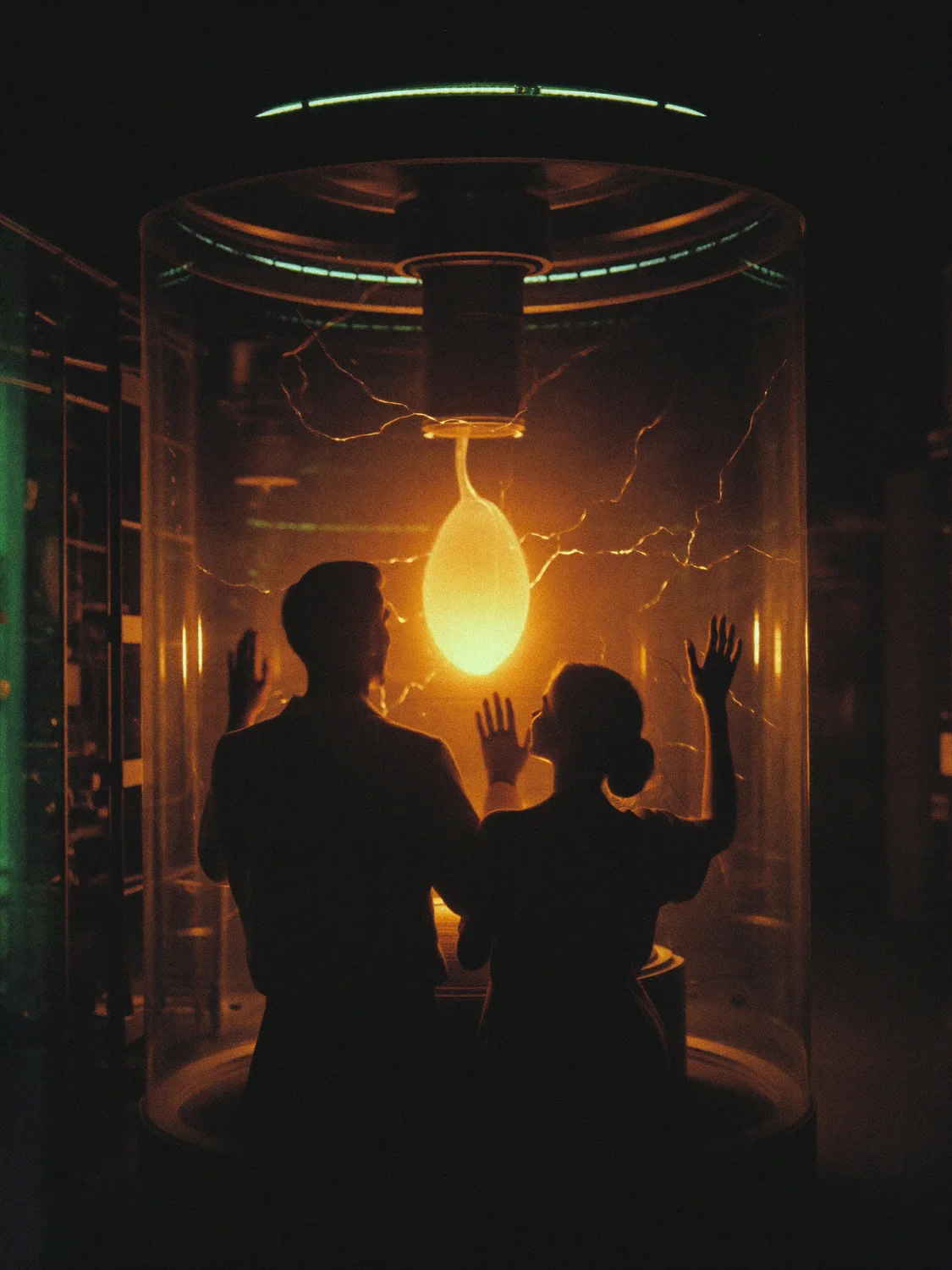
19 February 2051. D-Day. A month after her skin cells were taken, Olivia and Liam wait in a room beside the lab, an augmented projection of the biologist's microscope shared on the glass between them. They watch a cell from Olivia's own arm become an egg — an egg her body could no longer make, grown from the part of her the cancer never touched. It settles into a sterile rack beside hundreds of others, each one somebody's impossible wish, made routine and ordinary and real. Olivia squeezes Liam's hand. She had thought, in the surgical ward five years ago, that a door had closed forever. It turns out it had only moved — out of her body, into the lab, and open again. From the dusk of that diagnosis, somehow, against everything, a dawn. She does not fully understand the machine that is giving her a child, this quiet miracle of biology and glass. She only knows that it is, and weeps quietly into Liam's shoulder, and lets herself, at last, after five long years, believe it.
// The science behind it
The prophecy that had its landmark year
The 2021 edition rated this chapter at 60/100 — a real maybe on whether reproduction would be fully liberated from the body: eggs and sperm made from skin cells (in-vitro gametogenesis, IVG), babies grown in artificial wombs (ectogenesis), and the ancient link between sex and procreation finally severed. And then the science delivered a genuine landmark, right on cue. In 2023, researchers announced they had created viable eggs from the skin cells of male mice, fertilised them, and produced healthy pups — mice with, in effect, two biological fathers. The single most science-fiction claim in this chapter — that a same-sex couple could have a child genetically related to both, with no third party, exactly as the fiction's Levi and Aiden did — was demonstrated, in a mammal, within two years of the book's publication. IVG stopped being a theoretical possibility and became a proven biological reality in another species, with humans the obvious and actively pursued next target.
The race to make a human egg from a cell
That target is now the object of a serious, well-funded race. Startups backed by prominent technology investors have formed with the explicit goal of producing human eggs and sperm from ordinary cells, pouring money and talent into closing the gap between mouse and human. The motivation is not only the dream of universal parenthood the essay described; it collides directly with the birth-rate collapse of chapter twenty, giving reproductive technology a new and urgent political charge. If IVG works in humans — and the scientific consensus has shifted from "if" toward "when," with estimates of years rather than decades — the consequences are staggering: infertility, as the original predicted, could largely cease to exist; a woman who lost her ovaries to cancer, like Olivia, could make eggs from her skin; two men or two women could have a child of both their genes; even solo reproduction from one person's cells becomes biologically conceivable. The essay's boldest social predictions all hang on this one laboratory step, and that step has gone from fantasy to funded engineering problem. It has not been taken in humans yet. But the people trying are no longer dreamers; they are companies with timelines.
The artificial womb, arriving from the premature end
The chapter's other pillar — ectogenesis, the artificial womb — advanced too, though along the honest path the original identified: not from conception, but inward from the frontier of prematurity. The artificial-womb systems that kept premature lambs alive and developing in fluid-filled "biobags" progressed to the point where regulators began seriously considering the first human trials, aimed at giving extremely premature infants a womb-like environment to survive the deadliest weeks. This is partial ectogenesis, and it is close — a genuine bridge for babies born too soon, exactly the medical motivation the essay named. Full ectogenesis, the fiction's EUFI — an embryo grown from conception to birth entirely outside a body — remains far off and vastly harder; recreating the placenta and the whole nine-month dialogue between foetus and mother is a problem of staggering complexity. But the two ends are advancing toward each other: viability creeps earlier from the premature side, while embryo culture extends later from the conception side. Olivia's baby, grown start-to-finish in a machine, is still fiction. The machine that saves a twenty-two-week baby is nearly fact, and it is the same technology, seen from the other end.
The dimension nobody saw coming: embryos without eggs
Here the decade added a development so strange the 2021 essay could not have imagined it. Scientists learned to build embryo models — structures resembling early human embryos — entirely from stem cells, with no egg and no sperm at all. These "synthetic" or "model" embryos, created to study the earliest, previously invisible days of development, forced an immediate ethical emergency: the long-standing rule limiting embryo research to fourteen days was suddenly under pressure, because these new entities blurred the very definition of what an embryo is. The field opened a door the original never approached — toward a future where the raw materials of human development can be assembled from cells in ways that fit no existing legal or moral category. It is a vivid instance of this book's recurring lesson: the technology races ahead of our frameworks, and the questions arrive faster than the answers. We are learning to build the beginnings of a human being from spare parts, and we have not decided what that means.
The end of an ancient link, and the questions it opens
Step back, and the through-line of the chapter is the one the original named most clearly: the severing of the ancient, seemingly unbreakable link between sex and procreation. That severing is no longer hypothetical — it is happening across multiple fronts at once. Three-parent babies, created by combining genetic material from three people to avoid inherited disease, are now a real and legal medical reality, with the first such children born and thriving. Egg freezing became mainstream, decoupling reproduction from age. IVG promises to decouple it from sex and from fertility. Ectogenesis, one day, may decouple it from the body entirely. Each step is, for someone, a profound liberation — the cancer survivor, the gay couple, the woman without a uterus, all able to have a genetically-related child who could not before. And each step opens exactly the hornet's nest the original flagged and the decade has begun to sting from: How many parents may a child have? Is this a right for all or a last resort for the desperate? Does making reproduction easy and editable (chapter twenty-two) accelerate the designer-baby future? What does it do to a society when women are no longer the sole vessel of the next generation — a liberation to some, a loss to others, and a genuine upheaval either way? These are not idle speculations anymore. They are live questions being forced by real science, and the essay was right that we should have started thinking about them yesterday.
Who gets to be born, and who decides
There is a harder edge to this liberation that the decade sharpened and the chapter must not dodge. The same technologies that let the infertile conceive also hand unprecedented power over who gets born to whoever controls the process — and that is rarely the child, and not always the parents. Once eggs can be made in near-unlimited numbers from a scrap of skin, the embryo-screening of chapter twenty-two scales up accordingly: with hundreds of embryos to choose from rather than a precious few, the pressure and the ability to select for traits — health first, then perhaps height, then perhaps more — intensifies enormously. IVG does not merely make babies possible; it makes them plural and selectable, and that quietly turns conception into a design problem for those who can afford the choices. Layer on the fertility-crisis politics of chapter twenty, and the questions turn sharp: will states, desperate for births, subsidise and steer reproduction? Will access split, as everything in this book threatens to, along lines of wealth — the rich designing abundant, screened, optimised children while the poor conceive the old way or not at all? The dissolution of the link between sex and procreation is a genuine emancipation, and this book celebrates it for every Olivia it frees. But emancipation and control are, as ever, the same tool held at different angles, and a civilisation that can manufacture eggs by the hundred has acquired a power over its own genetic future that it has barely begun to govern. The lab door that opened for Olivia opens, for society, onto a room it has not yet learned to navigate.
The tenderness underneath the technology
For all the ethical weight, this chapter must end where the fiction does, because it is the most human of the Fiction block. Strip away the labs and the acronyms and the bioethics committees, and what remains is the oldest longing there is: to have a child, to not have that door closed by biology or fate or bad luck. Olivia weeping at the sight of an egg grown from her own arm is not a story about technology; it is a story about hope returned to someone who had given it up. The two-father mice, the artificial wombs, the eggs from skin — behind every one of these advances is a real person for whom it means the difference between childlessness and a family. That is the light this chapter holds against all its shadows. Reproductive technology, more than almost anything in this book, is a machinery of yearning fulfilled — and the ethical care it demands is precisely a measure of how much it matters. We are learning to make life in new ways, for people who could not make it the old ways. The task, as with every power in these pages, is to do it wisely, and for love. From the dusk of a diagnosis, a dawn. That is the whole promise, and the whole responsibility.
// 2021 → 2026 verdict
2021 verdict: Probability 60/100 — reproduction freed from the body: eggs and sperm from skin cells (IVG), babies grown in artificial wombs, the link between sex and procreation severed. 2026 reality: a landmark year, arriving from both ends. IVG had its breakthrough — viable eggs made from male mice's skin cells, producing pups with two fathers, exactly the fiction's scenario, proven in a mammal — and a funded race is now on to do it in humans, given fresh urgency by the birth-rate collapse. Artificial wombs advanced toward first human trials from the premature-infant side, while full womb-to-birth ectogenesis stays distant. And an unforeseen frontier opened: embryo models built from stem cells with no egg or sperm, detonating the old ethical rules. Three-parent babies are already real and legal. The ancient link between sex and procreation is genuinely dissolving — a profound liberation for the infertile, the cancer survivor, the same-sex couple, and a genuine upheaval for everyone. Behind the acronyms is the oldest hope there is. From dusk, a dawn.
This chapter was rewritten in 2026 by Brice × Claude Fable5. Read the original 2021 edition — written entirely by humans, published one year before ChatGPT existed.