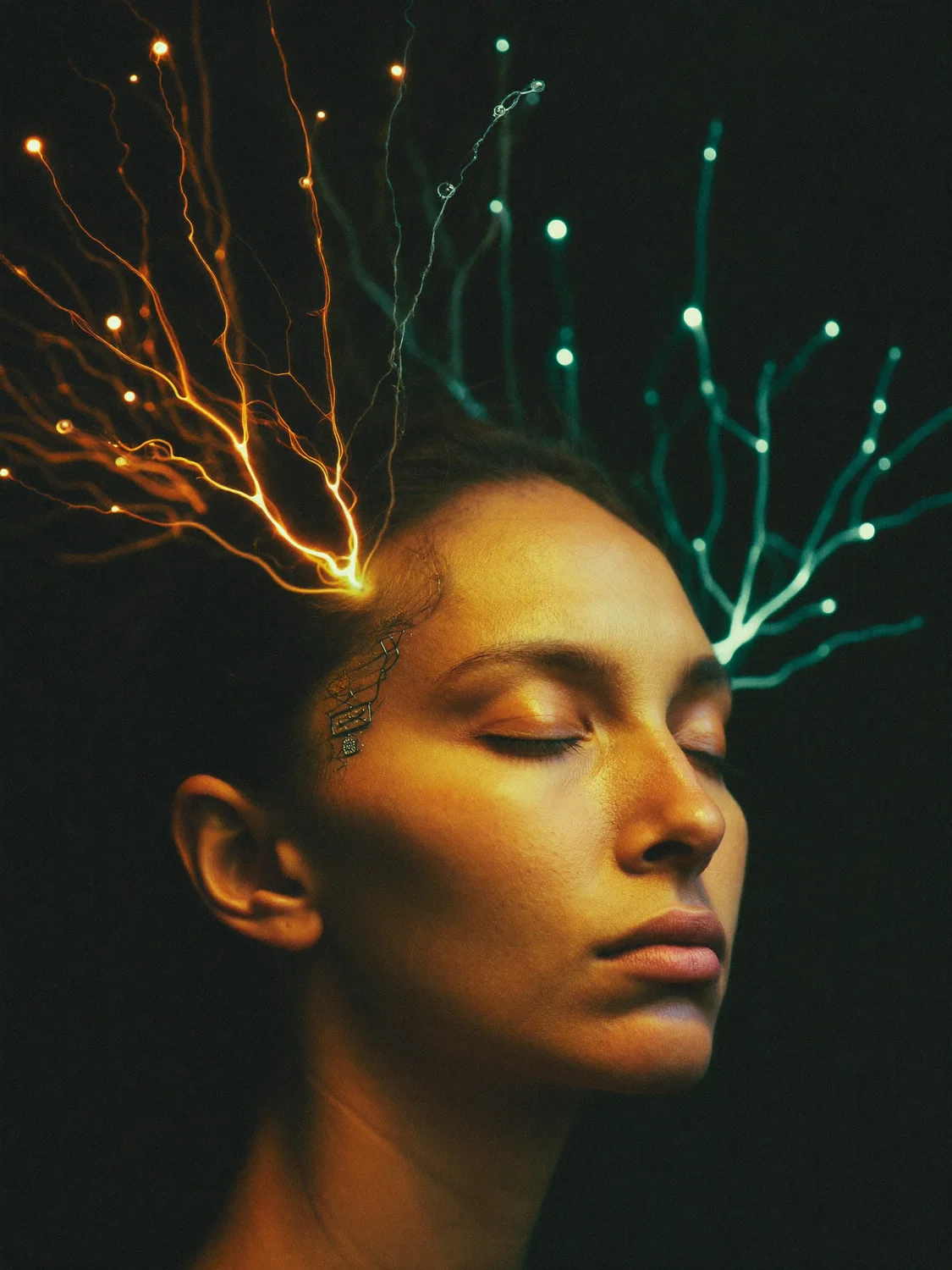
27Telepathy· 2026 edition
Universal Mind Control
// A story from 2051
December, 2051. Sarah is late again, as ever, for the family's New Year's Eve dinner, racing a work deadline that in an earlier age would have been a genuine logistical ordeal and is now managed with childlike ease. She activates her Subcutaneous Personal Assistant — a discreet chip beneath the skin of her forearm — and simply thinks her report into being, the words assembling and firing off to her team in Sydney before their workday starts, all while she showers. Time itself, reclaimed from thought alone.
Brushing her hair, she frowns at her pallor in the mirror, which reads her face and gently offers a two-minute tutorial to put colour back in her cheeks. Her AI has already laid out an outfit chosen for the dinner's mood and — tactfully, for the way her body feels this week — flattering at the waist. As she slips on her shoes, the mere decision that it is time to leave summons an autonomous car; she never states a destination, because the vehicle has read her calendar and knows. On the way she remembers it is her friend Amber's birthday, and a few seconds later Amber messages from New York to thank her for the flowers — flowers Sarah's assistant sent the instant the thought half-formed. A last-minute wine is ordered by drone to her parents' door; she never specifies the grape, because the shopping assistant asked her mother what was cooking and matched it to the meal.
The car, seemingly on a whim, routes her past her childhood home — no whim at all; the house is for sale, and her assistant has noticed how often, lately, her mind drifts back to it. Sarah looks at the lit windows of the place where she was small, and feels the old ache the machine detected before she did, and understands, not for the first time, that she is never quite alone inside her own head anymore. The assistant means only to help. It always, only, ever means to help. She thinks, deliberately and with effort, of nothing at all — a small privacy, perhaps the last one left — and lets the car carry her on toward the family she can still, for now, surprise.
// The science behind it
The prophecy that walked out of the lab and into a patient
The 2021 edition rated this chapter at 80/100 — a confident bet that brain-computer interfaces would let us control machines by thought, and eventually knit human minds into a network. Of every Fiction-block prediction, this is the one that came true fastest and most literally, and it did so in a way that should silence any doubt about the direction of travel. In the years right after publication, brain implants moved from animal research into human patients: people paralysed from the neck down received neural implants and learned to move a cursor, click, type, play chess, and control a computer using nothing but their thoughts. A less invasive approach threaded an electrode array into the brain through a blood vessel, letting patients operate devices by intention without open-skull surgery. The core claim of this chapter — control things by thought — stopped being a dream and became a clinical reality, performed on real people, on the record. Sarah "thinking" her report into being is no longer the far edge of science fiction. Its first, halting, medical version exists now.
Thought into speech, thought into text
The most moving vindication is the one that restores what disease steals. Researchers built brain-computer interfaces that decode intended speech directly from the motor cortex, letting people with paralysis or ALS — who had lost the ability to speak — "talk" again at conversational speeds, their imagined words turned into text and synthesised voice, in some cases reconstructed to sound like their own voice from old recordings. A person who could not move or speak, speaking again through a machine reading their brain: this is the single most humane thing in the entire book, and it is happening in laboratories and trials right now. Sarah's effortless thought-typing is the consumer daydream; the profound reality underneath it is a mute person restored to conversation, a locked-in mind given back its voice. The technology the fiction treats as a convenience arrived first, and rightly, as a liberation.
Reading the mind from the outside
Even without surgery, the mind grew more legible than the 2021 essay dared predict. AI systems learned to reconstruct, from brain scans, rough approximations of the images a person is seeing — and even imagining — and to translate the gist of their continuous inner language into text. These "semantic decoders" are crude, require cooperation, and are nowhere near mind-reading in the sci-fi sense. But the direction is unmistakable and, frankly, unnerving: the inside of the skull, the one place that was always, absolutely private, is becoming — partially, imperfectly, but really — readable from the outside. The essay imagined connection flowing into the brain. The decade revealed the more disquieting flow: information coming out of it, decoded by machines. And that single fact reframes this whole chapter, because it turns the last sanctuary of the self into potential data.
The Ubernet is real, and it has a dark side the essay soft-pedalled
The original's grand vision was the "Ubernet" — a brain-to-brain internet dissolving distance, sharing memories and emotions raw, mind to mind, building a planetary "collective intelligence" that would deepen empathy and understanding between peoples. The primitive first steps exist: labs have linked brains to pass simple signals directly, human to human. But the decade taught a harder lesson than the essay's optimism allowed. We already built a planetary network that connects billions of minds and promised collective understanding — the social internet — and it delivered, alongside genuine connection, an engine of outrage, addiction, misinformation and division (chapters five and eight). The 2021 chapter assumed that connecting minds more directly would make us kinder and wiser. The evidence of the very network we have suggests the opposite is at least as likely: that a brain-to-brain Ubernet, optimised by the same attention-and-persuasion economy, could be a machinery of manipulation more total than anything yet built — not the sharing of empathy but the harvesting of it. The essay's dream of collective intelligence must now be read through the disillusionment of the decade that networked us and found the result was not automatically wisdom. Connection is not the same as understanding. We learned that the hard way, and any neural Ubernet inherits the lesson.
Neurorights: defending the last private place
Which is why the most important development in this chapter is one the 2021 essay barely glimpsed: the birth of neurorights. As soon as brains became readable and writable, thinkers, and then lawmakers, recognised a new category of human right — the right to mental privacy, to freedom of thought, to protection of your own neural data from corporations and states. One country wrote neurorights into its constitution; international bodies began drafting principles; the question "who owns the data from your brain?" went from philosophy seminar to live legislation. This is the governance frontier the fiction's Sarah lives inside — an assistant that knows her longing for her childhood home before she does, that is never quite out of her head. The essay worried, almost in passing, about the "privacy compromises" of hyperconnection. The decade revealed those compromises to be the whole ballgame: when the inside of your skull can be read and influenced, mental privacy is not one concern among many — it is the last line defending the self. Building the technology without building that defence, as this book argues everywhere, is the real danger. The mind-reading came faster than the mind-protecting. Closing that gap is the work.
The rest of Sarah's morning arrived too
It is worth noticing that the fiction's quieter predictions — the ambient, thought-adjacent conveniences around the headline brain-chip — nearly all came true without any implant at all, which tells us something about how this future actually arrives. Sarah's mirror that reads her face and suggests a fix is a real smart-mirror product (chapter sixteen). Her AI laying out an outfit for the occasion and her mood is what recommendation engines and AI stylists already attempt. Her car that knows her destination from her calendar without being told is the logical end of the assistants and autonomous vehicles of chapters ten and twelve. Her shopping assistant that asks her mother about the meal and picks the matching wine is precisely the agentic AI of chapter eighteen, buying on her behalf. The striking thing is that almost none of these required reading her brain — they required reading her data, her calendar, her camera, her habits, her context. The lesson the decade underlines is that you do not need a neural implant to build a life that anticipates you; you need only enough data and a capable AI. The brain-computer interface is the dramatic frontier, but the anticipation the fiction is really about — the assistant that knows you before you speak — arrived through the far less invasive route of simply watching everything you do. Which raises the chapter's quiet question: if the machine can already predict your longing for your childhood home from your data alone, how much does it actually need to get inside your skull?
Uploading, immortality, and the merge — still fiction, taken seriously
The essay's most extravagant reach — digitising consciousness, uploading the mind into an android or a starship, immortality through mind-transfer, "the Ubernet to conquer the Universe" — remains exactly what it was: speculation, and this chapter honours the Fiction-block label by saying so plainly. We cannot upload a mind; we do not even understand consciousness well enough to know if it is possible in principle. And yet the decade added an eerie half-step the original didn't foresee: the AI "griefbots" and digital replicas (chapters four and twenty) that reconstruct a dead person's personality from their data — not an uploaded mind, but a convincing echo of one, enough to unsettle every assumption about what survives us. Meanwhile the framing around brain implants shifted from pure medicine toward something more cosmic and more contested: the argument, pushed by their most prominent backer, that humanity must merge with AI through neural interfaces in order to keep pace with the artificial superintelligence this whole book has been circling — that "mind control" may become less about controlling machines and more about not being controlled by them. That is a genuinely epochal question, and it is no longer purely hypothetical. The upload remains a dream. The merge is becoming a policy debate. And the last, deliberate privacy Sarah guards — thinking, on purpose, of nothing at all — may turn out to be the most precious freedom of the century this chapter opens onto.
// 2021 → 2026 verdict
2021 verdict: Probability 80/100 — brain-computer interfaces let us control machines by thought and network minds into a collective "Ubernet," heading toward mind-uploading and digital immortality. 2026 reality: the fastest, most literal vindication in the Fiction block. Brain implants entered human patients, letting paralysed people control computers by thought and restoring speech to those who had lost it — the humane reality beneath Sarah's effortless thought-typing. AI began decoding images and language from brain activity, making the skull's contents partially readable from outside. The brain-to-brain Ubernet exists in primitive form — but the decade's experience of the social internet warns that connecting minds more directly could harvest empathy as easily as spread it. Most importantly, the age of readable minds birthed neurorights — the fight to protect mental privacy as the last sanctuary of the self. Mind-uploading stays fiction; the "merge with AI" became a serious debate. The prophecy walked out of the lab and into a patient. Now the question is whether we protect the mind as fast as we learn to read it.
This chapter was rewritten in 2026 by Brice × Claude Fable5. Read the original 2021 edition — written entirely by humans, published one year before ChatGPT existed.