17Climate· 2026 edition
Cloudy with a chance of artificial rain
// A story from 2051
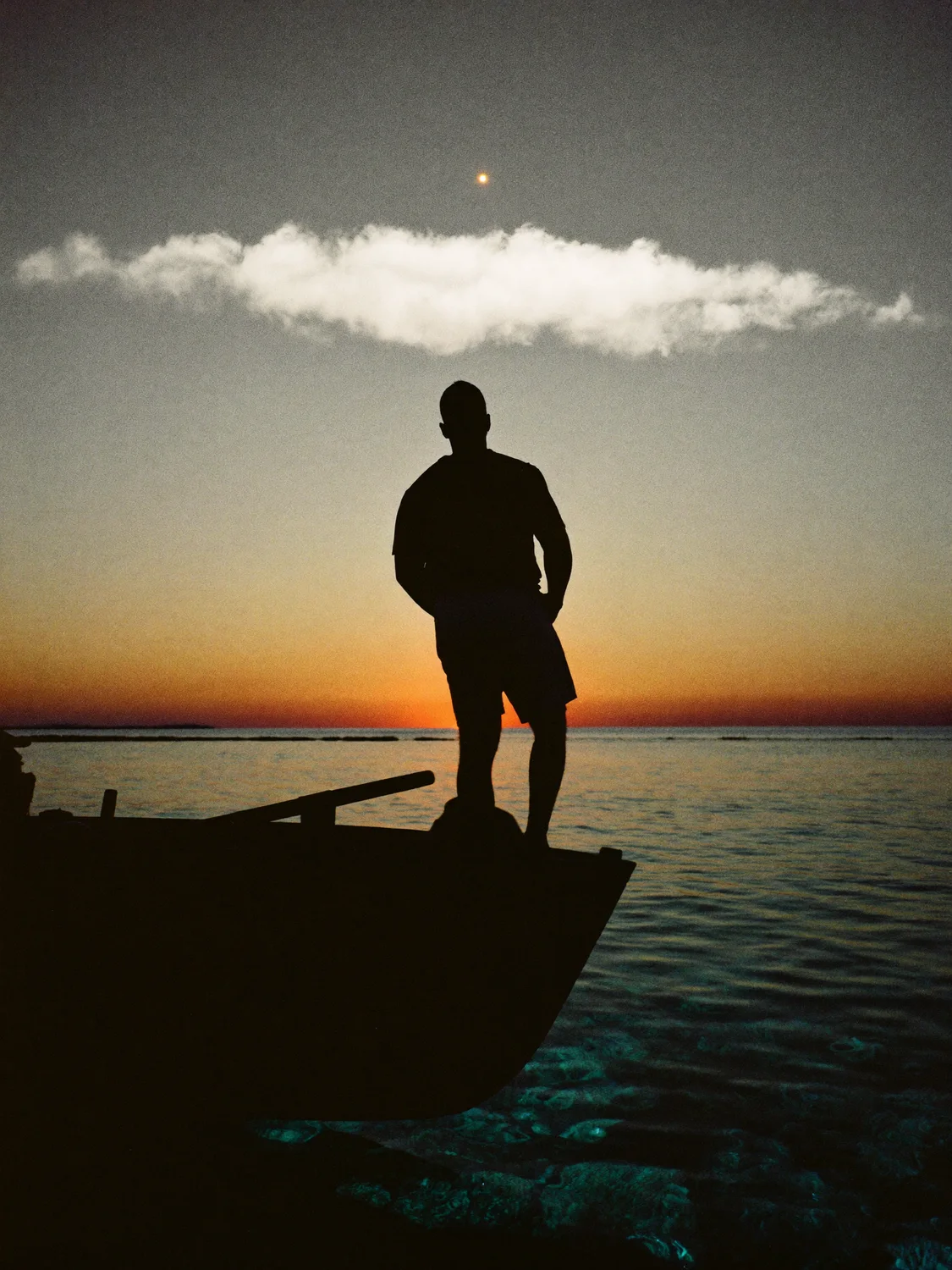
January 2051, the height of summer in Port Douglas, and Noah is up before the tourists to have the harbour to himself. As he readies his boat for the Low Isles, a bright dot crosses the brightening sky and is gone — MirOne, the orbital sunshade, catching the dawn before it slips back into shadow. Its mirrors take the hard edge off the Queensland summer now. Noah barely remembers when they didn't.
By seven he's over the reef. Thick white cloud hangs low over the water — the brightening ships passed in the night, spraying fine sea-salt mist into the marine layer to whiten it and bounce the sun back before it can cook the shallows. He drops anchor and goes down. The water is cool, barely 22°C, and the coral is alive — staghorn and plate coral crowded with fish and shellfish and a cruising turtle, a reef that fifteen years ago the scientists had all but written off. Local cooling saved it. Noah has learned not to say the word "saved" too loudly; the reef is on life support, and everyone here knows the difference between a patient recovering and a patient kept alive by a machine that must never be switched off.
At noon the Surf Club terrace is packed, its refurbished walls a dazzling regulation white — Queensland made the high-albedo coating mandatory on commercial buildings, and Noah painted his own roof to match, with a government rebate. He shows his friends the morning's reef photos over lunch. In the afternoon, on his lounger with a book, a thin engineered haze softens the sky to a pale, pretty blue and keeps the worst of the sun off him. It is 26°C in January. He remembers, as a child, summers that suffocated.
Toward evening he calls his sister Ava, a glaciologist on a New Zealand expedition, her team refreezing a glacier that had all but vanished. She is happy, and tired, and careful. "It's holding," she says, meaning the ice, and then, after a pause, meaning everything else: the treaties, the funding, the fragile global agreement to keep the whole apparatus running for another year. They both know the arithmetic their grandmother's generation left them. The thermostat works. Nobody is allowed to stop paying the bill. Not this year, not next year, not ever — because the day the machines go quiet, all the heat the world spent thirty years hiding comes back at once, and comes back fast. Noah watches the artificial cloud go pink over the reef and thinks: we did not fix the fever. We built a hand that holds the compress in place, forever, and now we must never let go.
// The science behind it
The prediction the world backed into
The 2021 edition of this chapter made a bet that felt, at the time, faintly outlandish: that humanity would respond to a warming planet not only by cutting emissions but by actively engineering the climate — dimming the sun, brightening clouds, whitening cities, refreezing ice. Five years on, the outlandish part is gone. Solar geoengineering moved from the fringe of climate science to its uncomfortable centre, and it did so for exactly the reason the original essay guessed: the emissions cuts, though real, arrived too slowly, and a frightened world began, quietly, to look at the thermostat. The prediction's mechanism was right. What the 2021 version underplayed — and what the years since have made searingly clear — is that the hard part was never the physics. It is the politics, the ethics, and the terrifying one-way nature of the bargain.
The decade the heat won the argument
The context has darkened since 2021, and honesty demands we say so. The years that followed delivered the hottest on human record, one after another; the symbolic 1.5°C line that the Paris Agreement was built to defend was breached in the readings, sooner than almost anyone modelled. Fire seasons lengthened, "wet-bulb" heat — the humid heat a human body cannot survive — began appearing in places that had never known it, and the reef of Noah's fiction, the actual Great Barrier Reef, suffered mass bleaching events of a frequency that gave the coral no time to recover between blows. The 2021 essay imagined geoengineering arriving "in response to a catastrophic event, much like during a pandemic." That is precisely the trajectory the decade traced: not a considered choice, but a series of shocks steadily eroding the taboo against reaching for the emergency lever. Climate change stopped being a future tense.
The lever, examined
So look hard at the lever, because the world now is. Stratospheric aerosol injection — the equatorial "air-raids" of the original, seeding the high atmosphere with reflective particles to dim incoming sunlight by a percent or two — remains the most-studied and most-feared option, and the science underneath it is real: the 1991 eruption of Mount Pinatubo, which cooled the planet half a degree for two years by veiling it in sulphate, is the natural experiment everyone cites. It would be, by a distance, the cheapest thing humanity could do to lower the global temperature — cheap enough that a single determined country, or a coalition, or conceivably one very rich individual, could attempt it alone. That cheapness is not a comfort. It is the whole problem.
Marine cloud brightening — the "saline blasters" of the fiction, spraying sea-salt mist to whiten low ocean clouds and bounce sunlight back — moved from theory to open-air trial in exactly the place the original set its story: researchers ran real brightening experiments over the Great Barrier Reef, testing whether local cooling could buy the coral time. It is the gentlest, most localised, most reversible tool in the kit, and it is already being tried. High-albedo surfaces — the mandatory white roofs and reflective coatings of Noah's Port Douglas — are the least controversial of all, quietly rolling out in hot cities as cool-roof mandates and reflective pavements, a genuine, boring, effective adaptation. And glacier preservation — Ava's reflective blankets — is a real Swiss practice, covering the Rhône glacier in white fleece each summer, alongside newer, wilder schemes to pump water and refreeze sea ice. The 2021 chapter's toolkit was not fantasy. Every item in it now exists as a study, a trial, or a policy.
The terrifying part: you cannot stop
Here is what the original touched but the decade underlined in red. Solar geoengineering does not remove carbon. It masks the heat that carbon traps. It is, precisely, holding a cold compress to a fever without treating the infection — and beneath the compress, the fever keeps climbing, because the CO₂ keeps accumulating. This creates the single most dangerous property of the whole enterprise, the one the fiction is built around: termination shock. If a world came to lean on a solar shield and then stopped — a war, an economic collapse, a treaty breaking down, a change of government — all the warming that had been suppressed would return not gradually but in a matter of a few years, a temperature spike far faster and more violent than anything gradual emissions would have produced, with no time for ecosystems or societies to adapt. To deploy at scale is to sign a contract with no exit clause, binding not just yourself but every government that follows you, for as long as the carbon stays up there — which is centuries. Humanity has never successfully committed to anything on that timescale. The technology asks us to start.
Who holds the thermostat?
And whose hand is on the dial? This is the question that has moved geoengineering from a scientific curiosity to a matter of war and peace. A shield that dims the sun does not dim it evenly; the models show it could shift monsoons, redistribute rainfall, dry one continent while sparing another. A cooling that saves one nation's harvest could, plausibly, be blamed for another nation's drought — and there is no world government to arbitrate, no agreed answer to "what temperature should the Earth be?", no mechanism to stop a desperate country from acting alone and every other country from retaliating. The mid-2020s saw the first small, unauthorised, freelance attempts to release reflective particles — and the first governments moving to ban the practice outright in response. The reef trials advanced; moratoria were debated; a fragile, incomplete conversation about global governance began, exactly as the original hoped and years too late. The 2051 of the fiction, with its treaties and its shared apparatus and its brittle annual agreement to keep paying the bill, is the optimistic outcome — the one where humanity learned to hold the thermostat together. The pessimistic outcome is a sky weaponised.
The only real cure is still the boring one
Which returns this chapter, as every honest climate discussion must return, to the one truth geoengineering cannot repeal: the sunshade buys time, and buys it at frightening risk, but it cures nothing. The infection is the carbon, and the only cures are ceasing to emit it and pulling back what we already have. The genuinely hopeful news the decade delivered lives here, not in the sky: clean energy — the solar, wind, storage and grids of chapter seven — crossed the threshold where it is now simply the cheapest power humans have ever built, and it is being deployed faster than almost any forecast dared. Carbon removal — the original's phytoplankton and reforestation, joined now by industrial direct-air-capture plants and enhanced rock weathering — grew from PowerPoint to a real, if still tiny, industry. The race is genuinely on between the cure and the disease. Geoengineering is what a wise civilisation keeps in the medical cabinet for the emergency it prays never comes — a compress for the worst of the fever while the real medicine takes hold. A foolish one reaches for it instead of the medicine, and mistakes a suppressed symptom for a healed patient. Noah's world got the balance right, barely, and knows it must hold the compress forever. Ours is still deciding whether to.
The orbital mirror, and the long game
And then there is MirOne, the boldest item in the original's list and, honestly, the most distant: a giant reflective structure in space, a travelling mirror that bounces sunlight away before it ever reaches the atmosphere. This is the one piece of the 2021 toolkit that remains genuinely speculative in 2026 — the engineering of a sunshade at the L1 point between Earth and Sun, or a swarm of reflective craft, is a serious proposal in serious papers, but its cost and scale still belong to mid-century, not to now. Yet the collapsing price of getting mass to orbit — the reusable-rocket revolution of chapters ten and fifteen — is precisely what moves a space sunshade from science fiction toward engineering. It is the geoengineering option with the fewest side effects on Earth's chemistry and the highest bill, and it is exactly the kind of interstellar-scale project a coalition might attempt once cheaper measures prove insufficient. The fiction is right to make it a bright dot in Noah's dawn: a monument to a civilisation that decided, in the end, that it could not simply wait for its own emissions to relent. Whether that monument is a triumph of stewardship or the tombstone of a planet that engineered its symptoms instead of its disease is the question the whole chapter, and the whole century, is really asking.
The road to 2051
The taboo breaks under the heat. As record years stack up and disasters compound, research and limited trials of cloud brightening and stratospheric aerosols move from unthinkable to studied to, in places, deployed — driven by fear, not by wisdom, exactly as the pandemic analogy predicted.
The gentle tools go mainstream first. White roofs, reflective cities, glacier blankets and reef-scale marine brightening — local, reversible, low-stakes — become ordinary climate adaptation long before anyone dares dim the whole sky.
Governance races the technology, and nearly loses. The cheapness that lets one actor cool the planet forces the hard birth of a global authority over the thermostat — treaties, monitoring, an agreed answer to "what temperature?" — because the alternative is climate as a weapon.
Termination shock becomes the defining fear. Any world that deploys a sunshade is bound to maintain it for centuries; the apparatus can never simply stop. Society organises around never letting go.
And the cure keeps pace with the compress. Cheap clean energy and scaling carbon removal do the real work of ending the fever, so the shield stays what it should always be — an emergency measure, held in reserve, and never mistaken for the healing itself.
// 2021 → 2026 verdict
2021 verdict: Probability 70/100 — humanity engineers the climate: sunshades, brightened clouds, white cities, refrozen ice. 2026 reality: the mechanism arrived; the governance and the exit didn't. Every tool the original named — stratospheric aerosols, marine cloud brightening over the very reef of its fiction, cool roofs, glacier blankets, carbon removal — is now a real study, trial or policy, and the taboo is breaking under record heat exactly on the predicted "catastrophe forces action" trajectory. What the years added is the terror the original only hinted at: a shield you can never switch off, a thermostat no one agrees who should hold, and the iron truth that dimming the sun cures nothing. The forecast was right. The bargain is worse than it looked.
This chapter was rewritten in 2026 by Brice × Claude Fable5. Read the original 2021 edition — written entirely by humans, published one year before ChatGPT existed.