16Beauty· 2026 edition
Faces for sale
// A story from 2051
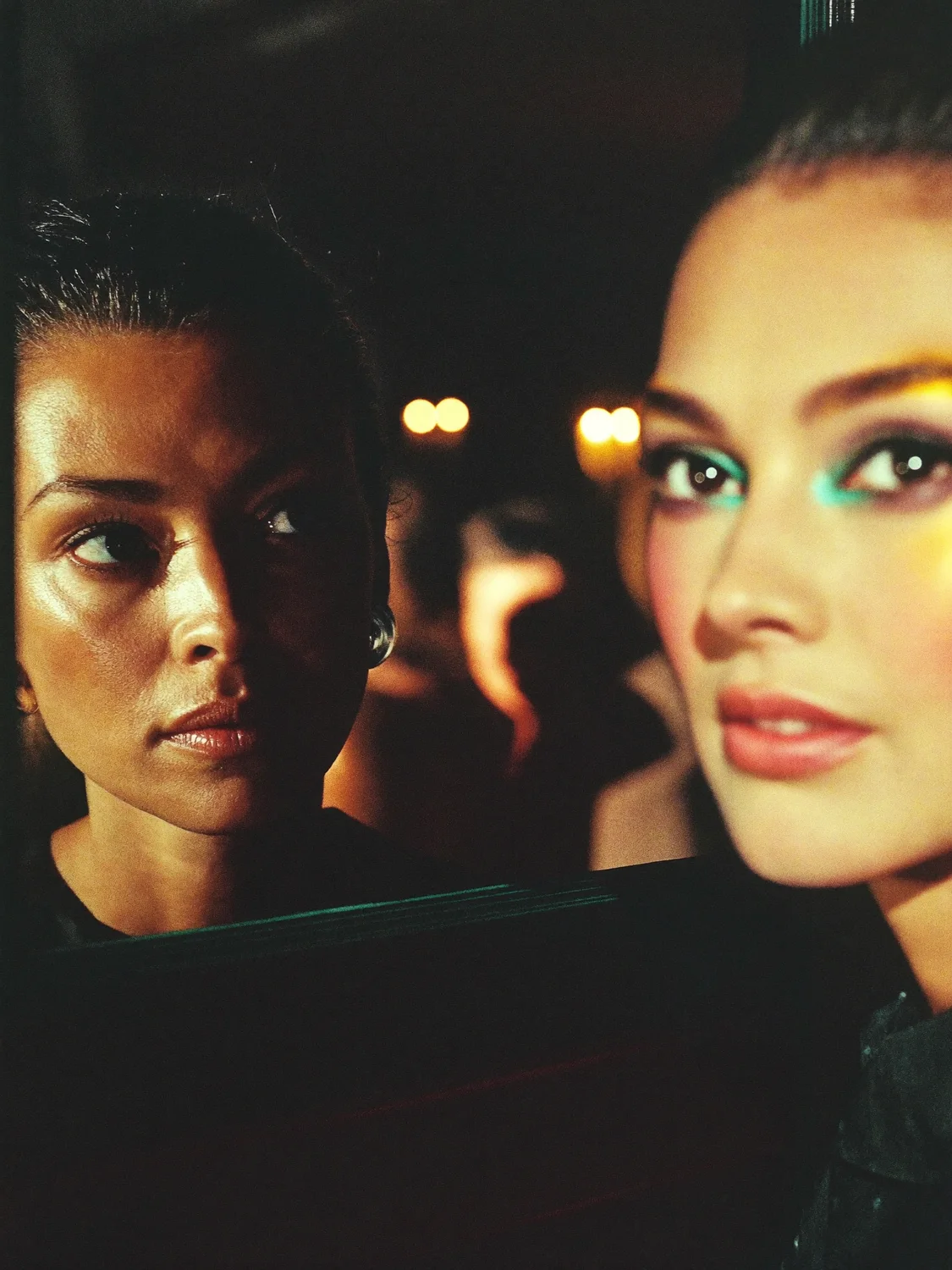
She wants to keep her face intact — she paid enough for it. Tonight she is wearing an original De Backer, and she smiles a little too widely at the guests, hoping they notice, and they do, because the artist's signature style is unmistakable and the rights to wear it cost more than her car.
The face is not make-up. There is no make-up in 2051, not for occasions like this. The look is a licensed layer — a living design that sits over her real features through the augmented lenses everyone in the room is wearing, so that the woman she was born as is visible only to herself, in the mirror, before the party. To the two hundred guests she is a De Backer: the impossible cheekbones, the shifting under-light, the eyes that catch colour that isn't there. She rented the look for the evening. Owning it outright — the exclusive, the one nobody else may wear tonight — is a different price, and a different kind of person.
What she tries not to think about, what nobody at these parties says aloud, is the quiet question underneath the whole economy: which of the faces in this room are worn by the people born to them? The lawyer across the canapés is wearing his own late father's face, licensed from the estate, as a tribute — or so he says. The influencer by the window is wearing a composite that does not correspond to any human who has ever lived, generated to be maximally trustworthy by a model trained on ten million faces people found kind. And somewhere in the crowd, statistically, is at least one person wearing a face that was taken — scraped, cloned, worn without consent, the beauty economy's oldest and ugliest crime.
She checks her reflection in a darkened window: her real face, for a private second, tired and forty-nine and entirely hers. Then she turns back to the party as a De Backer, and the strange arithmetic of the age settles over her like the look itself. Her face is the one thing she was given for free. It is now the one thing she can neither fully own nor fully sell — because in 2051, a face is not a fact. It is a file.
// The science behind it
The prophecy that came terrifyingly true
The 2021 edition of this chapter made a bet so specific and so strange that it deserves to be judged plainly: that faces would become tradeable digital assets, that AR filters would grow realistic enough to wear as "looks," and that a beauty economy would spring up around buying, selling and owning the human face. Strip away the NFT framing that dated within a year, and the prediction was not just right — it was, in its underlying mechanics, an understatement. The face did become a file. It just became a far more dangerous one than a make-up collectible.
Because while the 2021 essay imagined the consensual version — influencers selling looks fans would love to wear — the technology that actually matured first was the non-consensual one. The same face-mapping that lets you wear a designer look lets anyone wear your face, or graft it onto a body that was never yours. The deepfake, barely a rumour when the original was written, became the defining beauty-and-identity technology of the decade, and its overwhelming first use was abuse: the vast majority of deepfake content online is non-consensual intimate imagery, weaponised overwhelmingly against women, from celebrities to schoolgirls whose classmates generated fake nudes with an app. The 2021 chapter dreamed of a market in faces. It arrived — but the black market came first, and it is the shadow over everything else in this chapter.
The filter became the face
Set the abuse aside for a moment (we return to it, because we must) and the consensual prophecy also landed. The beauty filter escaped the novelty app and colonised perception itself. A generation grew up seeing its own face, in every front-facing camera, already subtly "improved" — jaw slimmed, skin smoothed, eyes enlarged, by default, often without a toggle to turn it off. The psychological term coined for the result — "Snapchat dysmorphia," patients bringing filtered selfies to surgeons and asking to be made to match — went from curiosity to clinical commonplace. The augmented look the 2021 essay predicted is here; it simply arrived as an invisible default rather than a purchased luxury, which is worse, because a luxury you choose and a distortion you can't switch off are different kinds of thing. The mirror started lying to an entire generation, gently, automatically, at thirty frames a second.
And the market in designed looks is assembling exactly as forecast, now that the AR glasses of chapter thirteen are becoming real. Virtual make-up "try-on" is a standard feature of every beauty retailer; digital fashion houses sell garments that exist only to be worn in images; virtual influencers with millions of followers wear faces no surgeon could build and no birth ever produced. The "wear a licensed look through your lenses" economy of the fiction is a straight-line extrapolation from technology shipping in 2026 — and the beauty conglomerates, exactly as the original noted, are pouring money into it, because a look you rent monthly is a better business than a lipstick you buy once.
The synthetic standard of beauty
Here the chapter turns from make-up to something deeper and more troubling: generative AI didn't just let us wear new faces — it began manufacturing the ideal face, and selling it back to us as a standard no human can meet. The feeds now teem with AI-generated people of impossible, uncanny perfection — flawless synthetic influencers, virtual models in real ad campaigns, beauty that was computed rather than born. When the aspirational image is not a retouched photo of an unusually attractive human but a machine's distilled average of everything a billion clicks found attractive, the target moves beyond reach by construction. You cannot diet or exercise or even operate your way to a face that was designed to be unachievable. The 2020s' rising tide of body-image harm, especially among the young, is the measurable cost of a beauty culture whose reference image is now, increasingly, not real at all.
The counter-current is real too, and this book insists on it: a backlash toward authenticity, "de-influencing," unfiltered movements, and a dawning cultural literacy about synthetic images — the young who grew up with the tools are often the quickest to distrust them. The 2051 equilibrium will be a negotiation between these forces, and its outcome is not yet written. But the structural fact is set: for the first time, the beauty standard is partly synthetic, optimised by machines for engagement rather than by evolution for health, and learning to live sanely alongside faces that were computed to be irresistible is a genuinely new human skill, one no previous generation had to develop.
Your face is your password, and your password leaked
The face became a file in the most literal, consequential way of all: it became identity infrastructure. Facial recognition unlocks the phone, boards the plane, enters the building, pays the bill; the verified-identity systems of chapters eight and eleven increasingly ride on your biometrics. Which means your face is now a credential — and unlike a password, you cannot change it when it leaks. The collision is exact and unforgiving: the same decade that made your face your key also made faces trivially forgeable. Presentation attacks, deepfake "liveness" spoofs, and stolen biometric databases turned "your face is your password" from a convenience into a vulnerability, and the security arms race of chapter eleven now runs straight across your cheekbones. The 2051 settlement is a layered one — biometrics plus cryptographic proof, "liveness" that resists synthesis, revocable identity tokens that sit behind the face rather than in it — because a civilisation that made the face a key had to reckon with the fact that keys can be copied and faces cannot be reissued.
Owning a face, in law
All of which forces the question the fiction lives inside: who owns a face? The law is scrambling to answer, and the shape of the answer is emerging. Publicity and likeness rights — long a niche protection for celebrities — are being extended and strengthened for everyone, with new statutes specifically targeting AI replicas of a person's face and voice; estates now license the faces of the dead, and the resurrected-performer clauses of chapter four are one instance of a broader market in facial IP. Consent is becoming the legal fulcrum: it is increasingly illegal to generate, wear or distribute someone's likeness without permission, and the deepfake-abuse laws passed across jurisdictions in the mid-2020s — criminalising non-consensual synthetic intimate imagery — are the first hard edges of a coming body of face law. Provenance and watermarking (chapters one and eleven again) will let a face carry proof of whose it is and whether it may be worn.
The 2051 world the fiction inhabits is the destination of all this: a face is property — lickable, rentable, inheritable, protected — and the central crime of the age is identity theft in the most literal sense, the wearing of a face that was never yours to wear. It is a strange and slightly dystopian place. But it is the logical terminus of the 2021 prophecy, followed honestly to its end: once a face becomes a file, everything that is true of files — copying, theft, licensing, ownership, forgery — becomes true of faces. The beauty economy the original imagined is real. It just turned out to be an identity economy wearing make-up.
The body follows the face
Beauty was never only about the face, and the 2020s pushed the same logic into the body — with the appetite drugs of chapter two as the unexpected pivot. GLP-1 medications did to the beauty industry what nothing else had: they made thinness pharmacological, detaching it from discipline and reattaching it to a prescription, and in doing so upended a century of diet culture, fitness marketing and body ideals almost overnight. The "Ozempic look" — rapid weight loss and the facial gauntness that follows — became a beauty phenomenon and a beauty problem in the same breath, spawning its own counter-industries. When the body, like the face, becomes editable — by injection, by surgery grown ever safer and more routine, eventually by the gene edits of chapter nineteen — the notion of a "natural" appearance erodes from both ends at once. The 2051 person will curate their body with the same menu of options they curate their face: pharmaceutical, surgical, augmented, and genetic, each with its price, its risks, and its quiet coercion. And the coercion is the point worth flagging: when everyone can edit, not editing becomes a statement, and eventually a disadvantage — the same treadmill this book meets in enhancement after enhancement, from the classroom to the DNA. Choice, at scale, has a way of curdling into obligation.
Beauty's quiet democratisation
It would be untrue to this book's method to leave the chapter all shadow, because the same technologies carry a genuine, underreported gift: beauty got radically more inclusive and more democratic, almost as a side effect. AI-matched foundation across thousands of skin tones ended a century of a beauty industry that stocked shades for some and ignored others; virtual try-on let anyone experiment at zero cost and zero waste; the face filters that harm self-image also, in their kinder uses, let people play with gender presentation, try on selves, and find communities — trans and non-binary people especially describing the augmented look as a rehearsal space for an identity, a low-stakes mirror of who they might become. Personalised skincare driven by the diagnostic mirror (a real product now, dispensing routines from a camera's read of your skin) brings dermatological precision to the bathroom. The democratisation is real: the tools that let the influencer sell an impossible face also let an ordinary person, for the first time, cheaply and safely explore their own. As with every technology in this book, the same capability that enables the harm enables the liberation — and which one dominates is decided not by the tool but by the culture and the law around it. Beauty, of all domains, proves the rule.
The road to 2051
The worn face becomes normal. Licensed looks, designer faces, augmented beauty layered over real features through everyday lenses — the make-up counter migrates into the AR layer, rented monthly, signed by artists, and the birth-face becomes something seen mostly in private mirrors.
The synthetic standard is confronted, not defeated. Machine-optimised, impossible beauty saturates the feeds; a countervailing culture of authenticity, provenance labels and literacy fights it to an uneasy draw. Learning to live among computed faces becomes a taught skill.
The face becomes protected property. Likeness rights for all, consent as the legal fulcrum, criminal penalties for wearing a face not yours — and the resurrected, the licensed and the composite share the world with the born, under law.
Biometric identity is rebuilt to survive forgery — layered with cryptographic proof and liveness, revocable tokens behind the unchangeable face — because the key that cannot be reissued had to be defended some other way.
And the abuse is fought as the crime it always was. The non-consensual deepfake, the beauty economy's original sin, is met with law, detection and provenance — never fully eliminated, like every crime, but named, criminalised, and stripped of the impunity it enjoyed in the lawless early 2020s. The face went up for sale. The century's task was making sure it could only be sold by its owner.
// 2021 → 2026 verdict
2021 verdict: Probability 95/100 — faces as tradeable digital assets, wearable looks, a beauty economy on the blockchain. 2026 reality: right in mechanism, darker in practice. The NFT framing died; the underlying prophecy came true with a vengeance. The face did become a file — worn, licensed, faked and stolen — and the beauty economy the original imagined turned out to be an identity economy, its greatest promise and its greatest crime the exact same technology. Faces are for sale. The only question left, as it was in the fiction, is whose.
This chapter was rewritten in 2026 by Brice × Claude Fable5. Read the original 2021 edition — written entirely by humans, published one year before ChatGPT existed.