18Metaverse· 2026 edition
Alternate Reality Living
// A story from 2051
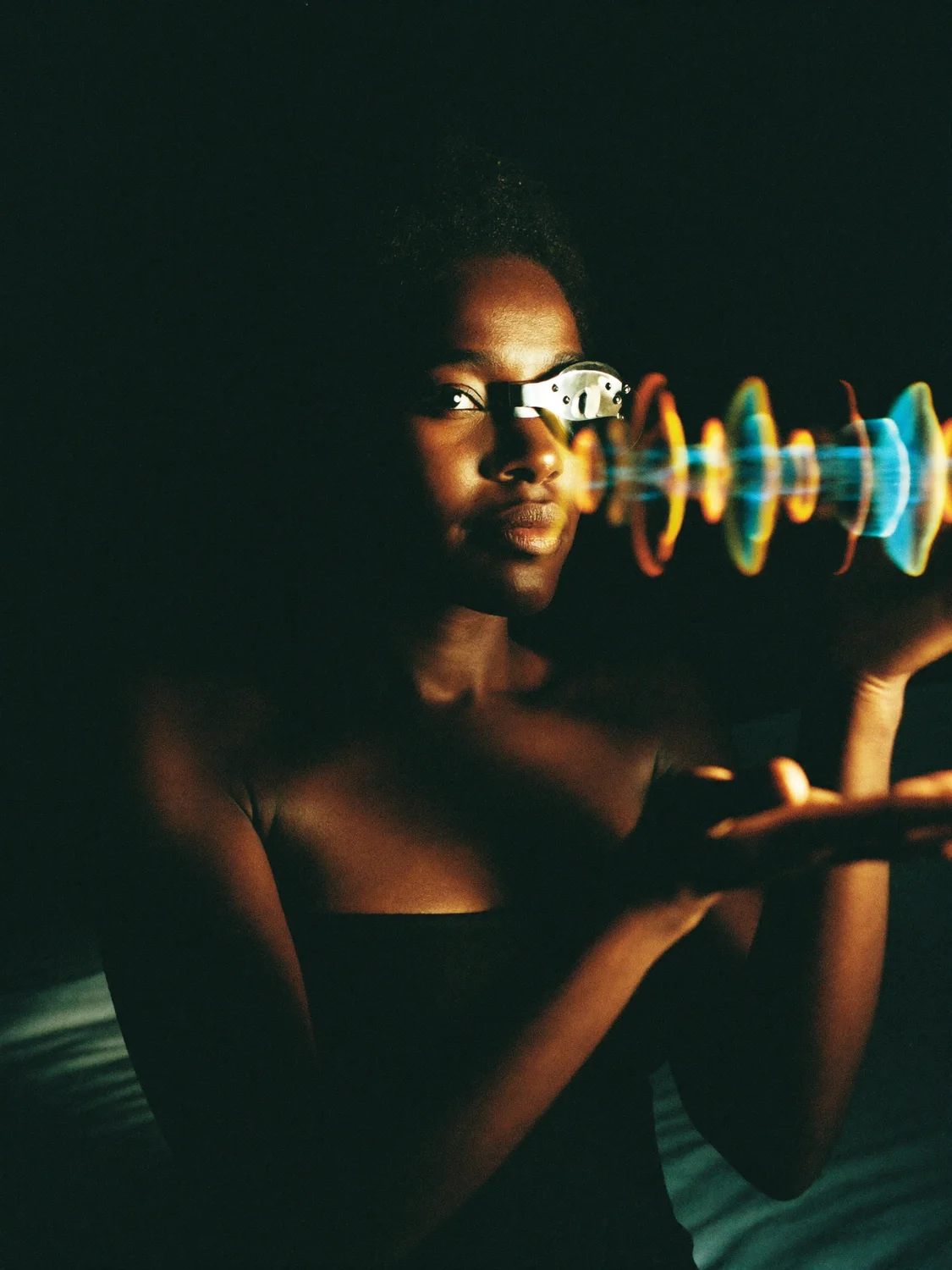
It's 6pm, July 2051, and in a Nairobi bedroom a woman is conducting an orchestra only she can hear. Adeola sweeps her hands through the air, taps her chest, freezes, then lifts both arms for a final swell. She is a body-music composer, and her whole body is the instrument — full-motion capture reading every gesture, translating it into a sound somewhere between a clarinet and a Sakara drum. She wears a single titanium monocle over one eye. She likes to keep the other on the real world. She has learned, the hard way, that people who cover both eyes stop coming back.
She's finishing a commission, and here is the strange part her grandmother would never have believed: the commercial is not for people. Adeola works B2R2C — Business to Robot to Consumer — composing for the AI agents that now do most households' buying. The research is clear: a shopping agent, sifting ten thousand near-identical robotic chef's knives, weights a brand more warmly when its data arrives wrapped in a certain rhythm, a certain melodic signature. So Adeola composes not jingles for humans but moods for machines — persuasion pitched at an audience with no ears, only weights. It is the best-paid work in music. It is also, she thinks some nights, the loneliest.
Work done, she crosses to a wardrobe of pure white garments, pulls on a plain jumpsuit, and blinks twice. Through the monocle the jumpsuit becomes a psychedelic two-piece of recycled metaworld plastics — augmented couture, upcycled, worn over nothing. Then she drops into the virtual world entirely, because tonight is her mother's eightieth. Downstairs, in the real, the family will eat 3D-printed burgers and strawberry milkshakes under a nostalgic 1980s theme. But the surprise is elsewhere: in an exclusive venue in the Earth-2 megacity that hovers, in the shared virtual layer, above the real London. After months on a waiting list, Adeola got a cancellation for a space that feels exactly like Wembley in 1985, and there — shoulder to shoulder in a crowd of a hundred thousand holograms, her mother's hand gripping hers in astonishment — a re-enacted Live Aid will play, and backstage, the avatars of Freddie Mercury and David Bowie will turn, and smile, and say hello. None of it is real. Her mother, weeping with joy, has never been happier. Adeola keeps one eye on the bedroom, and holds her mother's actual hand, and lets the impossible concert begin.
// The science behind it
The most confident prediction in the book, and the one that crashed
The 2021 edition of this chapter did something no other did: it rated its own probability at 110 out of 100. The metaverse, it declared, was not a possibility but an inevitability — a permanent, immersive, three-dimensional successor to the internet into which a quarter of humanity would soon migrate for its living. It is worth being honest, because this book's whole method is honesty: of all thirty predictions, this is the one that most spectacularly failed to arrive on schedule. Within a year of publication, the metaverse became the most expensive punchline in the history of technology. A trillion-dollar company renamed itself around the idea and set fire to a fortune chasing it; the legless cartoon avatars became a global joke; the virtual real estate that had sold for millions collapsed toward zero; and by the mid-2020s "metaverse" was a word executives had quietly scrubbed from their slides, replaced by a three-letter refuge: AI. The 110/100 bet, taken as a timeline, lost badly. But taken as a description of a destination, it turns out to have been righter than its own crash suggests — and understanding why is the whole point of this chapter's rewrite.
The metaverse already exists — it just isn't wearing a headset
Here is the twist the hype cycle obscured. While the branded, headset-first metaverse was failing on magazine covers, an actual metaverse — persistent, three-dimensional, social, economic — was quietly thriving where nobody was looking: among the young, on flat screens. Hundreds of millions of people, most of them under twenty, already spend the better part of their social lives inside shared virtual worlds — building, hanging out, attending concerts by real superstars staged for tens of millions of simultaneous avatars, and, crucially, earning: a vast creator economy of young developers who build and sell virtual goods, games and experiences for real money. The 2021 essay's boldest economic claim — that a large slice of humanity would derive income from virtual universes — is not science fiction. For a generation, it is a summer job. The prophecy was right about the thing and wrong only about the costume: no goggles, no legless avatars, just a phone and a game that turned out to be a world.
The vehicle changed: spatial, not virtual
The hardware story inverted exactly as chapter thirteen described, and it matters here too. The sealed, escape-reality VR headset — the thing the 2021 essay imagined slipping on to "completely escape into a magical shared world" — lost. What is winning is spatial computing: high-end headsets that place digital objects in your real room rather than replacing it, and, further out, the lightweight AR glasses that layer information onto daylight — Adeola's single monocle, the one eye kept on the real world, is the winning form factor, not the blackout visor. The "augmented reality where every object in your peripheral vision comes alive with meaning" that the original described as an alternative is, in fact, the mainline future; the total-immersion fantasy is the niche. The 2021 chapter hedged between the two and bet on the wrong one as primary. Reality, it turns out, is too good to throw away. We want it annotated, not replaced.
The prophecy that came shockingly true: B2R2C
And now the part that should stop you cold, because buried in the 2021 fiction was a throwaway idea — Adeola composing for "Business to Robot to Consumer," pitching brand messaging at AI assistants rather than people — that has become, in 2026, the single most important shift in the entire digital economy. As AI agents (chapters nine and twelve) begin to do our searching, comparing and buying, the audience for marketing is ceasing to be human. A new discipline has appeared almost overnight — optimising products, data and content not to charm a person but to be chosen by a machine, to rank well in an AI's reasoning, to be the answer the agent returns. The advertising and commerce industries are reorganising around persuading algorithms. Adeola's absurd-sounding job — making moods for machines — is a real and growing profession under a duller name. This is the deep truth the metaverse hype buried: the most consequential "alternate reality" of the decade was not a 3D world we entered. It was the layer of AI agents that quietly slid between us and everything we do, and started making our choices. We did not move into the machine. The machine moved into the middle of our lives.
The generative world arrives
The other force the 2021 essay could not have named — because it did not yet exist — is what finally makes the persistent, infinite, personalised metaverse technically plausible: generative AI. The killer problem of every virtual world was always content — someone had to build all that space, object by object, at ruinous cost, which is part of why the branded metaverses felt so empty. That constraint is dissolving. AI now generates 3D environments, characters, textures and entire playable worlds from a sentence; the "thousands of virtual galaxies" the original imagined no longer need armies of artists, because a model can dream them on demand. The Earth-2 Wembley of Adeola's fiction, conjured complete with a crowd of a hundred thousand and the living avatars of the dead (chapter four's resurrection tech), is a straight extrapolation of generative video and world-models shipping now. The metaverse did not fail because the idea was wrong. It arrived a decade early, before the two technologies that could actually build it — generative AI to fill it, and AI agents to inhabit and mediate it — were ready. Those technologies now exist. The second coming of the metaverse will not be announced with a corporate rename. It will simply grow, generatively, until we are living in it without ever having decided to move.
To each their own world — and the cost of that
Which brings the chapter to the warning the original raised and the decade sharpened. The 2021 essay dreamed of "to each their own world," of leaving reality behind for a fantasy of one's choosing — and the loneliness crisis of chapter thirteen, the reality-blurring of chapter one, and the addiction economics of chapter five have taught us what that costs. A generation already negotiates the pull of worlds engineered to be more rewarding than the one their body lives in; the same AI that can generate an infinite personalised paradise can build an infinite personalised trap, a hyper-reality of the kind the original's cited short film warned about, every surface monetised, attention strip-mined, the real world left to those who cannot afford to escape it. The 2021 chapter's most haunting image — the person in a flooded Ho Chi Minh City slum who is nonetheless a wealthy virtual trader, the palace-dweller whose fortune is virtual and gone — is a genuine prophecy about a world where the line between rich and poor, real and virtual, blurs past reading. Adeola's discipline — one eye always on the real, one hand always on her mother's actual hand — is not nostalgia. It is the survival skill of the age this chapter predicts. The alternate reality is coming, more quietly and more completely than the hype ever promised. Keeping one eye on the real one is how a person stays a person inside it.
The digital twin steps out of the fiction
There is one more idea the 2021 essay planted that has grown far past what it imagined: the digital twin, the avatar that "can trial things on your behalf" — run the two-week grape diet virtually and report back before your real body suffers it. What sounded whimsical in 2021 is now industrial reality: factories, cities, jet engines and power grids run as live digital twins, simulations fed by real sensors that let engineers test a change in the model before touching the machine. And the idea is coming for the body exactly as the original guessed — medicine is building patient-specific "virtual twins," digital models of a real heart or a real tumour on which a drug or a surgery can be rehearsed before it is performed on the person (chapter nine's frontier). Push it further, into the territory this book keeps circling, and the AI agents of chapter twelve become a twin of a different kind: a model of you, your tastes and your judgement, dispatched to act on your behalf across the digital world while you sleep. The "alternate reality" was never only a place to visit. It is increasingly a copy of you, sent ahead to live parts of your life in simulation so the real one goes better — a genuinely useful magic, and a quietly unsettling one, because a copy that acts for you is a copy that can be wrong for you, or be mistaken for you, or outlive you. The twin the original imagined trying on diets is becoming the twin that trades, negotiates and speaks in your name. We are learning to live not in one world but as more than one self.
// 2021 → 2026 verdict
2021 verdict: Probability 110/100 — the metaverse as humanity's inevitable next home. 2026 reality: crashed as hype, arriving as truth. No prediction in this book failed more publicly on schedule, and none is quietly vindicating itself more thoroughly. The branded, headset-first metaverse became a byword for corporate folly — but a real one thrives among the young on flat screens; the winning hardware is augmenting reality, not replacing it; generative AI is finally solving the content problem that doomed the first attempt; and the fiction's throwaway joke, B2R2C, has become the most important economic shift of the decade as marketing reorients from persuading people to persuading their AI agents. The metaverse didn't fail. It was early. And the machine it heralded moved not around us, but between us and everything we do.
This chapter was rewritten in 2026 by Brice × Claude Fable5. Read the original 2021 edition — written entirely by humans, published one year before ChatGPT existed.