19Genetics· 2026 edition
Genes for your jeans
// A story from 2051
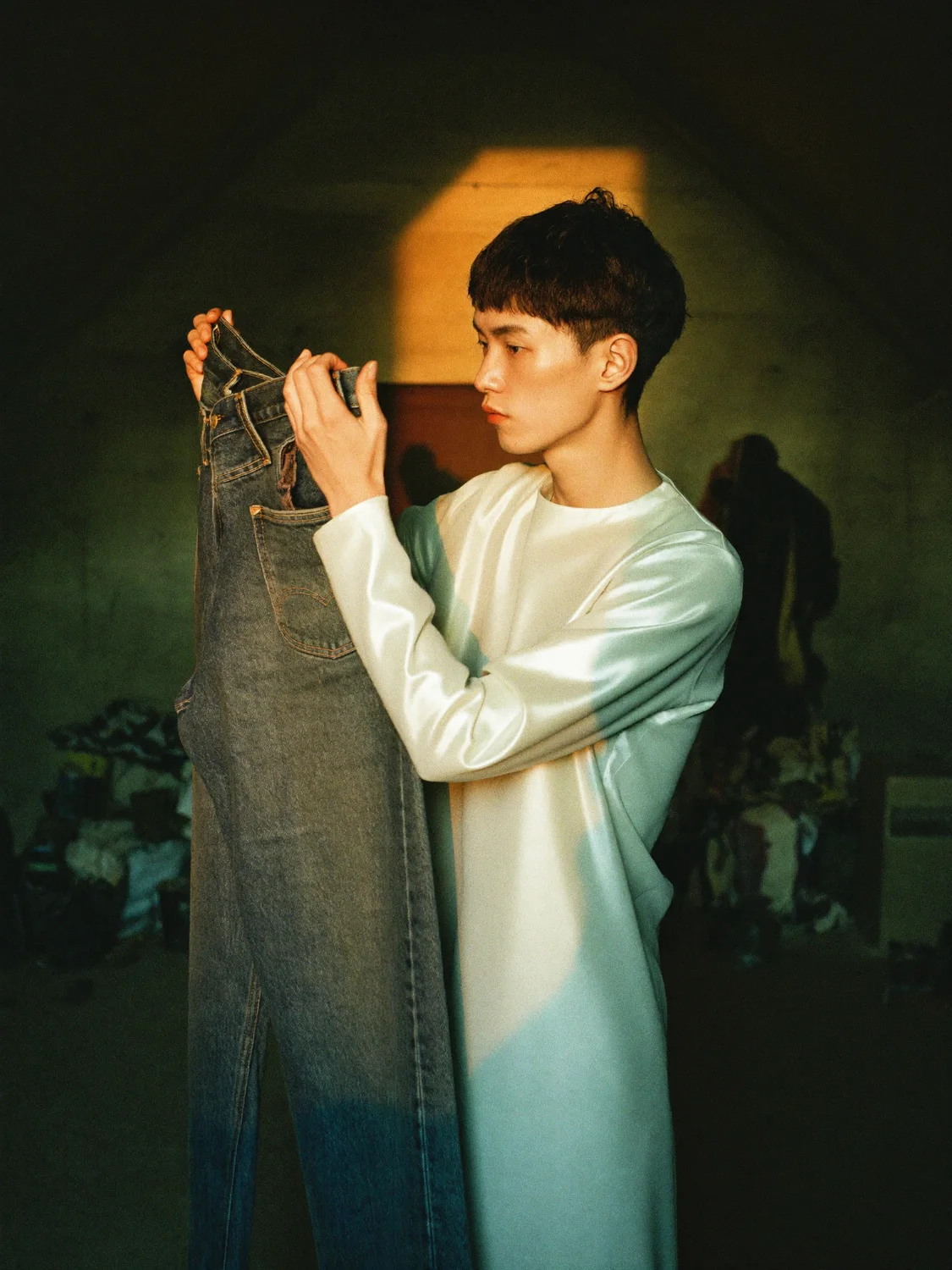
Today was the first time Bao ever touched jeans. Not the roughness surprised him, nor the strange absence of any patches shaped for particular parts of the body — it was the rigidity. The shape held itself, indifferent to the leg inside it. He wonders how his grandfather ever bore them. He is clearing the attic; the old man died of skin cancer earlier this month, and Bao, twenty years old, is sorting through objects he has never seen in his life. Most feel weirdly crude to him. Animal skins. Plant fibres that once needed lakes of water and clouds of pesticide, grown from species now extinct. He builds neat piles for the recycling plant, the way he was taught in school, sorting by feedstock so nothing is wasted.
Everything goes on the piles except the jeans. They intrigue him. On a sudden whim he peels off his own slim lab-grown trousers and wrestles the old denim on, fumbling for whole seconds at the small metal slider — a zipper, he remembers, from a clip where children born after 2035 were handed early-century objects and asked to guess their purpose. Zippers and buttons had vanished before he was old enough to have taste, around the time spray-on clothing went mainstream. He takes a few careful steps around the dusty attic. The fabric chafes. It does not adapt to his legs at all — which strikes him as a violation of the most basic thing a garment is for. Clothing should fit like a second skin and follow the body automatically; how were the probiotics in the fibres supposed to do their work if the cloth wasn't even touching the skin?
Then the smell hits him. Musty, old, faintly mouldy — no odour regulation at all. These must have needed washing, again and again, squandering clean water and poisoning rivers with detergent. He struggles out of them and drops them on the recycling pile with something close to pity. He pulls his own trousers back on and is instantly comforted: shape-memory snaps the fabric to a flawless fit, the sensors in the weave already reading the mild chafe on his knees, already waking the nanoparticles in the knee patches to soothe the reddened skin. The irritation, he knows, will be gone within the hour, without his having to think about it once.
He bags everything under a QR code and carries it to the kerb, where autonomous trucks will scan and collect it for the plant, where every fibre will be brewed back down and grown again into something new. As he seals the last bag, he pauses over the jeans one more time. His grandfather wore these, in the sun, for a whole day at a time, on unprotected skin. Bao looks at his own forearm, at the faint living sheen of the fabric there, quietly guarding him, and understands for the first time why the old man is gone and he, probably, will not be. The clothes changed. It turns out that mattered more than anyone in his grandfather's century believed.
// The science behind it
The reckoning the pandemic started
The 2021 edition opened on a shift the pandemic had just triggered: people, forced to reconsider everything they wore against their skin all day, began demanding clothing that was functional, comfortable, sustainable — that did something — and predicted that fashion would be dragged, reluctantly, from superficiality toward science. Five years on, that reckoning has not just continued; it has become one of the defining environmental fights of the age. The dirty secret the original named — that fashion is one of the planet's great polluters — moved from activist talking point to mainstream scandal. The world now knows the images: the mountains of discarded clothing visible from space in Ghana and the Atacama desert; the rivers dyed the season's colours downstream of the mills; the "fast fashion" machine producing garments so cheap and so disposable that the average item is now worn only a handful of times before it is thrown away. The pressure the 2021 essay said would force fashion to change is here, and it is enormous. What the original could not fully foresee was how slowly the industry would answer it — and how one particular pollutant, invisible in 2021, would turn the whole argument personal.
The plastic in your blood
Here is the dark discovery the decade delivered, and it belongs at the front of this chapter because it changes everything after it. The synthetic fabrics that make most of the world's clothing — polyester, nylon, the cheap plastics of fast fashion — shed microscopic fibres with every wear and every wash, and those microplastics have now been found everywhere: in the deep ocean, in Arctic ice, in rain, and, most disturbingly, in us — in human blood, in lungs, in the placenta, in mothers' milk. Clothing turned out to be not a passive thing we wear but an active source of a contamination now inside nearly every human body, with health consequences science is only beginning to measure. The 2021 essay framed the case against synthetics as one of sustainability — water, land, waste. The case in 2026 is one of human health, and it is far more visceral. Bao's horror at his grandfather's washable, shedding, chafing jeans is not aesthetic snobbery. It is the recoil of a generation that learned its ancestors were, unknowingly, dressed in a slow-release plastic — a garment that quietly deposited a little more of itself into their lungs and their bloodstream every single day they wore it, and into the water and the food of everyone downstream of them. This single fact is the strongest engine yet behind everything the original predicted: if your clothes are poisoning you, "clothing that heals you instead" stops being a luxury and becomes the point.
The bio-fabricated fibre grows up — messily
The 2021 chapter's boldest material bet was on biofabrication — growing fibres from living organisms instead of drilling, farming or slaughtering for them — and specifically on brewed spider silk, the protein spun by microbes rather than spiders. Five years on, the honest verdict is a hard-won partly, and the honesty matters. Lab-brewed silk protein, mushroom-root "leather" grown from mycelium, bacterial cellulose, cultivated animal-free leather grown from real cells — all of it moved from the laboratory into real products, real runway pieces, real partnerships with the biggest names in fashion. And then the harder truth arrived: growing a material in a vat and growing it at the scale and price of the oil-based stuff it must replace are wildly different problems, and several of the most celebrated bio-material ventures stumbled, paused, or folded when the economics refused to cooperate. This is the pattern this book keeps meeting — the technology works in principle and fights for its life in practice. But the direction did not reverse; it slowed and matured. Brewed-protein fibres are now woven into premium garments; grown leather is entering luxury goods; the underlying science advanced. Bao's world, where every fibre is grown and brewed and then dissolved and grown again, is not a fantasy. It is the destination of a road that turned out to be longer and steeper than the 2021 optimists guessed — and one that a new accelerant is now dramatically shortening.
AI learns to invent materials
That accelerant is the force the original could not have named, because it barely existed: artificial intelligence has become a materials-discovery machine. The central bottleneck in every prediction in this chapter was always the same — inventing a new material, a new fibre, a new nanoparticle blend, meant years of painstaking trial and error in a lab. AI collapsed that. Models now propose hundreds of thousands of novel stable materials at a stroke, design proteins that do not exist in nature (chapter six's revolution), and predict which molecular structure will yield the strength, the water-repellence, the antibacterial action a designer wants — turning a decade of guesswork into a computational search. The self-cleaning, UV-shielding, wound-healing, odour-killing "smart fabrics" the 2021 essay described as slowly emerging from nanotechnology now have, behind them, an engine that can dream new versions on demand. The merger of clothing and biology that the original predicted was always gated by the pace of material invention. That gate has been thrown open. The next decade of fabrics will be designed as much by algorithms as by chemists.
Probiotic clothing was real — and it shipped
The most startling vindication in the chapter is the smallest and most specific. The 2021 essay pointed to a fashion designer and scientist, Rosie Broadhead, working with a microbiologist to encapsulate probiotic bacteria into the fibres of clothing — living cultures woven into fabric to improve the skin's own microbiome, reduce odour, and care for the body from the outside in. This sounded, in 2021, like the furthest reach of the whole piece. It is now a real product line. Clothing with beneficial bacteria built into the weave — activated by body heat and moisture, working with the skin rather than merely covering it — moved from research announcement to garments people can buy. Bao's certainty that clothing exists to deliver care to the skin, that probiotics in the fibres must touch the body to do their work, is not a 2051 invention. It is a 2020s product, in its infancy. The union of the garment and the skincare regime — the original's central thesis — has begun exactly where the essay said it would.
Spray-on and shape-memory: the runway caught up
And the two most futuristic-sounding delivery methods in the fiction both arrived, one of them spectacularly. Spray-on clothing — the liquid that becomes a garment on the body, from the company the original explicitly named — went from obscure demonstration to one of the most-watched moments in fashion history when a dress was sprayed directly onto a model on a Paris runway, in real time, before a global audience. The exact technology the 2021 essay cited became a viral emblem of fashion's future overnight. Shape-memory and adaptive fabrics — Bao's "bodywear" that snaps back to a perfect fit — advanced through smart textiles that respond to heat and stretch, and found an unexpected new urgency from the body-changing drugs of chapters two and sixteen: in a world where GLP-1 medications reshape millions of bodies rapidly, a garment that re-fits itself rather than being outgrown is not a novelty but a genuine need. The original's insight that adaptive clothing would beat spray-on for anyone whose body fluctuates has aged into a precise commercial truth. Meanwhile the health sensors the essay imagined "hidden within the patches, communicating live skin stats to your phone" are simply e-textiles now — conductive fibres woven into garments that read heart rate, breathing, temperature, and posture, turning the shirt into the descendant of the smartwatch. The garment is becoming a medical device you happen to also wear for warmth.
The melanoma thread, and the personal stakes
There is a quieter, sadder thread the original wove through Bao's story that the decade only sharpened: the grandfather dead of skin cancer, the constant UV monitoring, the melanoma anxiety driving fabric to become armour. This is not speculative. Skin cancer rates continued their long climb; UV exposure tracking became a standard feature of every smartwatch and weather app; and the case for clothing that actively shields the skin — UV-blocking nanoparticle weaves, the "bodyshield" of the fiction — grew straight out of real dermatological alarm. It ties, too, to the personal medicine of this book's other chapters: as diagnostics move onto and into the body, clothing becomes another surface for the same project — continuous, passive, invisible health protection, worn without thinking. Bao's dawning understanding at the end of the fiction — that his clothes are why he will likely outlive his grandfather's disease — is the emotional core the whole chapter builds toward, and it is grounded in a genuine trajectory: the twenty-first century is slowly turning clothing from decoration into defence.
The face-glove and the end of the mask
The original pushed its logic onto the face, too — "face-gloves," near-undetectable second skins releasing active ingredients slowly through the day, the descendant of the Korean sheet mask that never has to be peeled off — and here the decade has quietly delivered the early versions. The beauty industry of chapter sixteen went precisely this way: microbiome-friendly skincare, personalised formulations, and the first "smart" patches and bio-active films that dose the skin continuously rather than in a single morning application. The convergence the essay named — 3D-scanning a customer's face to mould a garment fitted exactly to it, a practice the original noted was already happening at a cosmetics counter — is now ordinary, driven by the same face-mapping that lets us wear digital looks. The distinction between "clothing," "skincare," and "medical device" that felt so solid in the twentieth century is dissolving into a single category: things you wear against your skin that actively work on your behalf. A garment, a serum, a sensor and a slow-release drug patch are becoming points on one continuous spectrum. Bao does not have separate words for his trousers, his sunscreen and his health monitor, because in his world they are the same object. That collapse of categories — clothing becoming biology becoming medicine — is the real prophecy of this chapter, and it is already underway.
The circular loom
Which leaves the deepest promise, the one Bao lives inside without remarking on it: a circular materials economy, where a garment is brewed from living cells, worn, and then dissolved back into feedstock to be grown again — no landfill, no ocean of shed plastic, no extinct species farmed for skins. This is the answer to the microplastic catastrophe and the waste-mountain scandal both, and it is the true prize behind biofabrication. It remains, in 2026, more aspiration than reality — recycling clothing at scale is genuinely hard, blended fabrics resist separation, and the infrastructure barely exists. But the pieces are assembling: chemical recycling that breaks textiles back to raw molecules, bio-materials designed from the start to be compostable or re-brewable, digital passports (the QR codes on Bao's bags) that track a garment's materials for reuse. The 2051 attic scene is really a portrait of a solved problem — a world where "throwing clothes away" has become as quaint and crude as the jeans themselves. We are very far from it. But for the first time, thanks to biology and AI together, it is a problem with a visible shape, and a plausible end. The clothes really are starting to do more than make us look good. In Bao's century, they are what keep us alive — and what stop us drowning the world in the castoffs of looking good the old way.
// 2021 → 2026 verdict
2021 verdict: Probability 60/100 — clothing merges with skincare and biology: probiotic fibres, brewed spider silk, spray-on and shape-memory bodywear, health sensors in the weave. 2026 reality: vindicated in the specifics, humbled in the timeline. Probiotic clothing shipped; spray-on fashion went viral on the very runway from the very company the essay named; smart textiles and UV-shielding weaves are real; biofabricated silk and leather grew up messily, stumbling on economics but not reversing. And the decade added the argument the original lacked: microplastics in human blood turned "clothing that heals you" from a luxury into a health imperative, while AI became a materials-invention engine that could finally build it. The genes went into the jeans, more or less on schedule. The hard part, as ever, was making them cheap.
This chapter was rewritten in 2026 by Brice × Claude Fable5. Read the original 2021 edition — written entirely by humans, published one year before ChatGPT existed.