24Oceans· 2026 edition
Beyond the blue
// A story from 2051
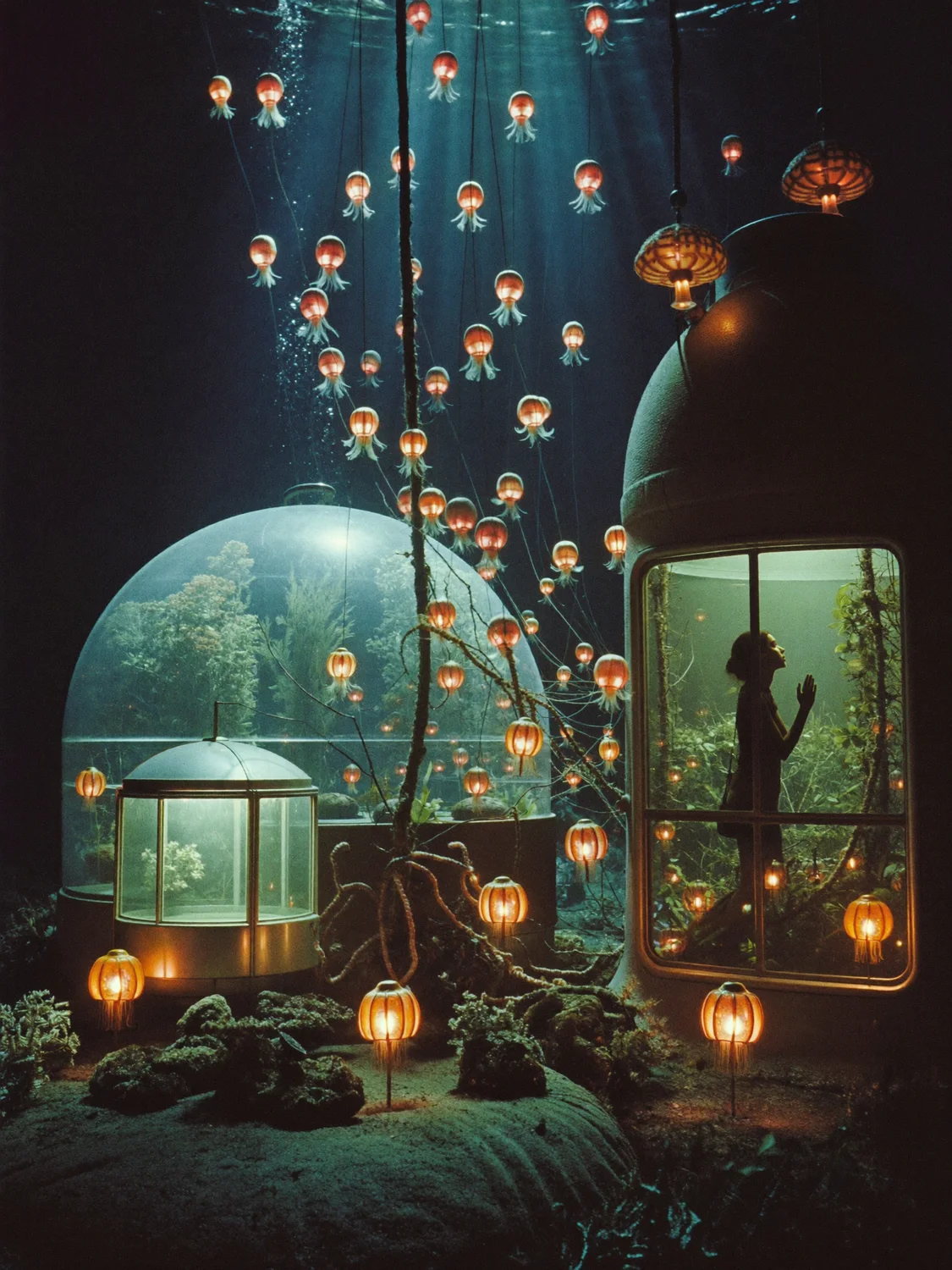
Marcelle wakes peckish, which is silly — her bespoke supplements leave her no reason to be hungry — but today is special: her twin sister Mignonne arrives at the Basin, and to celebrate they will eat actual food. It is 5am. Outside her small pod window hangs the usual hazy view of the seabed, twenty metres below the surface, blue fading to blue-black. Every so often a soft flash lights a tangle of structures: mussel socks and scallop lanterns drifting behind a distant sphere, a greenhouse dome growing watermelons in saltwater. The light comes from a swarm of firefly squid, gene-edited to glow brighter when they sense toxins in the water — living instruments, lured close to illuminate the colony and warn it of danger at the very same time.
The squid remind her of dinner. After months of smoothies and kelp salads she is aching for the cultured-meat schnitzels her friend has sourced, with sea-asparagus fries, curried kelp, and a "headache-light" Sauvignon Blanc. She hasn't seen Mignonne in over two long years — not since she and her partner Luc won a lottery to move to the island section of Neptopia, fifty miles off the coast of Darwin. Neptopia had accreted since the 2040s, an ocean farm first, then a full underwater city once a crypto billionaire decided to build one. For Marcelle it means a more deliberate life, and a test of whether two people can bear the deep for this long.
She thinks, sometimes, about why they all came. Some fled the drowning coasts. Some fled taxes, or governments, or the mind-bending noise of the metaverse, chasing a simpler life in the ultimate cocoon of perpetual blue and luminescent fireworks. Some came, quietly, because the land above had started to feel like it was ending, and the sea — three-quarters of the world, still mostly unmapped, still mostly unruled — felt like the last frontier left that a person could still choose. Marcelle presses her palm to the cool glass and watches the squid pulse their warning-light, all-clear, and thinks: her ancestors dreamed of leaving the Earth for the stars. She left it for the water instead, which was always closer, and always stranger, and had been waiting under them the whole time. Mignonne arrives at noon, on the supply run from the surface. Marcelle has so much to show her, and only the whole blue world to show it in.
// The science behind it
The most confident bet in the book, tested by a rising sea
The 2021 edition of this chapter rated its own probability at 95 out of 100 — near-certainty that humanity would move onto and into the ocean: floating cities, underwater habitats, sea farms, ocean colonies, an eventual "eighth continent." Five years on, the verdict is genuinely fascinating, because the why changed even as the what was vindicated. The original offered two engines for the move to sea: a hopeful one (utopian design, libertarian freedom, adventure) and a grim one (rising seas driving us off the land). The decade decisively picked the grim engine. The romance of seasteading largely faded; the necessity of floating did not. We are going to the water, more and more, but chiefly because the water is coming for us — and that changes the whole meaning of this chapter from a fantasy of escape into a story of adaptation, and, increasingly, of loss.
The libertarian seastead sank; the climate city floats
Honesty first, because the original leaned hard on a vision that has, frankly, failed. The seasteading movement it profiled at length — the Thiel-funded, Friedman-founded dream of floating micro-nations with "start-up governments," an escape from politics onto the blank slate of the sea — has not delivered its promised utopias. The most visible attempt, a libertarian couple's seastead off Panama, ended not in a new nation but in the residents being threatened with prosecution and fleeing; the movement's grander schemes remain, years later, renderings and manifestos. The reasons are exactly the ones critics named: the ocean is brutally hostile and expensive, no real government wants a tax-free sovereign platform off its coast, and "escape from politics" turns out to be a fantasy, because a hundred people on a platform reinvent politics by lunchtime. The 2021 essay's most Silicon Valley idea — that you can hack government by floating away from it — proved to be the weakest prediction in the chapter.
But — and this is the crucial correction — the other floating-city vision, the one framed as climate adaptation rather than libertarian escape, is genuinely being built. The concept the original cited, Oceanix, moved from roundtable to reality: a real prototype floating city, backed by the UN's own urban-development programme, is under development off Busan in South Korea — modular, sustainable, designed to rise with the sea rather than drown beneath it. The Maldives — the lowest-lying nation on Earth — is building an actual floating city in its lagoon, homes on a flexible grid, exactly as the essay described. The distinction the decade drew is sharp and important: floating-as-escape failed; floating-as-survival is happening. The billionaire's vanity seastead is a punchline. The engineer's climate-resilient floating neighbourhood is a construction site.
And the engineering that makes it credible advanced exactly as the original promised. The hardest doubt about floating cities was always the sea itself — how does a vast structure survive a storm and an eighty-foot wave? The Dutch marine-research institutes the essay cited kept refining the answer: modular platforms with flexible, wave-facing edges that cushion the blows rather than resisting them rigidly, tested against monster waves in the world's largest wave-simulation pools and, increasingly, at sea. The principle that a floating structure should yield to the ocean's force rather than fight it — bend, flex, and ride, like a raft of hinged islands — has matured from concept to engineering standard, and it is what turns "floating city" from a rendering into a buildable thing. Combine that with the modular, hexagonal, infinitely-reconfigurable design language the original described — small platforms that clip together into villages, villages into cities, each unit self-sufficient in power, water, food and waste — and you have a genuine architecture of the sea, one that can be built incrementally, towed into position, and expanded as need grows. The floating city is no longer waiting on a breakthrough. It is waiting on demand, and the rising water is manufacturing the demand.
The drowning has begun, and the retreat is real
The engine driving it is no longer speculative. The 2021 essay warned that rising seas would expose most of the world's largest cities and displace a billion people; the intervening years turned that forecast into visible policy. Coastal flooding grew more frequent and more costly; "managed retreat" — the once-unthinkable idea of abandoning land to the sea — became a real and painful practice in vulnerable places. Jakarta, sinking and flooding, is being succeeded as Indonesia's capital by a purpose-built new city inland, exactly the relocation the original flagged, now underway. And the most haunting development of all is one the essay half-predicted and reality made poetry of: the island nation of Tuvalu, facing the loss of its physical territory to the ocean, began building a digital version of itself — a "digital nation," its land, culture and statehood preserved in the metaverse (chapter eighteen) so that the country might legally survive even after the last atoll goes under. A nation uploading itself to the cloud because the sea is taking its ground is the single most 2020s sentence this book contains, and it is not fiction. The neighbouring low-lying states watch and prepare; some, like the atoll nations of the Pacific, have spent years securing legal recognition that their statehood — their seat at the table, their rights over their vast ocean territories — should survive even the total loss of their land, a wholly new category of country the twentieth century never had to imagine: the nation without a shore. The ocean chapter turned out to be, above all, a climate chapter. We are not romancing the sea. We are negotiating our surrender to it, and trying to do so with dignity.
Many waters, many answers: the spectrum of adaptation
What the decade also clarified is that there is no single response to the rising sea, but a whole spectrum, and the original was right to sketch most of it. At one end sit the great engineering defences: the colossal sea walls and storm-surge barriers that cities from Jakarta to Venice to New York are building or expanding, betting billions that they can hold the line. In the middle sit the softer strategies — the "sponge cities" pioneered in China that absorb and store floodwater through wetlands and permeable ground rather than fighting it with concrete; the "living with water" designs, from the Netherlands to New Orleans, that turn streets into canals and accept the water rather than expelling it. And at the far end sit the two hardest options: managed retreat, and floating. The Netherlands — a nation that has lived below sea level for centuries — remains the world's teacher here, and its expertise, once a national peculiarity, has become a global export as the rest of the coastline catches up to the Dutch predicament. The lesson of the decade is that no city will be saved by one idea; each will assemble its own answer from walls, sponges, canals, retreat, and floating neighbourhoods, according to its geography and its purse. The 2021 essay's catalogue of approaches was not a menu of competing bets. It was a preview of the composite, improvised, expensive patchwork that coastal humanity is now actually building.
The Global South is inventing the water city first
There is a justice to notice here, and the original caught it. The glossy floating-city renderings tend to feature wealthy enclaves — a Maldivian lagoon, a Korean bay — but the places already living on the water, out of necessity rather than design, are overwhelmingly poor. The essay singled out Makoko, the vast floating settlement in the Lagos lagoon sometimes called the "Venice of Africa," where a quarter of a million people already live and work on the water — and the Nigerian architect who designed a simple, cheap, locally buildable floating structure for it, a prototype that has since travelled to several countries as a model for African "water cities." This matters because it inverts the usual story: the innovation that wealthy futurists imagine as a luxury frontier is being pioneered, in its practical form, by communities in the Global South who never had the choice to live on dry land. As the seas rise, it is these communities — in Lagos, in Bangladesh, across the low-lying coasts of the tropics — who are simultaneously the most endangered and the most experienced at aquatic life, and whose vernacular, hand-built, affordable water architecture may teach the rich world more than any billionaire's seastead. The future of living on water is not only being designed in Silicon Valley studios. It is being lived, right now, by the people the rising water threatens first.
The plastic sea, and turning catastrophe into ground
The original raised a startling idea the decade has both advanced and complicated: what if, instead of building new islands, we inhabited the ones our garbage has already made? The Great Pacific Garbage Patch — the continent-sized gyre of floating plastic it described — remains a real and horrifying feature of the ocean, and the decade brought genuine, if partial, progress against it: the ambitious cleanup effort the essay mentioned has scaled up, its systems now extracting meaningful tonnages of plastic from the gyre and, more importantly, intercepting it in the rivers before it reaches the sea. The visionary schemes to turn the trash itself into habitable, self-sufficient islands remain, honestly, on the drawing board and the crowdfunding page where the original found them. But the deeper story the decade wrote is darker and more intimate than floating garbage: the plastic did not stay conveniently gathered in a patch to be scooped up. It broke down into microplastics and spread everywhere, into the deep sea, the ice, the rain, and — as chapter nineteen recorded — into human blood and lungs and placentas. The ocean became the vast, slow stomach digesting a century of our plastic and handing it back to us in our own bodies. Cleaning the visible patch is noble and necessary; but the ocean plastic crisis, like the carbon crisis, turned out to be less about the spectacular floating island and more about the invisible, pervasive contamination of the entire system, ourselves included. The sea returns everything we give it.
Living in the blue: from hotel novelty to real habitat
The original's giddy tour of underwater luxury — the Floating Seahorse Villas, the Water Discus hotels, the Poseidon resort — has aged into exactly what it was: a menu of expensive novelties, some built, most perpetually "coming soon," a rich person's aquarium view rather than a new way of living. But underneath the tourism, the serious prediction — that humans would develop the capacity to live underwater for extended periods — advanced meaningfully. Fabien Cousteau's Proteus, the "space station of the sea," progressed as a genuine project; and a new, ambitious effort emerged that the original could not have named: a serious engineering programme to build a permanent, habitable underwater base designed to let scientists live in the deep for weeks at a time, with the explicit goal of doing for the ocean what the space station did for orbit. The aquanaut dream the essay traced back to the 1960s pioneers is being revived with real capital and real engineering, aimed squarely at the deadline the original set. Marcelle's Basin — people living, working, and eating twenty metres down — remains ahead of us, but it is now the goal of funded programmes rather than the reverie of retired divers. Living in the blue is moving, slowly, from stunt to science.
And the science is real, not hand-waving. The original grounded its optimism in a genuine fact of physiology the decade continues to exploit: saturation. Once a human body has spent a full day underwater at a given depth, its tissues become saturated with dissolved gas, and — counterintuitively — it can then stay down almost indefinitely, decompressing only once at the end, rather than every day. This is why aquanauts, unlike divers, can live in the deep. The world's serious undersea laboratories continued to prove it: the last operational research habitat on the seabed off Florida kept hosting scientists, and NASA kept using undersea missions as an analog for spaceflight — sending astronauts to live underwater precisely because the isolation, the hostile environment, the airlocks and the psychological strain of a sealed habitat mirror a Mars base better than anything on land. That link between inner space and outer space, which the original drew, only deepened: the ocean floor is the best rehearsal stage we have for the other planets of chapters ten and fifteen, and the same generation of engineers is, quite literally, designing for both. The genuinely new development is ambition and money: a serious, well-funded programme now aims to build a permanent underwater habitat capable of housing researchers for weeks, a true "space station of the sea," turning what were week-long endurance feats into continuous habitation. Marcelle living underwater for two years is still far off. But the first humans to live below the surface for months at a stretch, by choice and in comfort, are plausibly alive today.
The ocean map, finally being drawn
One quiet prophecy has come true faster than almost any other in the chapter, and it matters more than the resorts. The original noted that some 80% of the ocean floor was unexplored, and made the mapping of it a central hope. The decade launched exactly that: a global effort to map the entire ocean floor in high resolution, a "Seabed 2030" push that has already charted a remarkable and growing fraction of the deep, aided by fleets of autonomous underwater drones and AI that can survey the abyss without a human aboard. We are, for the first time in history, actually seeing the shape of the two-thirds of our planet that was always dark. This is the necessary foundation for everything else in the chapter — you cannot farm, build, protect, or wisely exploit what you have never seen — and it is the ocean equivalent of the genome sequencing in chapter twenty-two: turning the unknown into data. The better we map the sea, the better we understand the currents and the climate that the sea, more than anything, controls. The eighth continent cannot be settled until it is charted, and the charting, at last, has begun in earnest.
The blue rush turned dark: mining the deep
Here the decade added a chapter the 2021 essay barely glimpsed, and it is the ocean's most bitter irony. The original spoke breezily of a "blue rush" to "exploit the vast, unclaimed ocean resources," imagining it as farming and energy. The blue rush that actually arrived first, and hardest, was mining — the race to scrape the deep seabed for the metals that batteries and electronics demand, hauling up the potato-sized polymetallic nodules that carpet parts of the abyss. It has become one of the fiercest environmental battles of the age: companies and some governments push to open the deep sea to industrial extraction, while scientists warn that we would be strip-mining the least-understood, slowest-healing ecosystem on Earth — destroying the abyssal life the mapping mission has barely begun to catalogue, before we even know what it is. Calls for a moratorium collide with the hunger for the metals of the green transition (chapter seven's batteries), in a genuine and unresolved conflict between two goods. The 2021 essay dreamed of the ocean as a frontier to inhabit. The 2020s revealed it, first, as a frontier to plunder — and the fight over whether the deep sea becomes a mine or a sanctuary is one of the defining environmental questions this chapter now must carry. The romance of the blue has a bulldozer in it that the original did not see coming. And the tragedy is that the deep sea may be the worst possible place to be careless: it is the slowest-changing environment on the planet, where the nodules being targeted took millions of years to form and the ecosystems that depend on them may take just as long to recover, if they recover at all. To mine the abyss for a decade's worth of battery metals, potentially destroying habitats older than agriculture that we have literally never seen, in order to build the clean-energy transition that is supposed to save the natural world — that is the kind of bitter, self-defeating bargain this whole book keeps warning against, playing out three miles beneath the waves where almost no one will ever witness it. The moratorium fight over the deep sea is, in miniature, the fight over the whole planet: whether we can restrain our appetite long enough to understand what we are about to consume.
Sea greens and the food from the water
On food, the original was not only right but ahead of the curve, and this is the chapter's happiest vindication. The prediction that the ocean would become a major, sustainable source of food — through deep-water fish farming, and above all through seaweed — is unfolding almost exactly as described. Open-ocean aquaculture pushed further offshore into ever-larger, storm-resistant farms; and the "sea greens" the essay evangelised became a genuine movement. Regenerative ocean farming — the zero-input, carbon-sequestering, reef-rebuilding cultivation of seaweed and shellfish together that the original singled out through the pioneer Bren Smith and his open-source model — grew from curiosity to a real and expanding industry, with kelp appearing not just on plates but in packaging, textiles, fertiliser and feed. The reasons are exactly the ones the essay gave: seaweed needs no land, no freshwater, no fertiliser; it grows fast, cleans the water, pulls down carbon, and could create enormous numbers of jobs on a warming, crowded planet. Add the cultured seafood of the cell-based-meat revolution (chapter two) — real farmed fish grown from cells, without the boat or the depleted stock — and the "food from the water" the fiction serves at Marcelle's celebration dinner is one of the most solidly-arriving predictions in the entire book. If the ocean is coming for our cities, it may, in fair exchange, help feed the people it displaces.
The frontier the essay reached for beyond seaweed — growing land crops in and on the sea — is also inching from experiment toward reality. The submerged greenhouse project it described off the Italian coast, growing strawberries, basil and lettuce in biospheres anchored to the seabed, continued its slow industrialisation; salt-tolerant crops engineered from the genes of mangroves (chapter six) advanced toward growing staple grains in seawater; and designs for floating hydroponic farms — sealed containers growing produce on the ocean's surface, lit by LEDs and powered by offshore wind — moved from concept toward prototype. None of this is at scale yet, and the honest word is emerging, not arrived. But the direction is unmistakable, and it points at the vision the fiction takes for granted: a greenhouse dome growing watermelons in saltwater on the seabed is not a fantasy detail. It is the logical endpoint of experiments running today. The ocean, long a place we only hunted, is becoming a place we farm — and that shift, from the last great wild harvest to genuine cultivation, may be as historically significant as the agricultural revolution that first tied humanity to the land ten thousand years ago. We are, slowly, learning to farm the other two-thirds of the planet.
The living instruments: marine biotech and the glowing sea
The fiction's most magical detail — the firefly squid, gene-edited to glow brighter when they sense toxins, both lighting the colony and warning it — is not as far-fetched as it sounds, and points to a frontier the original barely named: marine biotechnology. The ocean is the planet's greatest untapped library of biology, and the same tools transforming medicine and agriculture (chapters six and twenty-two) are being turned on it. Bioluminescence — the cold light that countless sea creatures already make — is a real and actively researched phenomenon, and engineering organisms to glow as living sensors is precisely the kind of synthetic-biology application now moving from lab to field. The deep sea's extremophiles — creatures thriving at crushing pressure, near-boiling vents, and total darkness — are yielding enzymes and molecules of enormous value, from industrial catalysts to new drugs, exactly the kind of "blue biotech" bounty that makes the ocean's genetic diversity worth protecting rather than destroying. Coral itself is being genetically studied and assisted — "assisted evolution" to breed heat-resistant corals that might survive the warming seas of chapter seventeen. The ocean, in other words, is not only a place to live and farm and mine; it is a genetic treasury whose value we are only beginning to read, even as we threaten it. Marcelle's glowing, sensing squid are a small emblem of the chapter's deepest tension: the same biotechnology that could let us live in harmony with the sea, reading and working with its life, is racing against the industrial appetite that would strip that life away before we have learned what it is. Which impulse wins — the biologist's or the miner's — is, once again, the whole question.
Powering the eighth continent
The energy piece, too, is landing where the original pointed. Floating solar — panels on the water's surface, cooled by the sea beneath them — went from novelty to one of the fastest-growing forms of renewable energy, with enormous installations on reservoirs and lagoons and the first serious moves offshore. Offshore wind became a backbone of the clean-energy transition (chapter seven). Wave and tidal power remain stubbornly niche, harder than the optimists hoped — the sea that offers so much energy also destroys the machines that try to harvest it — but they advance. The exotic frontiers the essay reached for, from plankton-powered seabed sensors to the fantasy of tapping underwater volcanoes, remain distant. But the core claim — that the ocean can power what we build on and in it — is sound and proving out. An ocean city need not be tethered to the land for its energy; it can, increasingly, make its own from the sun, wind and water around it. That energy self-sufficiency is precisely what makes permanent ocean settlement plausible rather than merely romantic.
It is worth dwelling on floating solar specifically, because it is the quiet giant of this section. Panels mounted on the surface of reservoirs, lakes and lagoons turn out to have a double advantage the original spotted: they generate clean power and they shade the water beneath, reducing evaporation — a genuine boon in a thirsty, warming world — while the water cools the panels and lifts their efficiency. What began as a novelty on a few reservoirs has become one of the fastest-scaling renewables on Earth, with enormous installations now floating on bodies of water from Southeast Asia to Europe, and the first serious engineering pushing the technology from calm inland waters out toward the far harsher open sea. A floating city ringed by floating solar, drawing additional power from the offshore wind and the waves around it, storing it in the ever-cheaper batteries of chapter seven, is not a fantasy of self-sufficiency; it is an assembly of technologies that each already work. The ocean settlement of the fiction does not need a scientific miracle to keep its lights on. It needs only the falling-cost curves this book has traced in chapter after chapter to keep falling — which, so far, they reliably do.
The ocean we are quietly losing
Before the verdict, the chapter owes the reader the truth its 2021 optimism understated most: even as we learn to live on and in the ocean, we are damaging the ocean itself, profoundly and fast. The sea is the planet's great regulator — it has absorbed the overwhelming majority of the excess heat humanity's emissions have trapped, and a vast share of the carbon dioxide too, quietly shielding the land from the full force of warming at a terrible cost to itself. That cost is now visible. The oceans are hotter than at any point in the instrumental record, and marine heatwaves — underwater analogues of the heat domes that scorch cities — have grown longer, fiercer, and more frequent, cooking reefs and reshaping fisheries. The absorbed carbon is turning the sea more acidic, dissolving the shells and skeletons of the creatures at the base of the marine food web, the very mussels and scallops and corals the fiction's colony grows around itself. Coral reefs — home to a quarter of all marine species — have suffered mass bleaching events of a scale and frequency that give them no time to recover, and the reef Marcelle admires from her pod window is, in the real 2020s, an ecosystem fighting for its life. The bitter irony sits at the centre of this chapter: the same rising, warming, acidifying ocean that is driving us to build floating cities and undersea habitats is being degraded by the very civilisation doing the building. We are moving toward the sea and harming it in the same motion. Any honest vision of an ocean future must hold both truths at once — the wonder of living in the blue, and the tragedy of what we are doing to the blue we hope to live in. The eighth continent will be settled on a sea we are simultaneously breaking. Whether it becomes a home or a ruin depends on choices — about carbon, about mining, about protection — being made on land, right now, by people who mostly never look at the water at all.
What the sea means now
So where does this leave the 95-out-of-100 bet? Vindicated in almost all its particulars — floating cities, underwater habitats, ocean farms, sea greens, ocean energy, the mapping of the deep — but transfigured in its meaning. The 2021 essay was, at heart, an optimist's chapter: the sea as playground, frontier, escape, adventure, a blank slate for utopias. The 2026 telling cannot be that, and should not be. The sea in this decade is the rising threat that drowns cities and uploads nations to the cloud; the contested deep that we are poised to mine before we have mapped it; the vast carbon-and-heat sink whose warming and acidification (chapters seventeen and two) threaten the very reefs the fiction admires from its pod window. The ocean is not a frontier we are conquering. It is a planet-sized system we are simultaneously fleeing to, feeding from, plundering, and fundamentally altering — all at once, and mostly without a plan. Marcelle's Neptopia will be built, in some form; some of us will live in the blue, and eat from it, and power our lives with it. But the deepest truth of this chapter, the one the original's exuberance missed, is that our relationship with the ocean in this century is not mainly about moving in. It is about whether we can stop breaking the thing that covers, feeds, cools, and ultimately governs our entire world — before it decides the terms for us. "The sea is everything," Verne wrote, and the original quoted him as a promise of adventure. In 2026 the same three words read as a warning, and a responsibility. The sea is everything. That is exactly why what we do to it, and in it, matters more than any other frontier we could name.
// 2021 → 2026 verdict
2021 verdict: Probability 95/100 — humanity moves onto and into the ocean: floating cities, underwater habitats, sea farms, ocean energy, an eventual eighth continent. 2026 reality: vindicated in substance, transformed in meaning. Floating cities are genuinely being built — but as climate adaptation (Oceanix Busan, the Maldives Floating City), not as the libertarian seasteads that flopped; underwater habitats are advancing from novelty toward real science; the seabed is finally being mapped; sea-greens and ocean farming are a true boom; ocean energy is landing. But the decade rewrote the chapter's soul: rising seas are driving managed retreat and even a nation (Tuvalu) uploading itself to the cloud as it drowns, and the "blue rush" arrived first as deep-sea mining — a fight to plunder the abyss before we have mapped it. The move to the sea is real. It is no longer an escape to a frontier; it is an adaptation to, and a reckoning with, the planet-sized system we are altering faster than we understand it.
This chapter was rewritten in 2026 by Brice × Claude Fable5. Read the original 2021 edition — written entirely by humans, published one year before ChatGPT existed.