25Wellbeing· 2026 edition
Postcards from Torporville
// A story from 2051
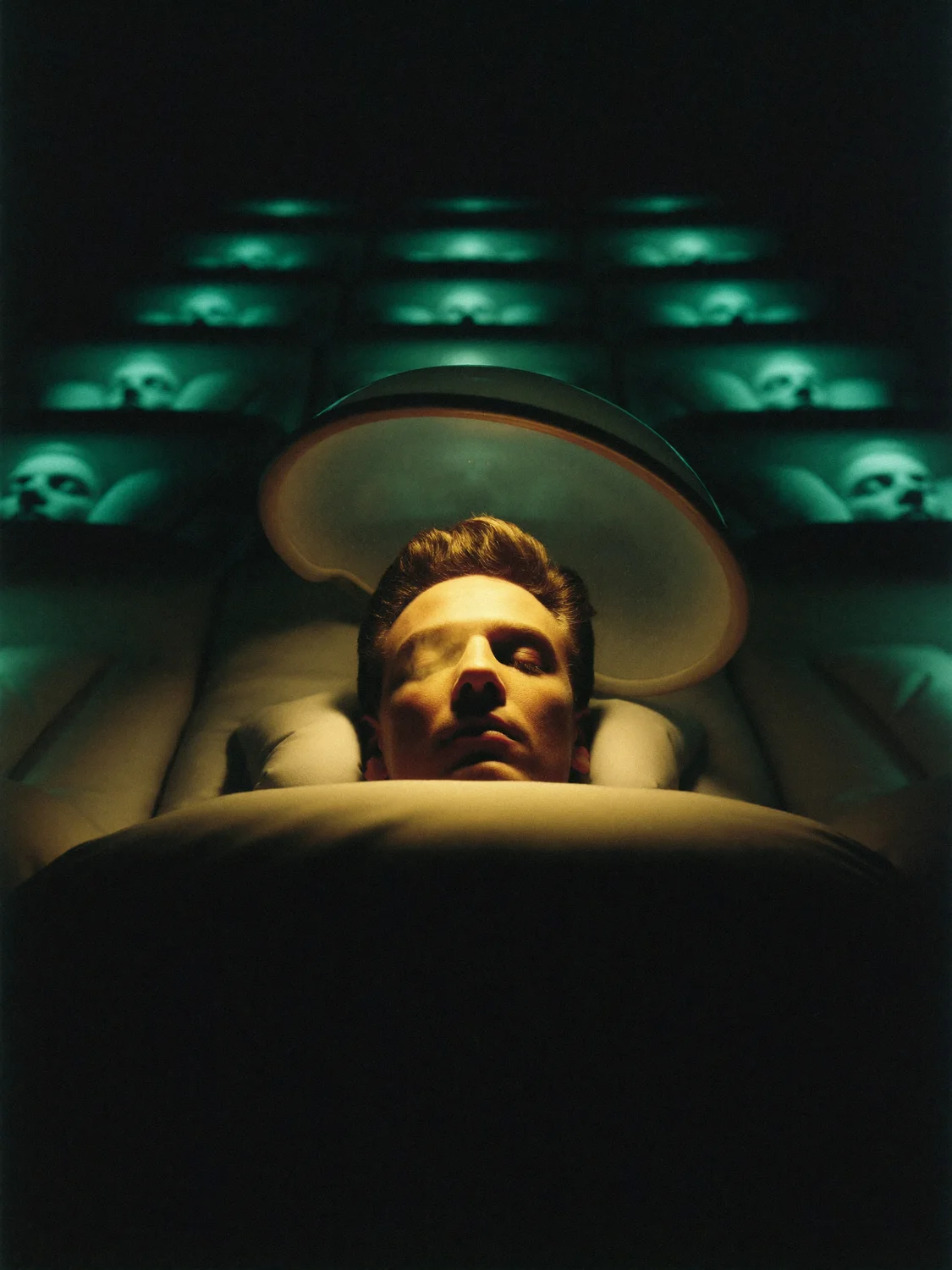
Tung's eyes flutter open into dim light. He stifles an enormous yawn, stretches his legs, and finds himself rested — the way you feel after a long afternoon nap — but with a sour taste in his mouth and a faint, all-over shiver. He doesn't know where he is, but the custom aromas breathing over his face smell of home, of the Yellow River, and so he is not afraid. A voice speaks as the lights slowly brighten. He is inside a padded pod. "Hi Tung, welcome back. You've successfully Hiberday-ed for one hundred and eighty days. Breathe, and relax, while we bring your body temperature back to normal."
It comes back in waves. Seven months ago, one dark Friday, he had sat with his hands in his hair, staring at a mountain of debt. For fifteen years he had run adventure tours in the Huang River Valley with an impossible unique selling point: he was one of the last operators on Earth still offering petrol cars. Nothing thrills like the roar of a combustion engine, and people flew across the world to get behind the wheel of a preserved Dodge Demon or a turn-of-the-millennium BMW, to feel a Harley shudder beneath them — the ultimate bucket-list holiday, reliving a childhood, driving faster and louder than the law now allows anywhere. China had come late and hard to carbon zero after a string of disasters; petrol cars stopped being built in the 2030s, and by the 2040s the survivors were taxed into near-impossibility, along with everything else — barbecues, unrecycled clothes, each additional child. Tung had made it work, barely, until a single monstrous dust storm killed a whole year of business. The insurance payout was the last nail, not the first plank. He was days from bankruptcy when a government insider mentioned the new programme: go off-grid, unconscious, for a few months, and save yourself.
So he did. Six months asleep. No rent, no food, no entertainment, no carbon tax — his home swapped to a holidaymaker, his emissions credited to the state, his debt frozen and quietly shrinking against the money he wasn't spending by existing. He had slept through half a year of a life he could no longer afford to live awake. The voice tells him his balance is clear. Tung breathes the false smell of the river he grew up beside, and feels the shiver fade, and does not yet let himself wonder what it means that the cheapest thing he could do, in the end, was to stop being conscious — or how many millions, tonight, are still under, all across a country that found it easier to pause its people than to fix the reasons they wanted to sleep.
// The science behind it
The lowest-probability bet, and why it aged strangely well
The 2021 edition rated this chapter at just 50/100 — the book's most honest shrug, a genuine coin-flip on whether humans would ever meaningfully hibernate. And five years on it has aged in the most interesting way of any prediction here: the science got markedly more real, while the society it imagined got more plausible for reasons that have nothing to do with the technology. The premise splits cleanly in two — can we put a human into safe, long torpor, and would we ever want to sell it as an escape? — and the decade moved both halves forward, one in the laboratory and one in the culture. This is a Fiction-block chapter, and it earns the label; but it is fiction that keeps brushing against fact from two directions at once.
The science crept toward Torporville
Start with the biology, because it advanced further than a 50/100 bet had any right to expect. The 2021 essay marvelled that hibernating animals drop their metabolism by up to 99% with no ill effects, and wondered why humans — who cannot naturally hibernate — could not be made to. The decade produced a startling partial answer. Researchers discovered they could induce a genuine torpor-like state in mice and rats — animals that do not naturally hibernate — by directly activating specific groups of neurons in the brain, flipping a switch that dropped body temperature and metabolism into a controlled hibernation and then safely back out. Even more remarkably, teams showed they could trigger the same torpor-like state non-invasively, using focused ultrasound aimed at that brain region — no drugs, no implants, just sound. The significance is hard to overstate: it suggests the "hibernation switch" is latent in mammals that never use it, humans plausibly included, and that it might one day be thrown deliberately and reversibly. Torpor-on-demand went, in this decade, from pure speculation to an active, credible research frontier. The fiction's Hiberday pod is still fiction. The biological mechanism it would need is no longer.
The hospital already does a gentler version
The original was also right that a mild form of this is old medicine, and the decade deepened it. Therapeutic hypothermia — deliberately cooling a patient's body to protect the brain after cardiac arrest — remains standard critical care. And the more radical idea the essay raised, preserving trauma victims by cooling them into a suspended state to buy surgeons time, moved from theory into actual human trials: "emergency preservation and resuscitation," in which a patient with catastrophic blood loss is rapidly cooled to pause their biology, operated on while effectively in stasis, and then rewarmed. This is suspended animation in the operating room, tested on real people in real emergencies — the most literal vindication in the chapter. The gap between "cool a dying patient for an hour to save them" and "cool a healthy person for six months to save them money" is enormous, and mostly a matter of safety, duration, and the profound question of what long unconsciousness does to a mind. But the near end of that spectrum is now clinical practice, not science fiction.
The reason we would actually want it
Here is where the chapter's real prescience lives, and it is not technological at all. The 2021 essay imagined people choosing long comas to escape debt, to dodge carbon taxes, to fast-forward through a life they could not afford — and framed it, half-jokingly, as a "wellbeing" holiday. What the intervening years added is the emotional truth underneath the joke. This became the decade of burnout — of a genuine, measured epidemic of exhaustion, of "quiet quitting" and "bed rotting" and a whole culture of young people fantasising, only half-ironically, about opting out of the relentless demands of a hyper-connected, always-optimising, economically brutal existence. The desire the fiction is built on — to simply stop, to be unconscious through the hard part, to escape a life that has become too expensive and too tiring to live awake — is no longer a quirky premise. It is a widely felt, openly discussed cultural mood. Tung sleeping through a year he cannot afford is a dark exaggeration of something real: a generation so depleted by the machinery of modern life that the fantasy of switching consciousness off for a while has genuine emotional force. The 2021 chapter guessed that hibernation might be sold as an escape. The 2020s proved there is a vast, aching market for escape — the technology simply hasn't arrived to serve it yet.
The dystopia hiding in the spa brochure
And this is where the 2026 telling must press harder than the original did, because the fiction contains a genuinely dark idea it treated too lightly. The essay floated, almost cheerfully, the notion that countries "under severe environmental pressure" might "pause parts of their population" to save resources — and Tung's story reveals the horror inside the convenience: a society that finds it cheaper and easier to render its struggling citizens unconscious than to address why they are drowning in debt and carbon taxes and despair. That is not a wellness product; it is a chilling political technology, the ultimate expression of a system that would rather switch off the suffering than fix its causes. In an age of deepening inequality (a theme running through this whole book), the ability to buy oblivion, or to be nudged into it by the state to balance a ledger, is a nightmare wearing a spa robe. The fiction's power is that it makes the nightmare sound reasonable — Tung is grateful, his debt is cleared, the aromas smell of home. The most valuable thing this chapter does in 2026 is refuse the cheerfulness: a world that offers mass unconsciousness as an economic instrument has not solved its problems. It has anaesthetised them. And the difference between a therapy and a sedative-for-the-inconvenient is the whole moral weight of the chapter.
The metabolic dividend, and the longevity dream
There is a quieter set of promises the original tucked into its wellness brochure that the decade made newly plausible, and they deserve a fair hearing alongside the dread. If a body can be safely slowed, then long torpor becomes a platform for other medicine: a window in which to run experimental treatments, to let the body heal from trauma undisturbed, to deliver several gene therapies at once (chapter twenty-two) without the friction of a conscious, moving patient. More provocatively, it reconnects to the oldest dream in this book's final act — longevity (chapter twenty-nine). A near-universal finding in biology is that slowing metabolism tends to extend lifespan; the animals that hibernate often live startlingly long for their size, spending months each year with their biological clocks all but stopped. If human torpor could safely pause the body's clock, then the "anti-ageing sabbatical" the original imagined is not purely marketing — it gestures at a real hypothesis, that time spent in torpor might be time the body does not fully age through. This is speculative, and belongs honestly in the Fiction block. But it is the kind of speculation the decade nudged from fantasy toward research question. And it reframes Tung's six months: he did not only escape his debt; he may have spent half a year barely ageing, emerging younger, relative to his years, than the awake world he left. In a century obsessed with buying time, the ability to not spend it — to bank the hours unconscious and unwithered — is a stranger and more seductive product than any beach holiday.
The one place it is unambiguously good: the road to Mars
There is, finally, one application where torpor is pure promise and no dread, and the decade kept it firmly on the table: space. The nine-month trip to Mars (chapters ten and fifteen) is brutal on the human body and mind — the boredom, the radiation, the sheer mass of food, water and air a conscious crew consumes. Putting astronauts into rotating torpor for the long cruise, as the space agencies and their contractors continue to study, would slash the resources required, ease the psychological ordeal, and might even protect the body from some of deep space's harms. Here the "switch off consciousness to cross an impossible distance" idea is not an escape from life but an enabler of humanity's greatest adventure, and it is precisely the torpor-induction science — the brain switch, the safe cooling and rewarming — now advancing in the lab that would make it real. The same technology that could let a burnt-out debtor sleep through his troubles could let the first humans sleep their way to another planet. Which of those futures we build it for is, as ever in this book, not a question the technology can answer. Torporville is coming. Whether it is a refuge or a prison depends entirely on why we go there, and who decides.
// 2021 → 2026 verdict
2021 verdict: Probability 50/100 — voluntary long hibernation ("Hiberday") as escape, therapy, resource-saving, and deep-space travel. 2026 reality: the science advanced faster than the coin-flip implied; the social case wrote itself. Researchers induced safe torpor-like states in non-hibernating mammals — even non-invasively, with ultrasound — while "suspended animation" for trauma entered real human trials, making the biology genuinely credible. And the desire the fiction imagined arrived on its own: a burnout epidemic and a culture openly fantasising about opting out gave the escape-into-unconsciousness premise real emotional force. What the decade sharpened most is the warning the original soft-pedalled — a society that would rather switch off its suffering citizens than fix their suffering is a dystopia in a spa robe. Torpor is real, and coming. Whether Torporville is humanity's route to Mars or its anaesthetic for the inconvenient is the only question that matters.
This chapter was rewritten in 2026 by Brice × Claude Fable5. Read the original 2021 edition — written entirely by humans, published one year before ChatGPT existed.