23Sports· 2026 edition
Enter the Arena
// A story from 2051
Having virtually arrived in the stands, Tom orders his implant, silently, to give him the panoramic view — one of the hundreds of nano-drones swarming the pitch, feeding him an angle no human seat could buy. Information scrolls across his vision: summaries of past games, the weather, the live physical condition of every player, the AI's prediction for the result. And, of course, a river of targeted advertising — betting odds, food deliveries, tickets to the next round — which Tom has long since learned to let slide past like rain on glass. He flicks to the settings and chooses tonight's commentator: he picks the synthetic voice of a legend fifty years dead, who will call the match in real time and, if Tom likes, answer his questions between plays.
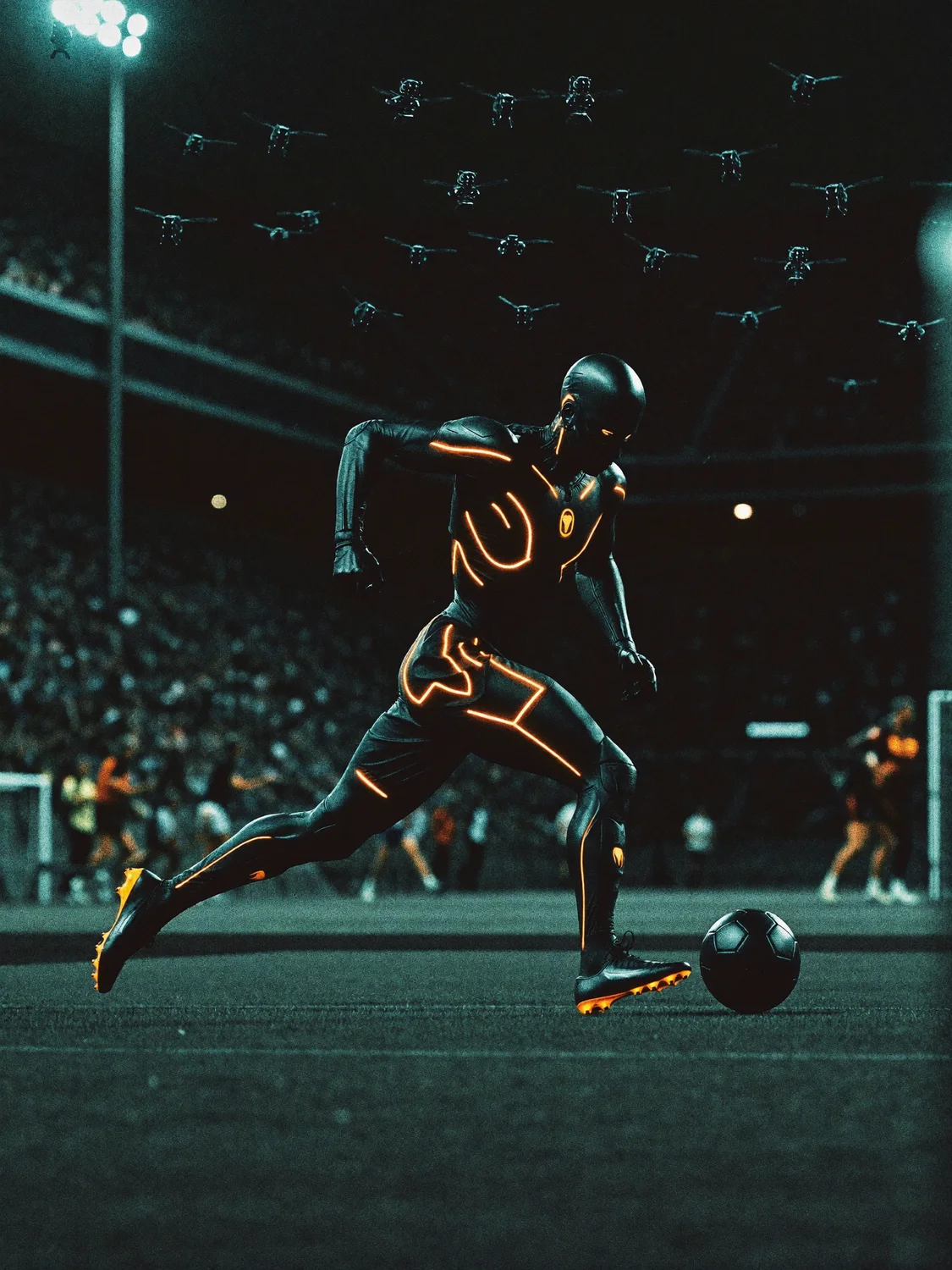
But Tom is not just a spectator today. For a small fee, he has bought the right to play — to remotely pilot one of the androids FIFA fields for exactly this purpose. Tonight the South Korean FC Jeonbuk Androids meet their Manchester United counterparts, and Tom, a lifelong Red, will pilot a defender and take it deadly seriously. When the whistle blows he snaps his point of view into the android's own eyes, and the world tilts into something impossibly immediate: the grass, the roar, the striker bearing down on him at a speed his real body, slumped on a couch somewhere across the city, has never once in its life known.
Half-time comes far too soon; he could swear the match began minutes ago, though Korea leads by one. His android trots to the changing room, where an AI checks its mechanics and an AI coach digests the half's data and whispers the opposition's weaknesses straight into the pilots' cortices. The second half is fierce. They lose, in the end, narrowly, but they held the defending champions to the last minute — and Tom, deactivating his implant and sinking back into his own couch, his own unremarkable body, is exhausted and elated, having lived ninety minutes as a top-flight athlete without ever leaving the room. He lingers for the closing ceremony in the metaverse, a vast live esports tournament thrown to thank the players, and thinks, drowsily, that he can no longer quite say where the sport ended and he began, nor whether it matters. In 2051, that blur is the whole point. Nobody, or almost nobody, merely watches from the stands anymore. Everybody, one way or another, plays.
// The science behind it
The prophecy that split sport into layers
The 2021 edition of this chapter made a wide, ambitious bet: that technology, long held at the door of professional sport, would come flooding in on every front at once — transforming how we watch it, how it is judged, how athletes are enhanced, and eventually who gets to be the athlete. Five years on, the striking thing is how the transformation is proceeding exactly along the layers the original identified, at wildly different speeds. The spectator revolution is here and accelerating. The analytics-and-betting revolution is here and reshaping the economics. The augmentation revolution — the most explosive and taboo of the essay's predictions — has just, astonishingly, begun in earnest. And the android revolution, the fiction's centrepiece, is the furthest off but no longer fantasy. Sport did not resist technology, as it had for a century. In this decade it surrendered, layer by layer, and the question the original raised — what is left of the contest when the machines are done with it? — became the defining anxiety of the arena.
Watching became doing
Start with the spectator, because that layer is nearly complete. The 2021 essay imagined personalised broadcasts — choose your camera angle, follow one player, pick your commentator's voice — and this is now ordinary. Streaming platforms offer multi-angle viewing, AR overlays paint live statistics and predicted trajectories onto the pitch, and the "synthetic Pelé calling your match" is no longer whimsy: AI-generated commentary, in any language and any voice, is real and spreading, and interactive AI companions that answer a fan's questions mid-game are arriving. The immersive edge advanced too — VR courtside seats, volumetric replays you can walk around, the athlete's-eye view piped from body-worn cameras. Tom's world, where the fan curates every atom of the experience, is a straight-line extension of what a sports fan can already buy. The one component still ahead is the neural implant that puts you inside the athlete's eyes — but as chapters ten and twenty-seven show, even that is now research rather than fiction. Watching is becoming participating, and the passive spectator is quietly going extinct.
The measured game, and the prediction crisis
The 2021 essay's sharpest insight was about data — that the relentless measurement of every step, heartbeat and pass would let algorithms predict outcomes with rising accuracy, and that this would provoke a genuine crisis: if the machine can call the result before kickoff, what is left to watch? This has arrived with a vengeance. Every professional athlete is now a walking sensor array — GPS vests, biometric wearables, optical tracking capturing every movement — and AI models digest it all to scout talent, prevent injury, optimise tactics, and forecast results. Alongside it, the essay's other prophecy landed with enormous force: legalised sports betting exploded across the world, wiring real-time AI odds into the very fabric of the viewing experience, exactly the "river of betting ads" Tom ignores. And the crisis the original foresaw is real and debated: as analytics homogenise tactics and prediction sharpens, insiders worry aloud that the game is becoming solved, that data-optimised play is less surprising, that the soul of sport — its glorious unpredictability — is being modelled away. The essay was right that measurement would eventually threaten the mystery. What it could not decide, and neither can we, is whether sport can measure itself this completely and remain worth watching.
The machine in the referee's chair
There is a layer the 2021 essay only glanced at that the decade fully delivered: technology did not just change how we watch and who competes — it took over judging the game. The original mentioned slow-motion review for rule violations almost in passing; since then, the machine moved from advisor to arbiter. Video review systems now overrule human referees across the major sports; goal-line technology and semi-automated offside detection make binary calls in milliseconds that no human eye could; ball-tracking systems adjudicate line calls in tennis with a precision that retired the human line judge entirely. This is the quiet revolution inside the arena: the pursuit of perfect fairness through perfect measurement. And it carries a cost the decade is still arguing over — the loss of the human element in officiating, the endless stoppages for review, the strange deadness of a goal celebrated and then erased by a machine minutes later, the way certainty drains a particular kind of drama from the game. The essay was right that technology would saturate sport; it under-predicted that some of the deepest saturation would happen not on the pitch but in the referee's chair. Whether a perfectly, mechanically fair game is a better game, or merely a colder one, is a question every sport is now living, and none has answered.
The augmentation taboo just broke — for real
Now the layer where the 2021 essay looks less like prediction and more like prophecy, because the thing it imagined for 2043 is being built in 2026. The original foresaw sport eventually, controversially, permitting enhancement — cybernetics, genetic engineering, augmented athletes — and splitting into categories: a "historical" un-enhanced division alongside an openly "augmented" one. That exact idea has arrived under a real name: the Enhanced Games, a genuine, tech-investor-funded competition explicitly permitting performance-enhancing drugs, marketing itself as the honest alternative to a sporting establishment it accuses of hypocrisy about doping. Whatever one thinks of it — and it is fiercely condemned by mainstream sport and medicine as dangerous — its mere existence vindicates the original's most outlandish call: a sanctioned arena where enhancement is the point, not the crime. The essay's imagined 2044 Olympics with an "augmented edition" is no longer a fantasy timeline; the augmented edition is being founded now, decades early. And the frontier beyond it looms exactly where the original placed it: gene doping, the fear that the CRISPR tools of chapter twenty-two could edit athletes for endurance or muscle, is now a named, monitored threat that anti-doping authorities actively test for. The taboo the essay said would fall is falling, on schedule and then some.
The prosthetic blur and the redefinition of "able"
The augmentation story has a more hopeful face the original also caught: the dissolving line between disability and enhancement. Advanced prosthetics have grown so capable that the old, clean division between Paralympic and Olympic performance is genuinely blurring — running blades, powered limbs, and exoskeletons are turning "assistive" technology into, arguably, augmentative technology, and forcing sport to confront questions it has no settled answers to: when does a prosthetic restore ability, and when does it exceed it? The essay's vision of a four-way Olympics — historical, Paralympic, augmented, android — reads less like science fiction every year, because the categories are already smearing into one another. And the deeper promise the original named is real and moving: technology that lets people who could never before compete at the highest level do exactly that, whether through a superb prosthetic or, further out, through a piloted machine. The arena is being redefined not only at its enhanced extreme but at its inclusive one — and the two frontiers are, unsettlingly, the same technology pointed in two moral directions.
The athlete as optimised system
Beneath every professional sport now runs a quieter augmentation the original foresaw in its "increasingly intensive collection of physical data": the transformation of the athlete's own body and preparation into a fully optimised, AI-managed system. Recovery, sleep, nutrition, hydration, training load — all are now measured continuously by wearables and tuned by algorithms, pushing human performance toward its biological ceiling without a single banned substance. The GLP-1 and metabolic advances of chapters two and sixteen, the personalised medicine of chapter nine, the diagnostic garments of chapter nineteen all converge on the elite body, which has become the most instrumented object in the world. This is enhancement by optimisation rather than by drug or edit, and it is entirely legal, which raises its own quiet version of the fairness question: when the difference between champion and runner-up is increasingly the quality of one's data science and one's medical team, has the contest shifted, subtly, from the athletes to the systems behind them? Careers lengthen as recovery science improves — athletes now compete at elite level into ages that would have been impossible a generation ago — and the human body, pushed and protected by ubiquitous technology, keeps redrawing the line of what is possible. The augmentation debate tends to focus on the dramatic frontier of drugs and genes. But the largest transformation of the athlete has already happened, legally, invisibly, in the form of the phone-sized labs now monitoring every heartbeat of every professional on Earth.
The robots take the field
The fiction's centrepiece — humans piloting humanoid androids that play the actual sport — is the furthest-off layer, but 2026 shows its unmistakable beginnings. Robots already play sport: long-running robot-soccer leagues pit autonomous humanoid machines against each other, and the humanoid-robot boom of chapter fourteen has produced the first real spectacles of machines running, kicking, and even competing in staged athletic "games." China staged widely watched humanoid-robot sporting events; drone racing is an established sport; robot combat has a devoted audience. What does not yet exist is Tom's version — the piloted android, an avatar an ordinary fan controls in real time against another fan's avatar, at athletic speed. But every ingredient is now on the table: capable humanoid robots, the low-latency telepresence of chapter thirteen, and the embodied-avatar technology that already lets disabled people be present through machines. The Android Ultra-Soccer World Cup is not a 2051 invention waiting to be discovered; it is a product waiting to be assembled from parts that all exist, and the first crude commercial version — fans paying to pilot a machine against another fan's machine — is closer to a funding round than to a fantasy. The fiction's most radical promise — that a quadriplegic could play top-flight rugby by proxy, with an experience indistinguishable from the real thing — is the single most humane idea in the chapter, and it is genuinely coming.
Esports crossed over, and sport had to make room
The original ended Tom's day at a metaverse esports tournament, almost as an afterthought — and the decade made that afterthought a main event. Competitive gaming completed its migration from subculture to mainstream sport: esports now fill real arenas, mint real millionaire athletes, and, decisively, entered the Olympic conversation, with the movement establishing dedicated Olympic Esports Games. The boundary the twentieth century drew between "sport" (physical) and "game" (virtual) has effectively collapsed; a generation makes no distinction between supporting a football club and supporting an esports team, and the skills, training regimes, and audiences overlap. This matters to the whole chapter because it completes the picture: sport in the 2020s is becoming a spectrum — from the purely physical, through the augmented and the prosthetic, to the piloted and the entirely virtual — exactly as intimacy did in chapter twenty and dating did alongside it. The arena is no longer one thing. It is a continuum, and Tom, piloting an android before unwinding at an esports final, lives across the whole of it in a single evening.
What remains when the machines are done
Which returns the chapter to the question the original raised and could not answer, the one that only sharpens as every prediction comes true: when sport can be perfectly measured, confidently predicted, chemically and genetically enhanced, robotically embodied and virtually replaced — what is left of why we cared? The answer, this book suspects, is the same answer that surfaces in every chapter where technology saturates something human. What we ultimately want from sport is not efficiency or spectacle but meaning — the human drama of a real person, with real limits, risking real failure, and sometimes transcending themselves in front of us. That is why the "historical," un-enhanced division the original imagined will not merely survive; it may become the most prestigious one, the way vinyl and handmade goods became premium precisely because the machine-made version was everywhere. As augmentation and simulation flood the arena, the unaltered human contest — fallible, unpredictable, gloriously inefficient — becomes the scarce and precious thing, the reality worth protecting. The machines will give us more sport than ever, in more forms than ever, and much of it will be dazzling. But the reason a stadium of strangers rises together as one, breath held, is that they are watching a person do something that might not work. No android, however skilled, and no algorithm, however certain, can manufacture that. Tom had a wonderful evening inside his machine. Somewhere, that same night, in a stadium full of ordinary bodies and no machines at all, a child watched an un-augmented human being run faster than a human being should be able to run, and cried without knowing why. That is the part of the arena the technology cannot enter.
// 2021 → 2026 verdict
2021 verdict: Probability 70/100 — technology floods sport on every front: personalised immersive broadcasts, AI prediction, enhanced and cyborg athletes, piloted androids, an Olympics split into human/Paralympic/augmented/android editions. 2026 reality: happening in layers, faster than expected at the extremes. The spectator revolution (multi-angle, AR stats, AI commentary) and the data-and-betting revolution are here and reshaping sport; the augmentation taboo just broke for real via the tech-funded Enhanced Games, with gene-doping now an actively monitored threat — the essay's "augmented edition" arriving decades early; prosthetics are blurring the able/enhanced line; robot and esports competitions crossed into the mainstream, the latter heading for the Olympics. The piloted-android layer remains ahead, but every part exists. And the question the original raised only grows louder: when everything can be measured, predicted, enhanced and simulated, the un-augmented human contest — fallible, unpredictable, real — becomes the rarest and most valuable spectacle of all.
This chapter was rewritten in 2026 by Brice × Claude Fable5. Read the original 2021 edition — written entirely by humans, published one year before ChatGPT existed.