01Art & Music· 2026 edition
Art & Alan Turing
// A story from 2051
Maria is bored. As an entertainment lawyer, she has sat through tedious negotiations all her life, but this one takes the cake. Four legal agents — hers, the label's, the model-owner's, and the estate's — have been arguing for three hours about a single question: who owns the voice of a woman who died before any of them were trained?
The case is cut and dried, in Maria's mind. The Debbie Harry estate licensed the vocal likeness in 2038, the generative rights reverted in 2046, and the model that performs her tonight was trained exclusively on licensed stems. Her provenance passport is clean — every weight accounted for, every training source receipted. End of conversation.
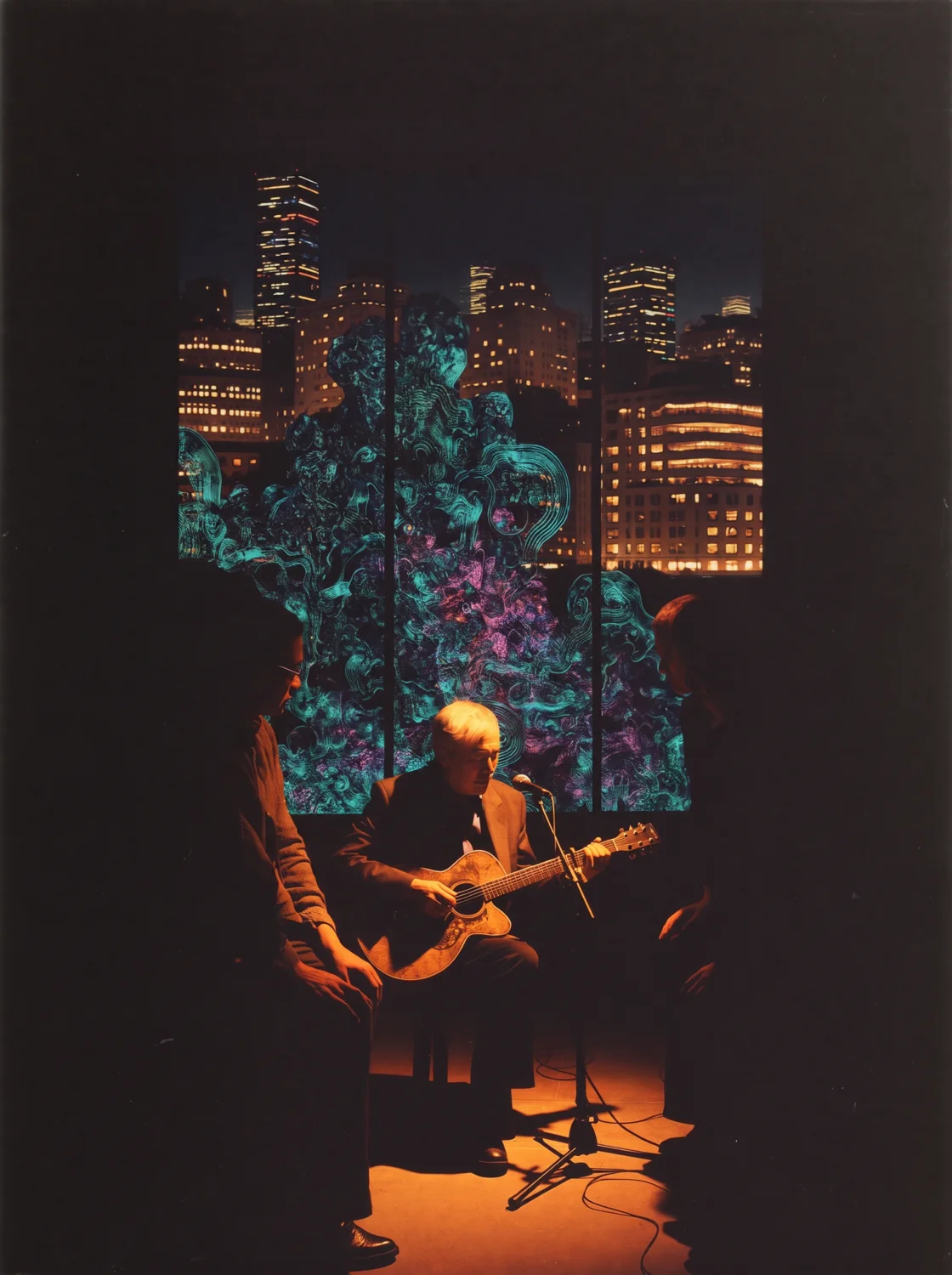
She clicks "end" and gets ready for the real event. Tonight she has the rarest ticket in town: not the AI punk opera in the harbour — anyone can have one of those generated, sold-out is a marketing fiction — but a small room, eighty seats, where a sixty-year-old man will play a wooden guitar with his actual hands. No personalisation. No adaptive soundscape reading her heart rate. He will play the same imperfect set for everyone, and it will never exist again.
Her ticket cost more than her apartment's monthly energy budget. On the certificate, embossed in gold, the words that changed the art market of the 2040s: Certified Human Performance — no generative assistance.
Walking out, she passes the city learning centre, its façade alive with ever-evolving generated art — beautiful, infinite, and free. Nobody stops to look anymore. In the small room, when the man's finger squeaks on the third string, eighty people hold their breath.
Scarcity, Maria thinks, was never about the music.
// The science behind it
The five-year lightning
Every art form humans have invented took centuries to mature. Painting had the Renaissance; photography needed a hundred years to be accepted as art; cinema took half a century to find its grammar. Generative art compressed that entire cycle into roughly five years — and we are all still standing in the crater, blinking.
The detonator was a pair of algorithms. The transformer, invented in 2017, taught machines to predict what comes next — in a sentence, a melody, a brushstroke. The diffusion model taught them to sculpt images out of noise, the way a photographer pulls a print out of a chemical bath. Neither was designed to make art. Together, they turned out to be the two levers that moved the entire creative world.
Text fell first. When ChatGPT arrived in late 2022, generative writing went from research curiosity to household utility in a single winter — the fastest-adopted consumer technology in history. Within three years, the successor models had stopped being autocomplete and become collaborators: systems that hold a book-length argument in mind, keep a character's voice consistent across four hundred pages, and — the part no one predicted politely — write with recognisable styles of their own, distinct enough that editors learned to tell them apart blind, the way critics once told Chandler from Hammett. Images fell next: Midjourney, Stable Diffusion and DALL-E made photorealistic image generation a commodity by 2023; FLUX and Google's image stack pushed quality past the point where juries could tell; today the frontier belongs to Nano Banana 2 and GPT-Image-2 — models that follow art direction like a seasoned studio assistant, render legible typography, and hold a character consistent across an entire campaign. The Turing test for images fell quietly along the way. Nobody even bothered to organise a farewell ceremony.
Design and architecture followed without a press cycle. Logos, packaging, furniture, fabrics, façades: the mood board became a slot machine, and the profession's centre of gravity moved from producing options to defending choices. Ask any creative director what changed and you get the same answer in different accents — the blank page is dead, the hundred first drafts are free, and the entire job now happens in the second draft, where judgment lives.
Music took barely longer. Suno and Udio now generate radio-ready tracks from a text prompt — with structure, hooks, and a mix that would have cost a studio week in 2020. In 2025, The Velvet Sundown — a fully synthetic "band" — gathered around a million monthly Spotify listeners before most fans realised no humans were involved. The same year the Beatles won a Grammy nomination for "Now and Then", a song completed using AI-assisted stem separation: the Academy had to write new rules about how much machine is allowed in human music, and the answer was not "none". It was "declare it".
And then video, the discipline nobody dared predict. Sora, Veo and Runway opened the door; by 2026 the frontier had moved again — Seedance 2.5 and Kling 3.0 generate multi-shot, sound-synced scenes with consistent characters from a single sentence. A teenager with a laptop can now produce, in an afternoon, footage that the visual-effects industry of 2020 would have quoted in months and millions. It is arguably the fastest any art form has ever gone from impossible to mundane — and the film industry knows it, which is why the actors' and writers' unions of the mid-2020s went on strike not over pay first, but over synthetic likenesses, and why every major studio contract now contains an AI clause the way it once contained a stunt clause.
The infinite gallery
The institutions surrendered faster than anyone expected — or, put more kindly, they adapted. Refik Anadol, the artist who turns raw data into architectural dreams, saw his Unsupervised acquired by MoMA: a machine-learning system hallucinating in the museum's lobby, on the museum's own collection, in real time. In 2025, Christie's ran Augmented Intelligence, the first major auction dedicated to AI art, over an open letter of protest signed by thousands of artists. The auction sold anyway. The art market, which survived photography, video art and the NFT fever, did what it always does with a scandal: it priced it. Within a season, the same galleries that had signed the protest letters were quietly asking their artists whether they had "anything generative" for the spring fairs — and the artists, being artists, did.
But the deeper change is not happening in museums. It is happening on living-room walls. One of the wildest ideas in the 2021 edition of this book — paintings that generate themselves, endlessly, on your wall — is now simply a product. It is called Zoetrope, and one of the authors of this update builds it: frames that host living, evolving, generative artworks — art as a stream rather than an object, a garden rather than a trophy. When a picture can be infinite, what you hang on your wall stops being a possession and becomes a subscription to a sensibility. That inversion — from owning an image to hosting a process — may be to this century what the printed reproduction was to the last.
The other half of the thesis walked into our own office. This very edition of Visions is being rewritten with the kind of machine the original essay could only speculate about, at Ex Machina, an agency built to make agentic AI do real work: systems that don't just answer questions but carry projects — researching, drafting, illustrating, correcting, shipping. The book you are reading is its own proof of concept. The 2021 edition asked whether machines could ever be creative collaborators. The 2026 edition is co-signed by one.
Who owns a style?
What the optimists underestimated was not the technology — it was the fight. The moment generative models became good, the question "who is the artist?" turned out to be a warm-up act. The real question of the 2020s is harsher: who was the training data, and were they paid?
The battle lines are now drawn in law. The US Copyright Office ruled that purely machine-generated work gets no copyright — authorship still requires a human. Getty sued Stability over its image library; artists filed class actions against the model makers; the New York Times took OpenAI to court over its archive. Europe's AI Act demands transparency about training data, and content-provenance standards are being built into cameras and creative tools so that an image can carry its birth certificate with it. Meanwhile the deal-makers moved faster than the judges: record labels that spent 2023 suing music generators spent 2025 negotiating licences with them, because the lesson of Napster is tattooed on the industry's memory — you cannot sue a technology out of existence, you can only decide whether you get paid when it wins.
Out of that fight, a genuinely new economy is being born, and it looks a lot like this chapter's fiction: licensed voice estates, where the dead sing under contract; provenance passports for models, auditing every source that shaped them; style unions, negotiating collective licences the way performing-rights societies once collected radio royalties; and — at the top of the market — the "certified human" label. In 2021 the question was whether machines could make art. In 2026 the answer is trivially yes, and the interesting question has flipped: when generation is infinite and free, what exactly do humans pay for?
What artists actually do now
Walk into any working studio in 2026 — music, film, design, games — and you will find the same scene: a human surrounded by tireless synthetic collaborators, doing a job that has quietly changed its nature. The scarce skill is no longer execution. It is intention.
The craft that survives is the craft of wanting something specific. A generative model will happily produce a thousand competent variations; only a human with taste can say this one, and explain why, and push it three iterations past comfortable. Art direction — once a specialised profession — has become the general condition of creative work. The prompt is an instrument, and like every instrument it rewards the ten-thousand-hour ear: two people type the same sentence into the same model and one of them gets wallpaper while the other gets a picture you remember. The difference is everything the machine doesn't have: a life, a point of view, a wound, an obsession.
And audiences, it turns out, can feel the difference — or at least they pay for it. The recorded-music economy keeps deflating while the live economy breaks records year after year; people who stream generated playlists for free spend a month's salary to stand in a field with a hundred thousand others watching an actual person sweat. Vinyl outsells CDs, film photography is back in the schools that once retired their darkrooms, and "handmade" commands the premium that "digital" commanded in 1999 — a full reversal of polarity in a single generation. None of this is nostalgia. It is the market doing what markets do when a good becomes infinite: repricing the adjacent scarcity. The scarce goods adjacent to infinite art are presence, risk, and authorship — the certainty that a particular human chose this, meant this, and could have failed.
The creator's big bang
While the industry argued, something larger happened underneath it: the number of people who can make things exploded. Not metaphorically — numerically. The teenager who could hum but not orchestrate now ships an album. The novelist who could not draw now storyboards her own adaptation. The shopkeeper who could never afford an agency now art-directs campaigns from a phone. Every creative discipline that once required a decade of technique now requires an afternoon of intention — and the result is the largest expansion of creative participation since literacy itself.
The consequences are visible everywhere in 2026. Solo creators run what are effectively studios: one person plus a constellation of agents, generating the concept art, the trailer, the soundtrack, the localisation, the marketing. Virtual performers — descendants of the vocaloid idols who filled arenas in the 2010s — now launch with synthetic faces, synthetic voices and very real fanbases, while established pop industries quietly A/B-test how much of an idol can be generated before the fans object. (The answer keeps rising.) Games populate themselves with characters who improvise dialogue that was never written. Fan fiction is becoming fan production: entire alternative seasons of beloved series, made by their audiences, circulating in legal grey zones that the studios alternately prosecute and, increasingly, license.
But infinite supply crashes into an old constraint: there are still only sixteen waking hours in a human day. When anyone can make anything, attention becomes the entire economy — and the gatekeepers of the old world, editors and labels and commissioners, are replaced by a subtler power: the recommendation layer. Whoever routes attention owns the market for creativity. That is a more concentrated power than any Renaissance patron ever held, and one of the quiet political questions of the coming decades is who gets to hold it — platforms, states, or the personal agents that will curate our culture as intimately as they manage our calendars.
The decade of the deepfake
There is a darker mirror to all of this, and pretending otherwise would make this chapter propaganda. The same five years that gave everyone a studio gave everyone a forgery workshop. Voice clones drained bank accounts and impersonated CEOs; synthetic candidates said things real ones never said, in election seasons across every continent; grieving families discovered chatbots wearing their dead; an entire genre of harassment was industrialised with a prompt. The twentieth century's naive contract with the camera — seeing is believing — is void, and everyone under twenty already knows it in their bones.
Civilisation is responding the way it always responds to a broken proof: by building a new one. Provenance standards now travel with images the way metadata travels with email; cameras sign their photographs at the sensor; platforms label synthetic media, imperfectly but increasingly by law, from Europe's AI Act outward. Verification is becoming a habit, then an etiquette, then an infrastructure. The historians of 2051 will likely mark our decade the way we mark the arrival of print forgeries and photographic manipulation: the moment a medium lost its innocence and society, painfully, grew a new organ of trust. Authenticity — of images, of voices, of authorship — is becoming a service, and the certificate in Maria's hand at the top of this chapter is its logical endpoint: in a world where everything can be faked, proof of the real is the product.
The soundtrack becomes a medicine
One more transformation is quietly maturing, and it points straight at 2051: art is becoming functional. Adaptive soundscapes that read your context and tune your state — descendants of the generative-audio pioneers of the early 2020s — are now shipping in cars, offices, hospitals and sleep apps. Music therapy is going from anecdote to protocol, with prescribed listening programs in rehabilitation and dementia care. When sound can be generated per-listener, per-moment, per-heartbeat, the line between playlist and prescription dissolves. By mid-century, "what are you listening to?" may be a medical question.
Games saw it coming first, because games were always generative at heart. The medium that once shipped fixed worlds on discs now grows them on demand: landscapes synthesised as you walk toward them, characters who remember you and improvise within their writers' intentions, side quests composed overnight from the telemetry of what a million players found fun yesterday. Interactive entertainment is quietly becoming the laboratory where all the questions of this chapter get tested at scale — authorship, liveness, personalisation, the economics of infinite content — because a game, unlike a film, has always been a conversation. Expect the grammar invented there to leak into everything: the film that notices you flinched, the novel that knows you skipped chapter six, the concert that reads the room because the room is wearing sensors.
The same logic is spreading to the visual world. Generative environments — walls, windows, entire rooms that repaint themselves to match circadian rhythm, weather, mood — are leaving the concept-video stage. This is the world Zoetrope is betting on: not art you visit, but art you live inside, ambient and responsive, as unremarkable in 2051 as wallpaper and as personal as a diary. The risk, of course, is the one every infinite medium carries: that beauty on tap becomes beauty ignored. Which is precisely why the fiction at the top of this chapter ends in a small room, with a squeaking string.
Collecting the infinite
If art can be generated without limit, what does it mean to collect it? The 2020s ran the experiment in fast-forward. First came the NFT fever — a speculative frenzy that burned collectors and discredited the word, but smuggled in a durable idea: digital provenance, the notion that a file can have a history, an edition, an owner. Then came the correction, and what survived it is quietly reshaping the art market: registries of authenticity that outlive platforms, editions of generative systems rather than static images, artists selling not a picture but a process — seeded, signed and bounded like a print run.
This is the world Zoetrope inhabits daily. When a frame hosts a living artwork, the collector owns something closer to a performance than a poster: this algorithm, this seed, this edition, evolving on this wall and nowhere else. Some works are pure code; some are trained on a single artist's lifetime of paintings, licensed and credited; the finest are collaborations in which a human sensibility sets the boundaries and the machine improvises within them, forever. Grandparents who bought lithographs find this scandalous until the moment they stand in front of one at dusk, when the piece slides into its evening palette — and then they ask what it costs. The answer, increasingly, is: what any art costs. Whatever someone who loves it will pay.
The deeper shift is in what "original" means. A century of mechanical reproduction taught us to prize the unique object precisely because copies were everywhere. Generative art breaks the frame again: every rendering is original, none is final, and scarcity lives in the authorship — the signed boundary of a system — rather than in the object. The market is relearning, as it did with photography, that art was never really about the substrate. It is about a mind choosing, and being answerable for the choice.
Teaching taste in the age of the machine
All of which raises the question every parent, teacher and conservatory director is now asking: what do you teach a young artist when execution is free? The art schools that panicked in 2023 — banning the tools, then surrendering to them — are converging on an answer older than the technology: you teach seeing. Drawing not because the world needs your drawings, but because drawing teaches attention. Music theory not to compete with the generator, but to know why its third chorus is a lie. Art history, more than ever, because the models were trained on it and the only way to lead them somewhere new is to know where everything already is.
The apprenticeship problem is real and unsolved. The old creative economy trained its masters in its basements — junior illustrators, cutting-room assistants, session players — and automation is bulldozing exactly those basements. If nobody inks cells for years anymore, where does the next great animator's eye come from? The optimistic answer is visible in the bedroom studios: a generation that iterates a thousand times before breakfast, developing judgment through sheer velocity of experiment, critiqued by machines that never tire and communities that never sleep. The honest answer is that we don't know yet — and that by 2051, the question "where does taste come from?" will have replaced "can machines be creative?" as the central mystery of the arts.
The road to 2051
So here is the map as we now draw it, twenty-five years out:
Every surface that can display art will display living art — generated, contextual, and as common as paint. The masterpiece industry will continue, but the wallpaper industry will be bigger, and mostly synthetic.
Music splits into two economies. Functional sound — generated per-listener, per-moment, medically tuned, essentially free. And witnessed music — scarce, human, unrepeatable, expensive, and thriving precisely because the other kind exists.
Posthumous performance becomes a regulated market, with estates, reversion clauses, licensed voice banks and provenance audits — the busiest niche in entertainment law, exactly as Maria could tell you.
Every creative profession completes its migration from execution to direction. The entry-level rungs of the old ladder — junior illustrator, session musician, assistant editor — largely vanish, and the industry spends the 2030s solving the problem it created: where taste comes from when nobody starts at the bottom.
Culture becomes conversational. The finished, fixed artwork — the album, the film, the novel as immutable artifact — keeps its prestige but loses its monopoly. Beside it grows a second culture of works you talk to: stories that branch for your child, films that recut for your evening, paintings that answer the weather. The masterpiece and the companion-piece, coexisting like theatre and television did.
Provenance becomes as fundamental as copyright. Every artwork carries its birth certificate — who made it, with what, trained on whom, owed to whom. The infrastructure being welded together now in courtrooms and standards bodies becomes invisible plumbing, and "unprovenanced" becomes what "bootleg" was to earlier generations.
And the scarcest luxury good in the creative economy will be verified human imperfection. The squeak of a finger on the third string. The brushstroke that trembles. The take they kept because the crack in the voice was true. Machines will make almost everything — and precisely because of that, the unmistakably human will never have been worth more.
One last thing, reader, before you turn the page — a disclosure that doubles as the chapter's proof. The 2021 edition of this essay was written entirely by humans, a year before ChatGPT existed; it is preserved, untouched, at the link below, and it aged remarkably well. This 2026 edition was written by one of those humans in open collaboration with an AI — argued over, corrected, redrafted, the machine proposing and the human disposing. You have just read several thousand words about whether such a thing can be art. We leave the verdict where it has always belonged: with the audience.
// 2021 → 2026 verdict
2021 verdict: Probability 99/100. 2026 reality: it happened — twenty-five years ahead of schedule. The only prediction left standing is the deepest one: that art would survive its own automation by changing what we mean by it.
This chapter was rewritten in 2026 by Brice × Claude Fable5. Read the original 2021 edition — written entirely by humans, published one year before ChatGPT existed.