02Nutrition· 2026 edition
The moths are in the pesto
// A story from 2051
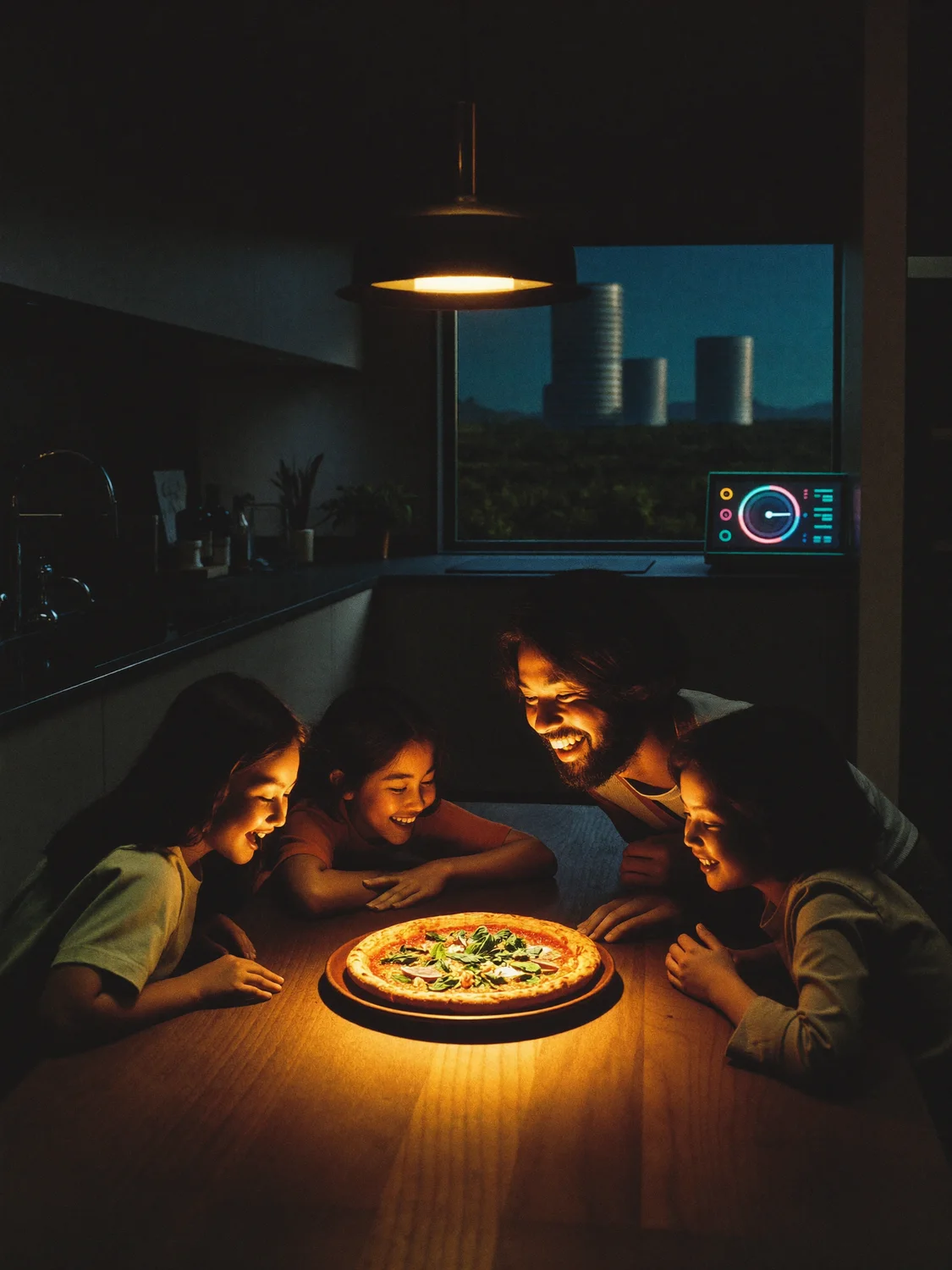
Friday night in the Brown household still means Pizza Friday. The tradition has survived two generations, three kitchen upgrades and one food-system revolution. Cassie Brown — who was a teenager when this ritual started, back when supermarkets were the size of stadiums — now runs it for her own kids.
What changed is not the pizza. It's the hunger.
All week, the family's metabolic companions have kept appetite where each of them set it: a quiet variable, like room temperature. Nobody snacks, because nobody wants to. Food arrives as it's needed — dense, precise, composed by the kitchen from each person's glucose curves, gut flora and training load. Her son calls it "fuel", without resentment, the way you'd talk about electricity.
But on Friday afternoon, the household dashboard shows the weekly event everyone actually waits for: Appetite On, 19:00.
By seven, the dials are up and the Browns are hungry — genuinely, gloriously, old-fashionedly hungry. The pizza is small by her grandmother's standards, and it is magnificent: heritage-wheat crust from the co-op's hot-summer strain, tomatoes bred for a climate nobody planned for, protein cultured in the vats out back of the old brewery. Her daughter closes her eyes at the first bite. This is what Fridays are for.
Cassie remembers her mother Lisa explaining, decades ago, that people once ate like this by accident — three times a day, every day, pushed by an industry engineered to keep them wanting. The kids never believe that part. An industry built on making you hungrier? Come on, Mom. Who would build that?
She serves the last slice and doesn't answer. Some history you let the pesto carry.
// The science behind it
The needle that resets appetite
For seventy years, the modern food system was built on a single, unspoken assumption: human appetite is a constant. You can market to it, supersize it, engineer snacks to hijack it — but you cannot turn it down. In the mid-2020s, that assumption quietly died in a pharmacy.
GLP-1 agonists — Ozempic, Wegovy, Mounjaro, Zepbound, and now their oral successors — began as diabetes drugs and became, within five years, the first technology in history that adjusts human appetite at population scale. Tens of millions of people take them. One of the authors of this update is among them: diabetic, first on Ozempic, now on Mounjaro, watching his own relationship with food change from the inside — the noise of constant craving, which most people don't even notice until it stops, simply switched off.
What began as an injection is becoming an interface. Daily pills are replacing weekly needles; next-generation molecules add muscle preservation to weight loss; combination therapies target sleep apnea, heart disease, kidney disease, even addiction — early trials show GLP-1 users drinking less, gambling less, doom-scrolling less, as if the drugs turned down not just hunger but wanting itself. Pharma's best-selling products are no longer treating illness; they are tuning appetites. It is hard to overstate how strange, and how consequential, that is: for the first time in the history of our species, "how hungry do you want to be?" is a question with a dial attached — and hundreds of millions of hands are reaching for it.
An industry built on hunger meets a world without it
Now put yourself in the boardroom of a snack multinational. Your entire business model — shelf placement, portion inflation, reformulation for craveability, the sacred growth metric of "share of stomach" — assumes the dial doesn't exist. Then your own annual report starts listing appetite-suppressing drugs as a material business risk, because it must: retail data shows GLP-1 households cutting snack purchases by double digits, and every earnings call features an analyst asking the question nobody rehearsed for.
The industry's response, already visible, is the great inversion this chapter is really about. When customers eat less, the only way to grow is to make every bite worth more — nutritionally, and therefore commercially. Food giants are launching GLP-1-companion product lines: high-protein, high-fibre, micronutrient-dense, portioned for suppressed appetites. Formulation targets are flipping from "irresistible" to "sufficient". Marketing is pivoting from indulgence to performance. The companies that spent the twentieth century engineering hunger are now hiring metabolic scientists to engineer satiety — not out of virtue, but because the business model demands it. Volume is dying; density is the new growth.
Follow that logic downstream and it reaches the fields. An industry that sells fewer, denser calories needs different agriculture: more protein per hectare, more legumes and specialty crops, fewer commodity calories destined for ultra-processing. Insurers and public-health systems, having discovered that a monthly injection is cheaper than a lifetime of diabetes care, are becoming food-industry stakeholders — subsidising the needle today, and tomorrow, inevitably, the groceries that go with it. The prescription and the shopping list are converging.
What actually feeds us now
Meanwhile, the future-food revolution that filled the headlines of the early 2020s took a stranger path than promised — and taught a lesson every food innovator should tattoo somewhere visible: food tech succeeds in inverse proportion to how much it asks the eater to notice.
The insects arrived, but through the back door. Europe duly approved mealworms and house crickets for human consumption; shoppers shrugged, and the tabloids had their fun with "bug bread". A decade on, insect protein is a genuine industry — in aquaculture, poultry feed and pet food, where the customers don't read labels. The gigafactories of the insect pioneers feed the salmon on your plate, not the plate itself. The moths never made it into the pesto; they made it into the fish.
Cultivated meat collected milestones — approved in Singapore, then the United States, then Israel — and collided with thermodynamics: growing muscle in bioreactors at commodity prices proved brutally hard, and several pioneers downsized or pivoted while a handful of jurisdictions, protecting their ranchers, banned the product before it existed at scale. Plant-based meat, after its stock-market supernova, settled into a permanent but modest corner of the barbecue. The quiet winner was the least photogenic technology of all: precision fermentation, brewing animal-free dairy proteins, enzymes and fats that slip invisibly into everyday products. No manifesto, no disgust barrier, no press release — just ingredients, which is exactly why it works.
The quantified gut
The other half of this chapter's 2051 kitchen is already on your arm. Continuous glucose monitors — medical devices a decade ago — are now over-the-counter wearables; millions of people watch, in real time, what a bowl of white rice does to their bloodstream, and adjust. Personalised-nutrition services have turned "your microbiome is unique" from a research finding into a subscription business. Point your camera at a plate and an AI estimates the macros; your watch already knows the sleep debt and the training load; the loop from measurement to meal is closing fast.
The gut itself is next. Microbiome science, oversold in its first hype cycle, is maturing into medicine: engineered probiotics designed to manufacture specific molecules in situ, faecal transplants normalised from taboo to therapy, and early trials of bacteria tuned to modulate mood, immunity and weight from inside. The intestine is turning out to be a programmable organ — a second pharmacy we all carry — and food is its user interface.
Assemble the pieces — the appetite dial, the glucose trace, the AI meal-planner, the kitchen that orders its own groceries — and the fiction above stops looking like fiction. Every component of the Browns' Friday exists in 2026 as a product; what's missing is only the integration, and integration is the one thing the consumer-tech industry never fails to deliver. The kitchen is becoming the terminal of the health system: the place where your data, your pharmacy and your dinner meet. The twentieth century medicalised the hospital; the twenty-first is medicalising the fridge.
Feeding nine billion on a hotter planet
All of this plays out against the backdrop that now shadows every chapter of this book: the climate has stopped being a forecast and become a grocery bill. The last few years delivered the food shocks in preview — cocoa prices exploding after failed West African harvests, coffee and olive oil turning into semi-luxuries, wine belts sliding north, staple harvests whipsawed by drought and flood. And where climate didn't disrupt supply, geopolitics did: a war between two grain superpowers turned wheat and fertiliser into strategic weapons, blockaded corridors repriced bread across Africa and the Middle East, and attacks on shipping lanes reminded every supermarket buyer that "just in time" assumes a peace nobody can guarantee anymore. Food security, a phrase from history books, is back in ministerial job titles.
Beneath the surface of every one of those shocks runs the ingredient nobody prices honestly: water. Agriculture drinks seventy percent of humanity's freshwater withdrawals, and the aquifers under the world's breadbaskets are dropping year on year while the glaciers that feed Asia's great rivers retreat. The next food crises will be announced not by empty shelves but by empty reservoirs — and the response is already reshaping what grows where: drip irrigation and soil sensors squeezing more crop per drop, desalination finally cheap enough to farm with in the Gulf and the Levant, and a quiet reckoning with the absurdities of the old trade map, in which drought-stricken regions exported their scarcest resource embedded in thirsty crops. By 2051, "virtual water" — the water content of traded food — will be negotiated as explicitly as carbon is today.
The response is a quiet redesign of agriculture itself. Gene-edited crops — drought-tolerant, disease-resistant, faster-breeding — are being fast-tracked by regulators who spent decades saying no to their GMO ancestors; necessity has a way of updating ideology. Farmers are replanting for climates their grandparents wouldn't recognise. The vertical-farming bubble burst on the economics of cheap lettuce, but its survivors found their real market: growing the fragile and the local where outdoor agriculture has become a gamble. And nations burned by blockades are re-shoring calories the way they re-shored chips — treating protein fermenters and seed banks as critical infrastructure. The food system of 2051 is being designed right now, and its guiding principle is no longer efficiency. It is resilience.
The trial of the ultra-processed
While pharma was tuning appetite down, the other end of the food system went on trial. "Ultra-processed food" escaped the nutrition journals and became a household accusation — the label for the engineered, shelf-stable, irresistible products that make up more than half the calories in many Western diets. The scientific case hardened link by link: associations with obesity, diabetes, depression, dementia; experiments showing people eat hundreds of calories more per day when the food is engineered to be effortless. And then came the lawyers, with a playbook everyone recognised: the tobacco playbook. Suits alleging that food companies knowingly engineered addictive products and marketed them to children; internal documents subpoenaed; the same firms, in some cases literally, that once defended cigarettes.
Governments moved from nudging to labelling to banning: warning labels on packages across Latin America, marketing restrictions aimed at children, ultra-processed products pushed out of school canteens, national dietary guidelines rewritten around degree of processing rather than grams of fat. None of this, alone, changes what's on the shelf. But combined with the GLP-1 shock — customers who can't be overfed meeting products that are being sued for overfeeding — it forms a pincer the industry cannot lobby its way out of. The reformulation wave now under way is not virtue; it is settlement risk management. And it is exactly how the pizza in this chapter's fiction becomes possible: not because indulgence dies, but because the default food of daily life is being forced, ingredient by ingredient, back toward something a body can trust.
The kitchen that cooks
The last piece of the 2051 dinner is the room it happens in. The kitchen — the most manual, most stubborn workshop in the modern home — is finally being automated from both ends. At the appliance end: combination ovens that identify the dish and steer the cook, countertop machines that ferment, sous-vide and pressure-cook on schedule, robot arms in restaurant kitchens flipping and frying through the labour shortage that never ended. At the software end: the meal itself is becoming computable. Recipes stop being documents and become programs — parameterised by who is eating, what the sensors say, what's in the pantry, what the metabolic companion recommends — compiled nightly into shopping lists the household agent fills automatically.
Food printing, that perennial demo, found its real niches too: not printing your dinner, but printing precision — texture-modified meals for hospitals and elder care, where dysphagia makes ordinary food dangerous; personalised nutrient dosing pressed into a morning bite; cell-cultured fat marbled into plant proteins one voxel at a time. The lesson repeats: the technology wins where it disappears into a need. By 2051, "cooking" splits the way "photography" did — an everyday automated function everyone uses without thinking, and a beloved human craft practised on weekends, on purpose, with flour on your hands. Cassie Brown does both. Her kitchen does the feeding; she does the pizza.
The road to 2051
Put the pieces together — the appetite dial, the density economy, the invisible proteins, the quantified gut, the climate-proofed fields — and the destination comes into focus:
Food becomes healthcare's delivery mechanism. The meal and the prescription merge; your kitchen composes both, and your insurer helps pay for the vegetables the way it now pays for the injection.
Appetite becomes a setting. What today's drugs do bluntly, mid-century successors will do precisely and reversibly. Hunger stops being fate and becomes choice — and, as with every automated instinct, the old default becomes an experience people schedule on purpose.
Agriculture flips from volume to density. Fields planted for protein, fibre and micronutrients per hectare rather than raw calories; food giants restructured into something a pharmacist would recognise; climate resilience priced into every seed.
Eating splits into fuel and feast. Daily nutrition — optimised, composed, barely noticed. And the feast — social, sensory, gloriously inefficient — protected precisely because it no longer has to do the feeding.
And pleasure survives. It always does. The Browns' pizza is smaller than yours, and they want it more than you have wanted anything all week. In a world where nutrition is solved, the point of dinner finally becomes what it always secretly was: the people at the table.
// 2021 → 2026 verdict
2021 verdict: Probability 99/100 — for insect pizza and personalised plates. 2026 reality: half right, for the wrong reasons. Nutrition did get personal — but the revolution arrived by needle and sensor, not by mealworm. The moths stayed out of the pesto; the future got in anyway.
This chapter was rewritten in 2026 by Brice × Claude Fable5. Read the original 2021 edition — written entirely by humans, published one year before ChatGPT existed.