06Agriculture· 2026 edition
Give a man a Crispr and he’ll eat forever
// A story from 2051
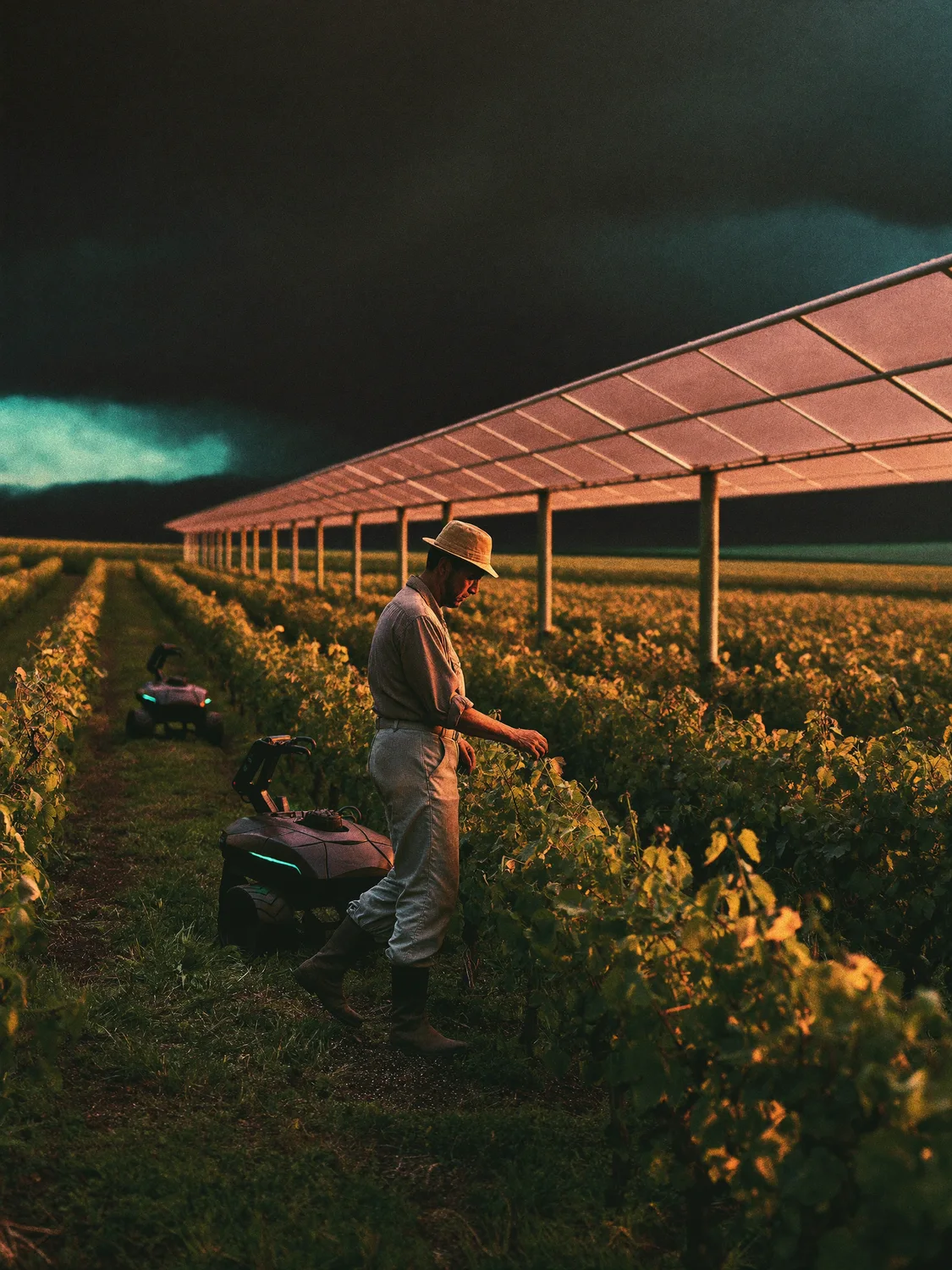
Tom is munching on a Blue Java banana — grown eleven kilometres away, in the old ferry terminal — and watching a storm front cross the North Sea on the wall of his farm office. The light in the room is faintly pink: the agrivoltaic canopies over his vineyard tune themselves through the day, sharing photons between the panels and the fruit, and at this hour they cast everything in rosé.
His vineyard. Flemish Chardonnay, four hundred hectares of it, on slopes his grandfather grazed dairy cattle across back when Belgium was too cold and too wet for serious wine. The climate that ruined Burgundy made Flanders a terroir; Tom's cuvées now sell to the same Parisian cellars that once wouldn't return his region's calls. The vines themselves are the pride of the appellation and the scandal of its purists: edited lines, mildew-resistant and heat-tolerant, that haven't seen a fungicide in a decade. The "naturals" across the border spray copper on their heritage clones and call his wine software. His wine wins the blind tastings. Both facts go in the brochure.
At 6:40, the farm wakes up around him. Ninety-one machines report in: the vine-row crawlers with their needle-dose sprayers, the harvest swarm charging under the panel canopy, the soil probes murmuring their moisture ledger from sixty centimetres down, the two old autonomous tractors he keeps out of sentiment, and the scarecrow drones the starlings long ago stopped believing in — though they still perform their patrols with what Tom swears is professional pride. His agronomist reports too — the patient, weatherworn AI that knows every one of his 1.9 million plants individually, holds forty years of his family's field notes, and speaks to him, at his own request, with his grandfather's turns of phrase.
It is harvest week — the fifty-first of his career — and the storm changes everything. The model's recommendation is unambiguous: pick the entire estate in the next thirty hours, before the hail risk crosses seven percent. Sugar at 12.9, acidity good, a clean, safe, excellent vintage. Certainty: 94 percent.
Tom stands at the window for a long moment, eating his blue banana.
Then he does what he does every year, the thing no succession of models has ever managed to train out of him. He splits the bet. The volume blocks — pick now, all swarms, full speed; the machines will finish in a day. But the four hillside hectares of the grand cru, the ones on the old pasture where the soil carbon runs deepest — those wait. Thirty-six more hours of hang time, under open sky, against the odds. His grandfather called it the only vote a farmer really gets.
The agronomist logs the override without comment. It has learned that, too.
Outside, the swarm fans out between the rows in the pink light, silent except for the snip of a thousand small shears. Tom finishes the banana, files the peel in the digester, and pulls on his grandfather's boots — because some part of every harvest, in every century, still has to be walked.
// The science behind it
The decade the weather broke the table
For most of modern history, agriculture's central promise was boring reliability: whatever happened in the world, the shelves refilled. In the mid-2020s, that promise developed visible cracks. Cocoa prices quadrupled after failed West African harvests; olive oil doubled and became a locked-cabinet item in some supermarkets; coffee, rice and wheat each took their turn as the crisis crop of the season. None of these were freak events. They were the new baseline announcing itself: the stable Holocene weather that agriculture was designed around — every planting date, every variety, every insurance table — is gone, and farming's operating system is being rewritten in real time.
The map is redrawing itself with almost cinematic literalism. Wine — the most climate-sensitive crop we grow, agriculture's canary — is migrating north at a pace measured in postcodes per decade: English sparkling wine now beats Champagne in blind tastings, Belgian and Dutch vineyards multiply yearly, while the historic regions of southern Europe fight harvest dates their grandparents would call absurd. What wine does loudly, everything else does quietly: maize creeping into Scandinavia, chickpeas into Germany, the whole atlas of "what grows where" sliding poleward and uphill. Adaptation is no longer a chapter in the sustainability report. It is the business plan.
And underneath it runs the resource arithmetic this book returns to again and again: agriculture drinks seventy percent of extracted freshwater, occupies half the habitable land, and emits roughly a quarter of greenhouse gases — while needing to feed two billion more people by mid-century. The twentieth century solved food with more: more land, more water, more chemistry. The twenty-first has to solve it with better — and "better", in farming, now has three names: data, robots, and genes.
The robot takes the wheel
Start with the machines, because they have stopped being prototypes. The autonomous tractor is a commercial product ploughing real fields in Illinois and Beauce alike; the driver's seat, agriculture's defining workplace for a century, is becoming optional. Camera-and-AI sprayers distinguish crop from weed at highway speed and dose herbicide plant by plant — cutting chemical use by the double-digit percentages that regulation kept demanding and chemistry kept failing to deliver. Harvest robots, for years a conference joke about squashed strawberries, now pick fruit commercially through the night in polytunnels from Kent to California, their fingers gentler than a tired human's at hour nine.
The economics driving them is not, mostly, wage arithmetic — it is absence. Across the rich world, the seasonal labour that harvests actually depend on has been squeezed between hostile migration politics and generational flight from field work; crops have rotted in place for want of hands in California, Ontario and East Anglia. The robot arrived not to undercut the picker but to replace the picker who no longer comes. And with it arrives a structural inversion worth pausing on: when the constraint on farm size was management attention, land consolidated into ever-bigger holdings; when a swarm can tend each plant individually, the economies of scale flatten. The robot makes the four-hundred-hectare estate manageable by one person — and it also makes the four-hectare specialty plot economically sane again. Both futures are being funded.
An agronomist in every pocket
But the deepest agricultural technology of the decade is the least photogenic: advice. Two-thirds of the world's farms are smallholdings, most of them under two hectares, farmed by families who have never once spoken to a trained agronomist. Their yield gap — the distance between what their land produces and what it could — is the largest untapped food reserve on Earth, bigger than any technology's promised gains.
That gap is now being attacked by the same leapfrog that brought the Global South banking-by-phone and tutoring-by-phone: the AI agronomist. A farmer in Bihar or Kisumu photographs a diseased leaf and gets a diagnosis, in dialect, in seconds; satellite passes tell her when to irrigate before the soil tells her too late; market and weather intelligence that once belonged to commodity traders arrives free on a five-year-old Android. The early results mirror the education chapter's: modest per-farm, staggering in aggregate, and most transformative exactly where the baseline was barest. If the 2030s close even a third of the smallholder yield gap, that alone outweighs every vertical farm ever built — a sentence this book's authors intend as arithmetic, not rhetoric.
Editing the harvest
Then there are the genes — the technology this chapter is named for, and the one whose politics flipped fastest. For twenty-five years, Europe led the world in refusing genetically modified food; the argument was cultural, precautionary, and apparently eternal. What broke it was not a public-relations campaign. It was the difference between transgenesis and editing — CRISPR's scalpel making changes indistinguishable from breeding, only decades faster — plus a war that spiked fertiliser and grain prices, plus the visible failure of old varieties under new weather. England passed its Precision Breeding Act; the EU, after years of trench warfare, moved to spring gene-edited crops from its GMO regime; Japan simply started selling health-optimised edited tomatoes. The question shifted from whether to edit the food supply to who gets to, and under what label — which is what normalisation looks like.
The pipeline says the 2030s belong to the edited harvest: wheat that shrugs off the rusts marching north with the heat; drought-tolerant maize already spreading through African seed systems; non-browning, longer-lived produce attacking the waste that consumes a third of all food grown. And the livestock side, for years the taboo half of the technology, went first where disease made the case unanswerable: pigs edited to resist the PRRS virus — a billion-dollar plague — approved for the American food chain; flu-resistant chickens in advanced trials while avian influenza, having jumped into dairy cattle and priced eggs like delicacies, makes the alternative to editing look less like caution and more like negligence. Nature is running an editing programme of her own, five mutations at a time. The argument that ours is the reckless one gets harder every season.
The vertical farming hangover
Honesty requires this section, because the 2021 edition of this chapter — like every optimistic text of that vintage — sang the skyscraper farm. The sector then delivered the decade's most instructive bankruptcy wave: the celebrated German pioneer whose in-store units graced a thousand supermarket aisles collapsed into insolvency; the American flagships that raised hundreds of millions filed one after another; the Appalachian tomato utopia became a securities-fraud case study. The physics never signed the pitch deck: when your sunlight comes from the grid, you are converting electricity into lettuce at a loss, and no software layer fixes thermodynamics.
Yet the technology didn't die — it found its actual niches, which is how hype cycles end. Vertical farms thrive where their two advantages, water efficiency and location, outweigh their one crushing cost, energy: leafy greens and strawberries in the Gulf, Singapore's food-security stack, herbs beside Nordic hydropower, pharma-grade plants where control is the product. And the sector's real legacy scattered into the wider industry: the LED recipes, the sensor stacks, the growing algorithms now standard in the greenhouses — the Netherlands' giant glass city foremost — that quietly produce a meaningful share of Europe's vegetables at energy budgets the towers never matched. The lesson, twice-taught in this book already: agtech wins where it disappears into the economics, not where it poses for the rendering.
Soil, and the politics of the field
The most consequential farm technology of 2051 may be the oldest: soil. The regenerative playbook — cover crops, minimal tillage, diverse rotations, livestock reintegrated as fertility engines rather than feedlot inmates — moved in a decade from fringe to farm-ministry policy, pulled by a seductive promise: healthy soil yields better under stress, holds water like a sponge, and banks carbon by the gigatonne. Food giants now pay premiums for regeneratively grown inputs; carbon markets, after a rocky, fraud-flecked adolescence, are learning to measure soil carbon by satellite and spectrometer instead of consultant's estimate.
But the decade also taught, at tractor-blockade scale, that agricultural transition is politics before it is agronomy. The farmer protests that gridlocked European capitals in 2024 — manure on ministry steps, motorways closed from Berlin to Brussels — were about many things, but underneath ran one message: the men and women being asked to re-engineer the food system are the least profitable, most indebted, fastest-aging link in it. Green requirements were rolled back within weeks; every subsequent reform has been negotiated rather than decreed. The lesson for 2051 is not that sustainability loses — it is that it must be bought, with income, insurance and respect, from the people who own the land. Any chapter about farming's future that forgets the farmer's bank account is fiction of the wrong kind.
Inputs, reinvented
Behind every harvest stands a supply chain of inputs the eater never sees, and the 2020s shocked it into reinvention. The war in Ukraine — fought between two of the world's great grain and fertiliser powers — sent synthetic nitrogen, natural gas's edible cousin, into price spirals that bankrupted farms from Ghana to Sri Lanka and reminded every government that Haber-Bosch is both civilisation's foundation and a strategic vulnerability. The response is a quiet input revolution: engineered microbes that fix nitrogen on cereal roots, shaving percentages off synthetic demand and improving yearly; biologicals — living pesticides and fungicides — as chemistry's patent cliff meets regulation; feed additives that cut cattle methane by a third, rolling out through dairy systems under climate law; and precision fermentation brewing the proteins, enzymes and vitamins that once demanded their own crops and herds. The fertiliser bag and the chemical drum, agriculture's twin twentieth-century icons, are being replaced by something closer to a microbiome — designed, brewed, and increasingly, edited.
Farming the unfarmable
Meanwhile the field itself is escaping its old definitions. Agrivoltaics — Tom's pink panels — went from research plots to gigawatts: crops and solar sharing land, panels shading lettuce through heatwaves and paying the farm's bills through drought, the same hectare harvested twice. Deserts host tomato farms watered by solar desalination in the Gulf and the Negev; salt-tolerant rice, bred and edited, plants coastal deltas that rising seas were stealing from cultivation — China alone counts its saline-soil programme in millions of hectares. And off the land entirely, the ocean farm scales: seaweed and shellfish, crops that want no freshwater, no fertiliser and no field, absorbing carbon and nitrogen while producing food, feed and packaging. The 2021 edition called this section "planting the unplantable". The 2026 reality is plainer: arable is no longer a category of land. It is a category of engineering.
The end of anonymous food, for real
The last promise of the 2021 edition — total transparency, blockchain from bean to burger — arrived, but through different plumbing. The blockchains mostly retired to the conference circuit; what shipped instead was regulation with satellites behind it. Europe's deforestation law requires geolocated proof that coffee, cocoa, soy and beef touched no cleared forest; digital product passports are extending the principle from batteries toward food; and orbital monitoring — the same eyes that watch Tom's vines — now watches the Amazon's cattle frontier with commodity-trader resolution. Provenance stopped being a marketing story and became a customs requirement.
The consumer half of the promise matured too, with a twist. The generation that was supposed to interrogate every barcode does — but it delegates the interrogation. The household agents of chapter three read the passports, apply the family's values — carbon ceiling, water footprint, no forced labour, this region's wheat — and filter the basket automatically. Anonymous food is ending not because every shopper became an auditor, but because every shopper acquired one. For producers, the consequence is bracing: in a world of machine-readable provenance, the premium goes to farms with nothing to hide and a story worth telling — and Tom's grand cru gamble, logged, timestamped and walked on foot, is exactly the kind of story the passports were built to carry.
Meat's two futures
No part of agriculture concentrates its dilemmas like livestock: forty percent of farm output by value, the livelihood of a billion people, the emissions problem, the land problem, the water problem — and the thing two billion rising consumers most want more of. The 2020s clarified the endgame, and it is not the one either camp campaigned for. The abolitionists' bet — that bioreactor meat would simply replace the herd — collided with scale-up economics and pre-emptive bans; a decade on, cultivated meat is real, approved on three continents, and still a boutique ingredient hunting for its cost curve, likeliest to arrive first as an invisible component — cultivated fat lending real flavour to plant proteins — than as a rib-eye. The traditionalists' bet — that nothing would change — is faring no better: methane now sits inside national climate accounting, Denmark has legislated the world's first livestock carbon tax, and the feed additives that cut enteric emissions by a third are becoming as standard as vaccination.
What is actually emerging is the split this book keeps finding: fewer, better animals. Precision livestock farming — the health trackers, breath analysers and welfare sensors trickling down from human medicine exactly as predicted — turns the herd from anonymous biomass into monitored individuals; edited disease resistance removes the plagues that made industrial confinement both cruel and fragile; pasture returns as carbon policy, with silvopasture — cattle grazing among fodder trees — promoted from permaculture curiosity to subsidised climate practice. The meat of 2051 sorts into the pattern of every chapter: an everyday tier increasingly hybrid, blended and partly cultivated, and a premium tier of pastured, provenanced, unmistakably animal meat — rarer on the plate, better on every metric, and priced like the occasion it becomes. The "cytovores" the 2021 edition coined will exist. So will the Sunday roast. They will often be the same person.
The water ledger
If carbon was the account the world learned to keep in the 2020s, water is the one agriculture will be forced to balance by the 2030s. The signs are already legal, not merely hydrological: the Colorado basin states negotiating cuts that retire farmland by the hundred thousand acres; India's breadbasket states rationing the free electricity that empties their aquifers; Spain and Morocco trading diplomatic notes over shared rivers while their orchards compete for the same rain. Groundwater — the invisible savings account that made the twentieth century's food miracle possible — is being drawn down on every continent, and unlike weather, its depletion has no good years.
The response stack is known and, finally, spreading: drip and precision irrigation, still used on a minority of the world's irrigated land, doubling water productivity where it lands; soil-moisture sensing and AI scheduling shaving the guesswork that wastes the rest; drought-tolerant and shorter-cycle varieties reducing the demand side; and, at the frontier, water markets on the Australian model — tradeable, capped, audited allocations that price the resource farming always treated as free. Expect the provenance passports of the previous section to grow a water line: litres embedded per kilogram, disclosed like calories. When they do, the geography of what grows where will shift again — because exporting almonds from a desert, once the market can see it, becomes as untenable as exporting deforestation.
Farming as risk management
Put weather volatility, price volatility and a leveraged balance sheet together and modern farming's true product becomes visible: managed risk. The decade's quiet revolution here is parametric insurance — policies that pay automatically when a satellite-verified trigger fires (rainfall below threshold, heat above it, wind past a speed), no adjuster, no dispute, cash in days instead of seasons. For smallholders, bundled a few cents at a time into seed purchases and phone credit, it is the difference between a bad season and a lost farm; for governments, sovereign drought bonds and regional risk pools — Africa's mutuals foremost — turn famine response from charity appeal into contractual payout.
The same modelling that prices the risk also shrinks it: the AI agronomist's real gift to Tom is not the picking date but the probability distribution behind it — hail risk by hour, disease pressure by block, price forecast by cellar. Farming has always been a bet placed with the sky; what changes by 2051 is that the bet is finally priced, hedged and shared by institutions built for it, rather than carried alone on the oldest shoulders in the economy. The catastrophic-loss farm bankruptcy, that staple of rural tragedy from Steinbeck to the evening news, is on its way to becoming what famine already is: not extinct, but an indictment of governance rather than an act of God.
The invisible harvest
A third of all food grown is never eaten — a statistic so obscene it reads like a typo, and the cheapest "new farmland" on Earth. The waste splits by wealth: rich countries discard at the shelf and the fridge, poor countries lose at the field and the road, and both are finally being engineered. In the Global South, the cold chain — the humble solar-powered cool room at the collection point — saves more food per euro than any technology in this chapter, and its spread tracks rural electrification like a shadow. AI grading rescues the crooked carrot that cosmetic standards condemned; dynamic pricing clears the shelf before the date does; and the dates themselves — the "best before" fictions that bin mountains of edible food — are being replaced by sensor labels that report actual spoilage instead of lawyerly guesswork.
By 2051, the arithmetic compounds: halving waste feeds roughly a billion people from fields already planted, with water already spent and carbon already emitted. No gene needs editing, no robot needs charging. It is the least glamorous section of this chapter and, per calorie, the most important — which is, by now, this book's most reliable pattern.
The pollinator's price
One dependency underlies a third of the crops in this chapter and appears on no balance sheet: pollination. The insect collapse documented across Europe's reserves — three-quarters of flying biomass gone in a generation — is not a nature-documentary lament; it is an input crisis for every orchard, berry field and seed crop on the continent. The 2020s' responses ran in two directions at once, and their contrast is instructive. The engineering path builds substitutes: managed hive logistics at industrial scale, pollination drones and robo-bees that work almond bloom in demonstration orchards — ingenious, headline-friendly, and hopelessly uneconomic against an animal that works for nectar. The ecological path re-engineers the farm instead: flower strips and hedgerows as subsidised infrastructure, pesticide classes retired — Europe's neonicotinoid bans the precedent — and habitat corridors stitched through monoculture.
The verdict, unusually for this book, is lopsided: the robot bee lost, the hedgerow won. By 2051, pollinator habitat will be priced into farmland like drainage — a utility you maintain because the alternative is renting what nature did free. And the broader principle generalises: biodiversity is becoming an input, audited by the same satellites and passports as carbon and water. The farm of mid-century is not a factory that happens to be outdoors. It is a managed ecosystem with a P&L — and the managers who grasp the difference are already outperforming the ones who don't.
The feeding belt
The vertical-farm hangover left one urban question standing: what is the city's role in feeding itself? The answer consolidating by 2026 is neither the skyscraper lettuce of the brochures nor the old model of total dependence, but the belt: peri-urban intensive agriculture — greenhouses, polytunnels, rooftop operations with free sunlight, market gardens on the metropolitan fringe — supplying the perishable fraction of the urban diet from within an hour's drive. Singapore, the densest test case, pursues its thirty-percent-by-2030 target through exactly this portfolio logic: high-tech greenhouses and aquaculture for resilience, imports for staples, verticals only where their economics close. Paris re-legalising urban agriculture across its rooftops, Gulf cities ringing themselves with solar-desalinated greenhouse acreage, Chinese megacities mandating vegetable self-sufficiency ratios — the pattern is the same everywhere: cities don't need to grow their calories, which travel well; they need to grow their freshness, which doesn't. Chapter three emptied the city's shops; this chapter rings it with growers. The metropolis of 2051 eats its grain from a continent away and its salad from the ring road — and both supply chains, for the first time, will be able to prove it.
Who will farm?
One question shadows every scenario in this chapter: the farmer is disappearing. Across the developed world the average holder is nearing sixty; successors decline the inheritance; the barrier to entry — land prices inflated by investors, sovereign funds and solar developers — locks out the young who do want in. Farmland has become a strategic asset class, purchased by states and pension funds with the same logic as chip fabs, while the people who actually work it retire without replacement.
The resolution taking shape is double. The industrial core automates: fleets, models and contractors managing consolidated acres with skeleton human crews — the Toms, one per valley, part agronomist, part fleet manager, part ecologist. And around that core, a counter-current the 2021 edition intuited: a new peasantry by choice — career-changers, climate-motivated young families, the beneficiaries of chapter three's rural renaissance — running small, intense, high-touch farms serving their regions at premium prices, viable precisely because robots handle the drudgery and provenance passports monetise the care. Industrial abundance and artisanal meaning, the same split this book finds in art, in food, in film. Agriculture, which invented civilisation's original division of labour, is being divided one more time.
The seed vault and the patent office
Every edited harvest raises the oldest question in agriculture wearing new clothes: who owns the seed? The twentieth century answered with consolidation — four companies controlling most of the world's commercial seed and the chemistry sold alongside it — and the editing revolution threatens to deepen the lock: a gene conferring drought tolerance is worth more than any single harvest it saves, and the patent filings say every player knows it. But the counter-currents are real this time. Open-source seed initiatives publish edited traits into legal commons the way software licences once freed code; public breeding programmes, hollowed out for decades, are being refunded as food-sovereignty policy from Nairobi to New Delhi; and the CRISPR patents themselves, tangled in a decade of litigation, have made exclusive control look more fragile than the incumbents hoped.
Beneath the legal fight sits the physical one: diversity itself. The Svalbard vault now holds over a million accessions under the permafrost — civilisation's seed backup, drawn on once already by a war-torn gene bank — while field collections guard the wild relatives whose genes keep bailing out their pampered descendants. The salt tolerance, the heat shrug, the disease indifference that editors splice into elite varieties are rarely invented; they are found, in landraces and weeds and forgotten cousins conserved by exactly the smallholders and public banks the market undervalues. The strategic resource of 2051 agriculture is not the editing tool, which is cheap and everywhere. It is the library of things worth editing in — and the fights over who holds its keys, and who gets paid when a Mexican landrace rescues a Kansas harvest, will make the century's other IP wars look polite.
What the wild still knows
Which points to the deepest correction the 2020s made to Agriculture 4.0 triumphalism: the factory metaphor fails at the edges, and the edges are where the century will be decided. The most resilient systems in the coming volatility are consistently the most diverse ones — the polycultures that lose one crop and keep three, the agroforestry systems whose canopies buffer the heat that flattens open fields, the heterogeneous landscapes that host the predators, pollinators and microbiomes monoculture must purchase as services. Agroecology, long dismissed as romance with a manifesto, keeps producing the awkward data: comparable calories, superior nutrition per hectare, and failure modes that degrade gracefully instead of catastrophically.
The future this book bets on is therefore not a winner-take-all between the swarm and the hedgerow, but their merger — precision tools deployed on ecological architecture. Tom's estate is the sketch: edited vines and deep-carbon pasture soils; robotic needle-dosing and flower strips the sensors route around; an AI that optimises and a farmer who overrides. Call it what the agronomists are starting to: high-tech agroecology — the factory's eyes with the forest's redundancy. It is the only version of Agriculture 4.0 that survives contact with the sky.
The road to 2051
The farm runs itself; the farmer decides. Autonomous fleets and AI agronomists handle execution; the human holds the overrides, the ethics and the bets. One farmer to a valley — and, for the first time in a century, new smallholders moving in rather than out.
The harvest is edited. Climate-proofed, disease-resistant, waste-resistant crops and livestock as the unremarkable norm; "unedited heritage" as the labelled, lucrative exception — agriculture's vinyl.
Inputs become biology. Nitrogen from microbes, protection from biologicals, protein from fermenters; the chemical age of farming closes the way the coal age of energy did — slowly, profitably, and then suddenly.
Every calorie carries a passport, read by machines, audited from orbit, priced by provenance. Anonymous food goes the way of anonymous finance.
And the sky keeps the last vote. Everything else in the system — the swarms, the models, the edited vines — exists to shrink the one gamble no technology retires: weather against harvest. Tom splits his bet because farming, alone among industries, still ends every year with the same ancient move: you do everything right, and then you look up.
// 2021 → 2026 verdict
2021 verdict: Probability 90/100 — Agriculture 4.0 as a well-oiled manufacturing industry. 2026 reality: directionally right, humbled in the details. The robots, the editing and the transparency all arrived ahead of schedule; the skyscraper farms went bankrupt on physics; and the decade's real discovery was political — the future of farming must be negotiated with the people who farm. Give a man a CRISPR and he'll eat forever. Give him a fair price, and he'll plant it.
This chapter was rewritten in 2026 by Brice × Claude Fable5. Read the original 2021 edition — written entirely by humans, published one year before ChatGPT existed.