07Energy· 2026 edition
Energy too cheap to meter
// A story from 2051
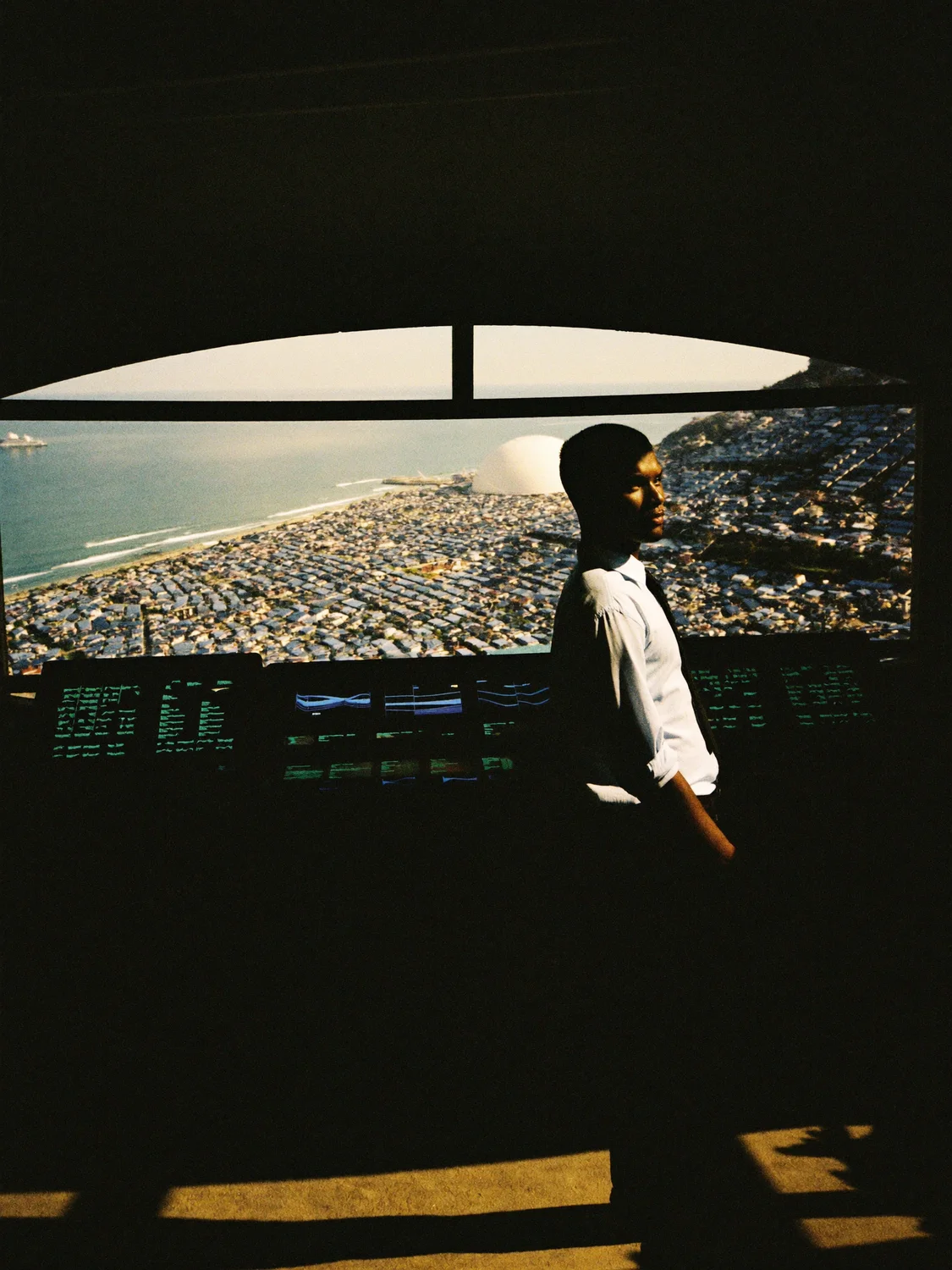
March 2051, 5 a.m. It's already a sweltering day in Durban — 39 degrees before sunrise, 75 percent humidity — and Mlungisi drinks his last kombucha standing in the light of the fridge, which quietly reorders it before the door swings shut.
He has half an hour, and one more kombucha's worth of quiet, before the biggest shift of his year. Mlungisi is a conductor — not of music but of megawatts: duty energy-master for the Moses Mabhida district, eleven city blocks that include the stadium dome, two hospitals, a vertical farm, the port's cold stores and the AI campus on the ridge. His job, on a day like today, is choreography. The morning belongs to scarcity: batteries drawn down overnight, the city sipping carefully, his dashboard amber. But in four hours the flood begins — the great daily tide his grandmother still refuses to take for granted.
She remembers Stage 6. She tells it like a war story, because it was one: the decade when South Africa's grid failed daily by schedule, when supper was cooked at fifteen minutes' notice and whole suburbs learned the candle again. She keeps a paraffin lamp on her windowsill the way other families keep medals. When Mlungisi was small she would point at the panels going up on every roof in KwaMashu — bought cheap from the endless Chinese boats — and say: count them. That is us, taking the sun back.
The paraffin lamp is not the only relic she keeps. Somewhere in a drawer lives the laminated load-shedding schedule for KwaMashu, Block 7, winter 2023 — Stage 6, four and a half hours of darkness, twice a day, printed in a font the whole country learned to hate. She makes every grandchild read it once, like a catechism. So you know what a kilowatt is worth.
By 9:40 the flood arrives on schedule. Two million rooftops, the solar farms marching up the Midlands, the panel canopies over every parking lot and reservoir — the province's meters stop counting, because between ten and four there is simply more electricity than anyone can bill. The dome drinks first: four seasons under one roof, the wave pool spinning up its solitons for the surfing final, the ice rink freezing down for tonight's match, ten thousand tonnes of cool banked into the walls for the evening. The AI campus wakes its training halls, which idled politely through the night, and begins selling its waste heat to the laundries and the desalination stacks. The RainDance powership sounds its horn in the harbour, batteries brimming, and turns north toward the drought coast with forty million litres of noon-made water.
Mlungisi's board goes green, then greener, then a colour the interface designers reserved for days like this. His actual work begins at 16:00, when the tide goes out and the city must land softly on its batteries — the daily descent his profession exists for, the hours when energy remembers its price.
At 11:58, his board pings with the day's small ceremony: the district's meters preparing to pause, the tariff sliding to zero, eleven blocks of the city inhaling the sun at once. And at noon exactly his grandmother calls, as she does every day, from a kitchen running every appliance she owns simultaneously — kettle, oven, washer, the ancient chest freezer she refuses to replace — her personal festival of abundance, her daily victory lap over the decade of darkness. "Free until four," she says, the way other people say grace.
"Free until four, Gogo," he answers, watching the flood come in.
// The science behind it
The cheapest energy in history
Somewhere around the middle of the 2020s, a line was crossed that historians of technology will treat the way we treat the steam engine: sunlight became the cheapest source of energy humanity has ever known — cheaper than coal, cheaper than gas, cheaper than anything that burns, in most of the inhabited world. The 2021 edition of this chapter dreamed of exotic saviours: thorium reactors, hydrogen valleys, flying wind turbines. The revolution that actually arrived was the least exotic technology on the list, manufactured at civilisational scale: the photovoltaic panel, its price in freefall for fifty straight years, its global deployment doubling on a rhythm that makes every official forecast look like satire within eighteen months.
The scale is genuinely hard to hold in mind. China alone now installs more solar capacity in a single year than the entire world possessed a decade ago; the panels pouring from its factories have become so cheap that they are used as garden fencing in the Netherlands. And the most telling deployments are the least planned: Pakistan's great rooftop rush, where businesses and households, exhausted by an expensive failing grid, imported gigawatts of cut-price modules in a single year and built themselves a parallel power system with no ministry in charge. That is the signature fact of the new energy era: solar is not merely clean power. It is retail power — the first generation technology cheap enough, small enough and safe enough for ordinary people to buy like appliances. Energy policy spent a century being something done to populations. It is becoming something populations do for themselves.
The battery decade
Sunlight's famous defect — it clocks off every evening — met its answer in the same factories. Lithium battery prices fell through floor after floor as iron-based chemistries took over, and grid storage went from curiosity to keystone in five years flat: the battery farms of California and Texas now soak up the afternoon flood and hand it back at dusk, flattening the evening peak that once defined the entire architecture of electricity. The duck curve — the graph that haunted grid engineers for a decade — is being tamed not by clever markets but by brute, cheap chemistry.
The same cells electrified the road. One in four new cars sold worldwide now plugs in; in China, the pivot country, it passed half — and the Chinese EV industry, led by champions the West barely saw coming, did to combustion engineering what its solar industry did to coal: made the incumbent look ornamental. Sodium-ion cells — no lithium, no cobalt, salt-cheap ingredients — are entering the market for stationary storage precisely where cost matters most, promising to do to battery prices what batteries did to peak power. None of this required a breakthrough. It required factories — which is the quiet moral of the entire energy transition: exponential manufacturing beats miraculous science, every time it's allowed to.
Intelligence is hungry
Then, just as supply learned to flood, a new demand arrived that nobody's forecast contained: thinking machines. After twenty years of flat electricity consumption in the rich world, the AI buildout bent the curve upward almost overnight — data-centre campuses drawing hundreds of megawatts each, gigawatt clusters on the drawing boards, utilities dusting off growth plans they had filed away in the 2000s. The companies of chapter one — the ones generating the art, the films, the conversation — turned out to be the energy story of the decade: intelligence, it emerges, is purchased in kilowatt-hours.
The clearest signal of the new order came from the hyperscalers themselves: they started buying power plants. Microsoft contracted to restart a reactor at Three Mile Island — a name that once meant the end of nuclear enthusiasm, now recommissioned to feed a cloud; Google and Amazon signed for fleets of small modular reactors; Meta optioned gigawatts of nuclear and solar alike. Electricity has become the binding constraint on the century's defining industry, and the phrase already circulating in 2026 boardrooms — compute is power — will read, by 2051, less like metaphor than like tautology. The nations that host the thinking will be the nations that mastered the watts; the energy transition and the intelligence transition are the same event, wearing two costumes.
The atom's second act
Which explains the strangest reversal of the decade: nuclear power, left for dead after Fukushima, is enjoying the most sincere rehabilitation in its seventy-year history. Germany's shutdown began to look, in retrospect, like the last act of the old era; elsewhere, life extensions became the norm, restarts moved from unthinkable to signed, and public opinion in country after country crossed back to favourable — driven less by advocacy than by arithmetic: firm, dense, carbon-free power turns out to be exactly what an electrified, AI-hungry grid prizes.
The build-out, as with everything in energy, is Chinese-led — dozens of reactors under construction on a cadence the West abandoned in the 1980s — while the West relearns. The small modular reactor, this book's 2021 darling, met its first economic reality check when the pioneering American project cancelled on cost overruns; the survivors sobered up, standardised, and signed their anchor customers among the data-centre buyers who don't flinch at premium prices for firm power. And the original edition's most romantic bet — the molten-salt thorium reactor, resurrected from Oak Ridge's archives by true believers — came literally true, in the one country that funds patience: China's experimental thorium molten-salt reactor in the Gobi desert achieved operation and even mid-run refuelling, the first of its kind in half a century. It remains an experiment, not an industry. But the 2021 edition would be quietly thrilled: the archive was right; it just needed a state that builds.
Fusion grows up
Fusion, meanwhile, made the leap that matters psychologically: from perpetual joke — "thirty years away, always" — to funded engineering program. The American ignition shots proved net energy from the physics; the private wave, led by the high-field magnet pioneers spun out of MIT, moved from papers to hardware with credible mid-2030s grid ambitions; a fusion startup even signed the industry's first power-purchase agreement — with, inevitably, a hyperscaler. Honesty requires the caveat the field's own leaders repeat: commercial fusion will arrive too late to lead the decarbonisation it was supposed to star in — solar and batteries took that role while fusion was in rehearsal. Its true destiny, visible from 2026, is the second half of the century: the dense, siteable, fuel-trivial power source for the megacities, the AI cantonments and — as later chapters will argue — the places sunlight can't follow. Fusion missed the transition. It will inherit the civilisation the transition builds.
Hydrogen finds its size
Now the correction this chapter owes its 2021 self most directly: the hydrogen economy — the Platinum Valleys, the home fuel cells, the hydrogen sedans — deflated. Not to zero: to its right size. The molecule lost every battle it fought against the electron: heat pumps routed hydrogen boilers, batteries routed fuel-cell cars, and the green-hydrogen megaproject pipeline, announced in the hundreds of billions, quietly cancelled itself project by project as the spreadsheet met the physics — electrolysis wastes energy that wires deliver whole.
What survives is the honest list, and it is not small: ammonia for fertiliser — civilisation's non-negotiable; the reduction of iron for green steel; long-haul shipping fuels; the chemical feedstocks no electron can replace. In those niches, hydrogen is not a dream but a procurement schedule, anchored where renewable power is absurdly abundant — the Gulf, Australia, and yes, Southern Africa, whose sun and platinum still write it into the story, if more modestly than the 2021 edition hoped. The lesson generalises across this book: technologies rarely die at the trough of their hype. They shrink to the truth.
The grid is the hard part
By mid-decade, the energy transition's real bottleneck was visible to everyone who looked past the panels: the wires. Interconnection queues in America and Europe held more capacity waiting for connection than the entire existing grid; transmission lines took fifteen years to permit and three to build; and in April 2025, the Iberian peninsula delivered the decade's great cautionary tale — a continent-class blackout that dropped fifty million people offline in seconds and turned grid physics into dinner-table conversation. The autopsy fed every agenda, but its durable lesson was neutral and profound: a grid built for a hundred spinning machines was being asked to run on a hundred million electronic ones, and the engineering of stability — inertia, storage, control — had to be rebuilt on purpose.
The rebuild is underway, and its shape is this chapter's title made precise. Storage and smart inverters are teaching solar-heavy grids to hold steady; dynamic pricing is teaching demand to dance — cars charging at noon, industries scheduling around the sun, households automated by the agents of chapter three to buy energy the way algorithms buy stocks. The endpoint, already visible in the sunniest markets where midday prices routinely touch zero, is the civilisation of Mlungisi's Durban: not energy too cheap to meter, but energy too cheap to meter at the right hours — a daily tide of near-free power around which the century will re-choreograph its work, its industry and its habits. The meter doesn't die. It learns to tell time.
War on the wires
The decade also taught, brutally, that energy infrastructure is a weapon and a target. Russia's invasion of Ukraine was an energy war twice over: the gas cutoff that shocked Europe into the fastest renewable pivot of its history — heat pumps as armament, panels as trench — and the missile campaign against Ukraine's grid, the first systematic attempt to unplug a modern nation, answered by the most heroic repair crews of the age and by a quiet global rethink. Centralised grids, it turns out, are magnificent and fragile; the distributed architecture the solar age enables — microgrids, islandable neighbourhoods, batteries in every basement — is not just economics. It is civil defence. From Kyiv's generator winters to the sabotaged cables of the Baltic seabed, the message of the 2020s is uniform: the century's infrastructure of freedom hums at fifty hertz, and nations will defend — and decentralise — it accordingly.
From petrostates to electrostates
All of which redraws the geopolitical map this book's readers grew up with. The twentieth century's power politics ran through oil chokepoints; the new ones run through supply chains — lithium, cobalt, rare earths, and above all the refining and manufacturing capacity that turns rock into batteries and panels, of which China built a decade's unassailable lead while the West was debating. The energy weapons of the 2020s made the shift legible: where once embargoes moved barrels, now export controls move minerals and machines.
But the deeper shift favours no cartel, and it is the most hopeful geopolitical fact of the century: sunlight is the first major energy source that is everywhere. No solar OPEC is possible. Every country with rooftops has reserves; the resource curse has no purchase on photons. The petrostates read the same forecast — hence the Gulf's frantic reinvention as solar exporter, hydrogen hopeful and AI host — and the mid-century equilibrium comes into focus: energy ceases to be something nations have and becomes something they build. Advantage flows to manufacturing scale, grid competence and political patience. It is a better basis for peace than geology ever was, which is not a high bar, and the century will test it.
The right to cool
One demand curve will shape the Global South's century more than any other, and Mlungisi's 39-degree dawn announces it: cooling. Air conditioning, a luxury for one billion people in 2020, is becoming a survival technology for four billion as heatwaves redraw the limits of the habitable day — and cooling demand is on track to rival today's entire electricity consumption of major economies. The catastrophe scenario — inefficient units, powered by coal, heating the planet to cool its rooms — is being fought on three fronts: efficiency competitions that doubled the performance of affordable units; passive design relearned from every hot culture's architecture, from wind-catchers to white roofs; and the elegant symbiosis of the problem with its solution — peak cooling demand and peak solar supply arrive, providentially, at the same hour. The right to cool will join the century's list of recognised necessities. Whether it arrives as burden or as showcase of the solar age is one of the biggest open bets in this book.
The leapfrog's second act
Which brings the chapter home to where its fiction lives. Africa — one person in six, one percent of installed solar at the decade's start — is the transition's greatest unfinished business, and its greatest optionality. South Africa's own arc is the parable: the state utility's decade of scheduled blackouts, Stage 6 as national trauma, answered not by the megaproject cavalry but by a bottom-up buying spree — households and businesses importing panels and batteries by the gigawatt, the way Pakistan did, the way Vietnam did before it. The grid of the unwired is arriving in pieces: minigrid clusters, pay-as-you-go solar sold like airtime, appliances engineered for scarce watts.
The continental stakes are the century's biggest energy question, full stop: Africa's population will near a quarter of humanity by 2051, its cities are being built now, and whether they are built around the tailpipe-and-coal model the rich world is abandoning or straight onto the solar-battery-electric stack is worth more carbon than every European policy combined. The ingredients — sun beyond any continent's, the minerals of the battery age, the youngest builders on Earth — are all local. The capital, so far, is not. The 2021 edition dreamed a South African energy fiction out of loyalty. The 2026 edition repeats it out of conviction: the solar century's centre of gravity ends up where the sun is.
The fleet becomes the grid
The hundred million electric vehicles arriving on the world's roads this decade carry a secret second identity: parked, plugged and pooled, they are the largest battery ever assembled — a distributed storage fleet dwarfing every grid installation on Earth, idle twenty-two hours a day. Vehicle-to-grid, a conference fantasy in 2021, crossed into product: cars that power the house through the evening peak and sell back to the network at dusk prices, fleets contracted as virtual power plants, school buses — the perfect V2G asset, parked all summer — backstopping small-town grids across the American pilot programmes. The car industry fought the idea for years (warranty anxieties, control anxieties) and then discovered it was a feature customers would pay for: the EV as blackout insurance sold itself after every storm.
Beyond the car, electrification climbs the weight classes on battery economics' escalator: delivery vans done, urban buses done — China's cities went first and quietest — heavy trucking crossing now on megawatt charging corridors, short-sea shipping and ferries following the Nordic lead. What resists — long-haul aviation, ocean freight — resorts to the chemistry set: sustainable fuels scaling slowly and expensively, ammonia engines for the sea trials, and a humbling reminder that some corners of the fossil world will be conquered last and dearest. The pattern holds regardless: transport, energy's most stubborn quarter-share, is converting from oil's captive market into the grid's most flexible customer — and its biggest battery.
Closing the loop
Every critique of the battery age eventually reaches the mine, and the decade's answer is taking shape in the scrapyard. Battery recycling graduated from pilot to industry on a simple discovery: a dead battery is richer ore than most rock — lithium, nickel and cobalt at concentrations no geology matches, pre-assembled in convenient packages. The recovery rates topping ninety-five percent in the best plants sketch the endgame: a circular materials economy in which, by mid-century, a majority of new battery metal is old battery metal, and the mining bulge of the 2020s–2030s is remembered as the one-time capitalisation of a permanent stock — civilisation buying its atoms once.
Second lives precede recycling: packs retired from cars at eighty percent health stack into stationary storage for another decade of gentler duty. And the loop's geopolitics may matter as much as its ecology: every tonne recovered at home is a tonne unbought from the refining monopolies, which is why "urban mining" features in industrial strategies from Brussels to Seoul. The resource curse of the electric age — such as it is — depreciates. Oil burned once. Lithium retires, and re-enlists.
The price of money, the price of sun
One more input decides how fast all of this compounds, and it is the least photogenic of all: capital. A solar farm or a wind fleet is fuel-free — its entire economics is the financing of its construction, which makes the interest rate the true fuel price of the renewable age. The rate shock of the mid-2020s proved it painfully, repricing offshore wind overnight while barely denting a gas plant's arithmetic; the corollary, rarely said aloud, is that central banks now sit among the great energy regulators of the century.
Which sharpens the injustice this chapter keeps circling: capital is cheapest where sun is scarcest. The two-tier financing world — rich-country projects funded at low single digits while African developers pay triple for the same panels under better skies — is the single largest misallocation in the entire transition, and fixing it (guarantees, currency hedges, development banks doing their actual jobs) would move more terawatts than any laboratory. The technologies of the solar century are solved and shipping. Its finance is not — and by 2051, the countries that mastered the funding of sunlight will matter as much as those that mastered its manufacture.
The last barrel's long goodbye
And the incumbent? Oil and gas enter the second quarter of the century in the strangest of states: record production, record profits in the shock years, and a horizon everyone can finally see. Peak oil — the demand version, not the supply scare of the 2000s — moved from heresy to base case in the official forecasts, dragged forward by Chinese EVs eating gasoline's growth market and by the petrostates' own behaviour, which speaks louder than their communiqués: sovereign funds diversifying at speed, national oil companies pivoting to petrochemicals — plastics as oil's retirement plan — and solar megaprojects rising beside the export terminals.
The endgame will be long, unequal and contested. Aviation and heavy chemistry will burn hydrocarbons for decades; the methane rules that could halve the industry's near-term climate harm are written but unevenly enforced; and every price spike resurrects the drill-baby chorus for a season. But the structural fact is settled and this book states it plainly: oil's second century will be a managed decline punctuated by profitable spasms — the business model of a very rich industry in a very long sunset. The interesting question for 2051 is not whether the barrel loses, but what the trillion-dollar machine built around it does with its final decades of cash flow. The wise ones are buying the future; the rest are buying back shares.
Wind's rough passage
Solar's sibling had a harder decade, and the difference is instructive. Offshore wind — Europe's pride, the planned backbone of the North Sea grid — sailed into a perfect storm of inflation, interest rates and supply-chain squeeze: auctions failed for lack of bidders, flagship projects cancelled, developers wrote down billions, and a politics hostile to turbines made every setback a headline. Onshore, the quiet workhorse kept building where permitted — but "where permitted" shrank as rural resistance organised across three continents.
The passage matters because wind is not optional: it is solar's night-and-winter partner, the other half of a renewable grid's heartbeat, and in the windy latitudes it remains among the cheapest electricity ever produced. The stabilisation is underway — reset auctions with honest prices, industrialised installation vessels, turbines standardised after a self-defeating size race, floating platforms opening the deep-water coasts of Japan, Korea and the Mediterranean. But the decade's lesson stands as a warning across this entire chapter: cost curves bend metal, yet the binding constraints of the energy transition are increasingly social — permits, ports, courtrooms and villages. The technologies are ready. The negotiation is not.
The efficiency dividend
The cheapest power plant of the century is the one never built, and the 2020s finally industrialised that cliché. The heat pump — a technology older than the transistor — became a geopolitical instrument the winter Europe weaned itself off Russian gas, tripling sales in the crisis years and proving that a device which moves three units of heat per unit of electricity beats any boiler ever made. Buildings, the sleepy half of energy demand, are being renovated under mandates that treat insulation as infrastructure; the LED conversion completed its silent conquest, deleting whole power stations' worth of lighting demand; and industry discovered thermal batteries — bricks and salts heated by cheap noon power, discharging process heat around the clock — turning the solar flood into steel-mill steam and cement-kiln heat.
Efficiency's deepest upgrade, though, is intelligence. The same optimisation that schedules Mlungisi's district now trims every large building's consumption by percentages that compound like interest; the household agents of chapter three haggle over tariffs their owners never read; and demand response — paying millions of devices to wait an hour — has become the grid's largest, cheapest, most invisible power plant. The unit of progress in energy used to be the gigawatt built. Increasingly, it is the gigawatt outwitted.
Storage beyond the evening
Lithium solved the evening; the century's remaining storage problem is the week and the season — the windless fortnight, the northern winter, the monsoon's other half. The contenders are sorting themselves by physics and price. Iron-air batteries — rust as a storage medium, dirt-cheap and gloriously slow — entered commercial deployment for multi-day duty; pumped hydro, the nineteenth-century champion, is enjoying a global renaissance measured in hundreds of projects; thermal storage banks summer heat for winter in Nordic district systems; and green ammonia positions itself as the strategic reserve — sunlight bottled in the Gulf and Western Australia, shipped and burned back to power in the dark months, the fossil trade's logistics reincarnated with a new molecule.
None of these will win alone; the seasonal problem dissolves into a portfolio — overbuilt solar so cheap that winter's fraction suffices, continental interconnection averaging weather across time zones, firm nuclear underneath, and reserves for the residue. The point for 2051 is that the problem is priced, not mysterious: every year the portfolio gets cheaper, and the last argument against the renewable grid — "but February" — is being retired line-item by line-item.
The heat beneath our feet
The decade's dark-horse entrant came, with poetic justice, from the oil patch. Enhanced geothermal — fracking's drill bits, steering and pad economics aimed downward at hot dry rock instead of hydrocarbons — moved from paper to producing plants in five years, and its first anchor customers were, inevitably, the data centres shopping for round-the-clock clean power. Unlike old geothermal, chained to volcanic luck, the enhanced kind works wherever the crust is hot enough deep enough — which is, with better drilling, almost everywhere; the roadmaps to superhot rock, where a single well rivals a small reactor, read like the early solar roadmaps did: implausible until you notice the cost curve already bending.
Geothermal's promise slots precisely into the system this chapter has assembled: firm, dense, dispatchable, sited where demand lives, staffed by the redeployed workforce of the industry it replaces. If fusion is the second half of the century's moonshot, hot rock is its safe bet — and for once, the incumbents' skills transfer whole. The rigs that built the petrostate may yet drill the electrostate's foundations.
Accounting for carbon
Finally, the ledger. The transition this chapter describes is racing a stock problem, not a flow problem: the carbon already banked in the sky. The 2020s brought the accounting era — carbon border tariffs making emissions a customs matter, disclosure rules dragging energy content into every annual report — and with it the first honest reckoning of the removal industry. Nature's offsets suffered their scandal years, as satellite audits (the same eyes watching Tom's forests in chapter six) exposed paper reductions; engineered removal — direct air capture — proved real but obstinately expensive, its pioneers scaling by grams while the gigatonne targets loomed; capture at the smokestack settled into its defensible niches, cement and steel, after a decade as the fossil industry's favourite alibi.
The sober consensus for 2051: removal is the cleanup crew, not the cavalry. Every credible path runs through the buildout this chapter describes — electrify everything, flood it with clean power — with removals reserved for the stubborn residue and the historical debt. The good news is the theme of the whole chapter: the cleanup crew, too, runs on cheap noon electricity. Every technology of repair inherits the solar dividend. Abundance, it turns out, is also the best remediation policy.
The road to 2051
Civilisation adopts the solar day. Heavy industry, computing, charging, cooling and desalination migrate into the daily flood of near-free noon power; evenings ride batteries; the energy-master conducting a district's daily tide becomes a profession as ordinary as air-traffic control.
Electricity becomes the universal currency — of mobility, heat, industry and above all intelligence. The kilowatt-hour is the input cost of thought, and nations rank themselves by clean terawatts the way they once ranked by barrels.
The atom splits into roles: fission — restarted, life-extended, modularised — as the firm backbone of the machine cities; fusion arriving from the 2040s as the dense successor, powering what the sun cannot reach.
The grid becomes plural: a continental backbone above, a million islandable microgrids below, warproofed and stormproofed by design, because the 2020s taught everyone what a single point of failure costs.
And the meter survives — as a clock. Energy too cheap to meter arrives exactly as predicted, six hours a day. The other eighteen are civilisation's remaining energy problem, and its remaining energy market. Mlungisi's grandmother, running every appliance at noon in ceremonial defiance, has the future's rate card exactly right.
// 2021 → 2026 verdict
2021 verdict: Probability 50/100 — hedged between hydrogen dreams and thorium romance. 2026 reality: the abundance arrived early, by the humblest door. Not hydrogen, not thorium — photovoltaics and iron batteries, manufactured like furniture. The exotic bets live on as second acts: thorium runs in the Gobi, fusion signs its first contracts. But the revolution came from the factory, not the laboratory — and it clocks in, every day, at sunrise.
This chapter was rewritten in 2026 by Brice × Claude Fable5. Read the original 2021 edition — written entirely by humans, published one year before ChatGPT existed.