09Healthcare· 2026 edition
Doctor AI will see you now
// A story from 2051
A typical morning in the year 2051. Mina wakes, pulls off the sleep mask that has been reading her brain all night, and pads to the kitchen while her health twin finishes its dawn shift.
It has been busy. While she slept it reconciled the night's data — heart rhythm, breath chemistry, the molecular gossip of her blood sampled painlessly by the patch on her arm — against forty years of her baselines and the anonymised patterns of two billion other humans. It adjusted today's nutrition plan (the kitchen already knows), nudged her training load down (poor deep sleep, elevated inflammation, nothing sinister), renewed two prescriptions, and closed seventeen minor investigations it never bothered her with. Her subscription costs less per month than her grandmother paid for painkillers.
But this morning there is a card on her display that appears perhaps twice in a decade: Please come in. Dr. Osei would like to see you in person. It's good news that needs a conversation.
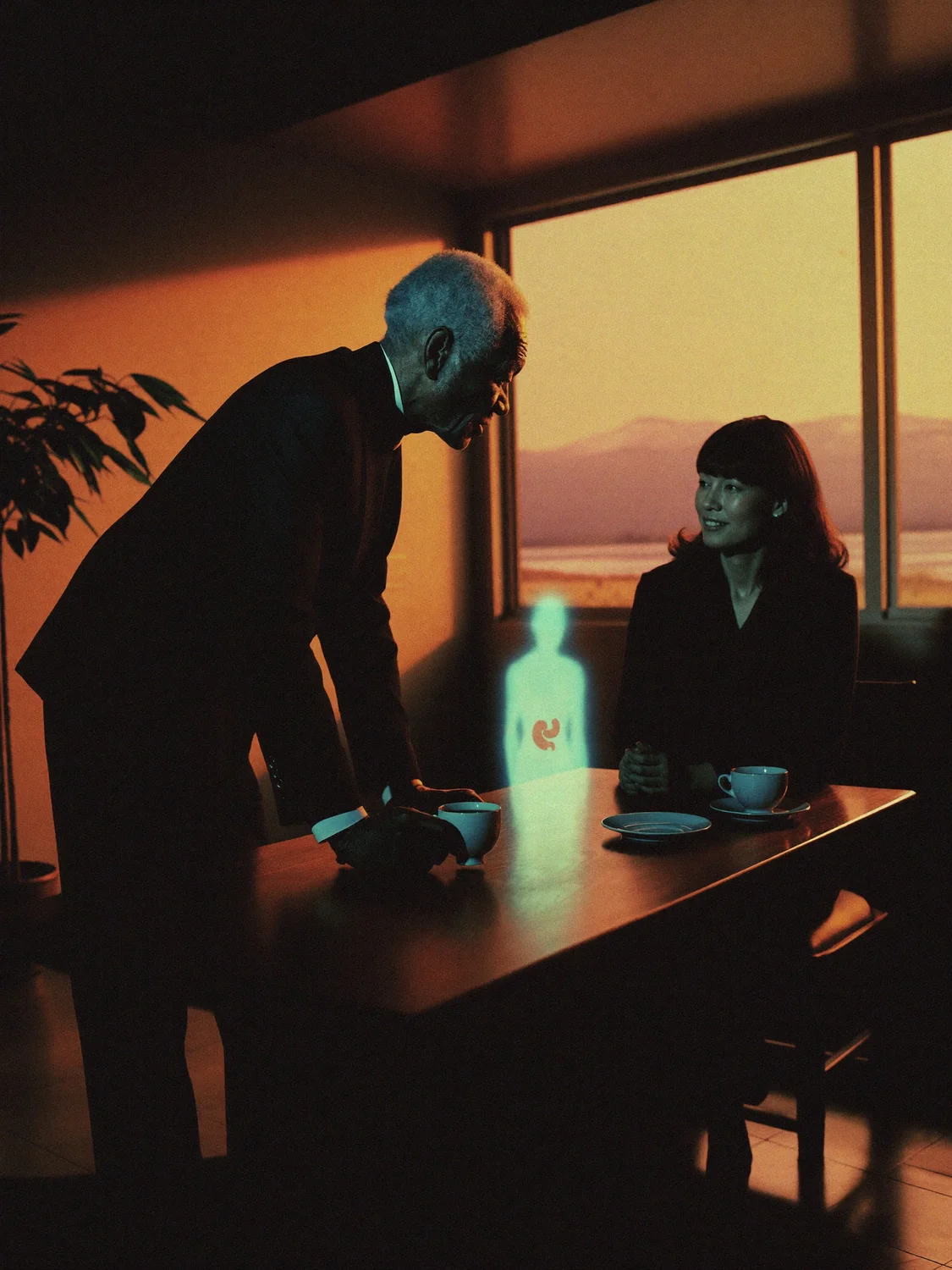
The clinic is calm the way cathedrals are calm. Dr. Osei — human, sixty, unhurried, the profession's last and most protected specialty — sits her down with tea. The twin flagged it eight months ago, he explains: a whisper in her blood chemistry, a pattern that used to be called early-stage pancreatic cancer back when it was a death sentence, because back then it was only ever found eight years too late. Hers was found eight years early. The vaccine — designed last week, printed for her tumour's exact fingerprint, three injections — begins Thursday. Survival at her stage: better than a broken wrist.
Mina hears almost none of the details. She is watching his face, which is why she came, and why his job exists. The machine found it. The machine will cure it. But sixty seconds of a human being looking her in the eye and saying you are going to be fine — that, no twin has ever learned to deliver.
Outside, she calls her daughter, laughing and crying at once. The twin, tactfully, holds her calendar clear until noon.
// The science behind it
The stethoscope learns to talk
Of all this book's 2021 chapters, healthcare is the one where the machines most exceeded the prediction. The essay dreamed of subscription medicine and watchful wearables; it did not dare predict that within two years, an AI would pass the medical licensing exam, or that within four, the studies would begin stacking up in which model diagnoses matched or beat panels of physicians — and, in the finding nobody in the profession enjoys discussing, were rated more empathetic than doctors in blind comparisons of written answers. The patient side moved first, as it always does: "Dr. Google," medicine's punchline for two decades, became Dr. GPT — hundreds of millions of people rehearsing their symptoms, decoding their lab results and preparing their questions with an AI before ever reaching a waiting room. The consultation now routinely contains three parties, whether the physician acknowledges the third or not.
Inside the clinic, the same technology attacked medicine's most corrosive problem: the keyboard. The ambient scribe — an AI that listens to the consultation and writes the clinical note — became the fastest-adopted hospital technology in memory, not because administrators loved innovation but because doctors were drowning; the specialty that spent a decade complaining it had become "data entry with a diploma" got its eye contact back. It is the pattern this book keeps finding, in classrooms and studios and farms: the machine takes the typing; the human takes the human.
Medicine's AlphaFold moment
Upstream of the clinic, biology itself changed epistemic gears. AlphaFold cracked the protein-folding problem that had humiliated computation for fifty years, mapped essentially every protein known to life, and earned its makers a Nobel Prize in chemistry — shared with the pioneer of designing proteins that nature never made. The consequence is a new kind of pharmaceutical industry taking shape around a new loop: models propose molecules, robotic labs test them, results retrain the models — a flywheel spinning at a pace the old trial-and-error chemistry cannot follow. The first AI-designed drugs are in human trials; the honest caveat is that biology still charges its toll in time — clinical trials remain years long, bodies remain complicated, and the graveyard of computational-drug hype is well tenanted. But the direction is set: the bottleneck of medicine is migrating from discovery to validation, and the 2030s will be spent rebuilding regulation around that inversion.
The mRNA platform, battle-proven by the pandemic, supplies the delivery half of the revolution. Its most beautiful application is exactly the one in this chapter's fiction: personalised cancer vaccines — the tumour sequenced, its unique errors identified, a bespoke vaccine designed and manufactured per patient — already in late-stage trials for melanoma with results that made oncologists use the word "transformative" in public. Combine the early-detection stack with the bespoke-vaccine stack and the shape of 2051 oncology is visible from here: cancer as a disease you are vaccinated against on diagnosis, at a stage when diagnosis means inconvenience.
The body, instrumented
The wearable decade delivered, by increments that added up to a different world. The watch that nagged you to stand became a medical device: FDA-cleared arrhythmia detection credited with a steady drumbeat of saved lives, sleep-apnea screening on tens of millions of wrists, rings and patches tracking temperature, glucose and blood oxygen through ordinary days. Multi-cancer blood tests — liquid biopsies screening dozens of tumours from a single draw — moved through enormous trials toward routine practice; AI radiology quietly passed the milestone where national screening programmes let it read mammograms alongside, and increasingly instead of, a second human; the retina became a crystal ball, a photograph of the eye now predicting cardiovascular risk years out.
The sum is the chapter's 2021 thesis vindicated: healthcare's centre of gravity is moving from reaction to surveillance — in the benign, clinical sense of the word. But the economics arrived by an unexpected door. The tech giants' insurance dreams mostly stalled (the 2021 essay's Amazon experiment died and was reincarnated as a clinic chain); what actually drives prevention at scale is nearer this book's second chapter: the GLP-1 shock taught insurers and governments that intervening early — with a drug, a sensor, a coach — is cheaper than the diseases it prevents, and "subscription prevention" is becoming policy language, not startup language.
Care, at home and everywhere
The pandemic's durable gift to medicine was permission: telehealth went from exception to default for half of primary care and most of mental care, and the hospital began dissolving outward. Hospital-at-home programmes — acute care delivered in the patient's bedroom with monitors, visits and a screen — went from pilot to standard reimbursement in country after country; dialysis, chemotherapy and post-surgical recovery followed the mattress. The hospital of 2051 is already legible: an ICU, an operating theatre, and a command centre for ten thousand beds located in ten thousand homes.
The frontier with the sharpest edges is the mind. AI companionship at scale arrived before anyone regulated it — millions confiding daily in chatbots, therapy apps triaging waiting lists, and the first lawsuits over what a companion said to a vulnerable teenager marking the field's tobacco moment. The need is bottomless — loneliness now carries surgeon-general warnings, and no country trains therapists fast enough — and the technology is genuinely helpful in the middle of the distribution and genuinely dangerous at its edges. The settlement being drafted in real time: AI for support, screening and practice; humans for crisis, depth and accountability; and hard lines, written in law, about machines that pretend to love you.
The trust protocol
Between the demo and the deployment stands medicine's non-negotiable: proof. The 2020s built the scaffolding for judging machine medicine, and its beams are worth naming because 2051 will rest on them. Regulators moved from approving devices to approving learning systems — software that changes after approval, monitored like a resident rather than certified like a thermometer. Liability found its early case law: when the AI misses and the doctor deferred, who pays? (The emerging answer — the institution that configured the system, not the clinician who trusted it — is quietly reshaping hospital org charts.) And bias graduated from academic critique to engineering requirement, after the early systems that read white skin better than black, or under-triaged the patients history had always under-treated, demonstrated that a model trained on medicine's past will faithfully automate medicine's injustices. The datasets are being rebuilt, population by population; the audits are becoming as routine as sterilisation. Trust, in machine medicine, is not a sentiment. It is infrastructure — and building it is the least glamorous, most decisive medical project of the era.
The doctor shortage meets its match
Behind every health-system debate hides one arithmetic nobody solves with policy: humanity is short some ten million health workers, and ageing societies are widening the gap faster than medical schools can narrow it. Half the world still lacks access to essential care; rich countries ration by waiting list what poor countries ration by absence. This is the context in which "AI doctor" stops being a Silicon Valley provocation and becomes a public-health necessity: for billions of people, the realistic alternative to machine medicine is not a human physician — it is nobody.
Which is why the most consequential deployments are the least publicised: symptom-checkers and triage agents running in languages no medical textbook was written in; community health workers in rural clinics wielding diagnostic support that puts specialist pattern-recognition in a backpack; ultrasound probes that plug into phones and read themselves, midwife and machine together doing the work of an imaging department. The leapfrog pattern of this book's chapters on money, school and energy repeats in its purest form: the regions that never built the twentieth century's medical infrastructure are assembling the twenty-first's directly — and by 2051, some of the best digital-first health systems on Earth will be in countries that never had analogue ones.
The road to 2051
Diagnosis becomes ambient. The annual checkup joins the fax machine; your twin watches always, escalates rarely, and the word "symptom" comes to mean what the machine missed.
Treatment becomes bespoke. Drugs designed per disease, vaccines printed per tumour, doses tuned per genome — mass medicine giving way to manufactured-for-one.
The hospital inverts. Acute care contracts to fortress campuses; everything else disperses to homes, pharmacies and pockets. Geography stops rationing medicine — the same leapfrog that banked and schooled the Global South now doctors it.
Health data becomes the most contested property of all — vaulted on the home servers of chapter three, subpoenaed by insurers, coveted by every model-builder on Earth. The fights will be ugly and worth having.
And the physician survives automation the way every profession in this book does: by contraction to the essential. Judgment, ethics, presence — the sixty seconds across the table. Dr. Osei's specialty has a name now used without irony in medical schools: the human part.
// 2021 → 2026 verdict
2021 verdict: Probability 90/100 — proactive, subscription-based, sensor-driven medicine. 2026 reality: the machines overdelivered. The AI passed the exams, folded the proteome, read the scans and wrote the notes — and medicine's oldest promise quietly flipped from healing the sick to keeping the well. What remains scarce is exactly what the fiction says: someone to look you in the eye.
This chapter was rewritten in 2026 by Brice × Claude Fable5. Read the original 2021 edition — written entirely by humans, published one year before ChatGPT existed.