10Mobility· 2026 edition
Around the world in 0.8 day
// A story from 2051
It's Friday morning and Jolene is feeling uncharacteristically nervous — and her health twin, tactless as ever, keeps saying so. Elevated heart rate since 6 a.m. Cortisol trending. Would you like a breathing exercise? No, she would not. She is nervous for the oldest reason there is: she is crossing the world for a person.
Noah. Two months of shared-presence evenings — his workshop in Darwin rendered around her Brussels living room so faithfully she could smell the cedar shavings, almost — two months of talking until the sun rose on one of them, and then last Tuesday he said, quietly, you know the presence rooms never get the gravity right. Come feel the real humidity. She booked the hop before he finished the sentence.
Door to door, Brussels to Darwin is now five hours and forty minutes. The pod collects her at 7:15 — no wheel, no driver, her luggage already validated — and slips into the morning flow, a river of vehicles that hasn't known a traffic jam in fifteen years. The maglev takes her from the city centre to the North Sea platform in twenty-two minutes, gliding above the old container port where her grandfather once drove trucks that drove themselves by the end of his career.
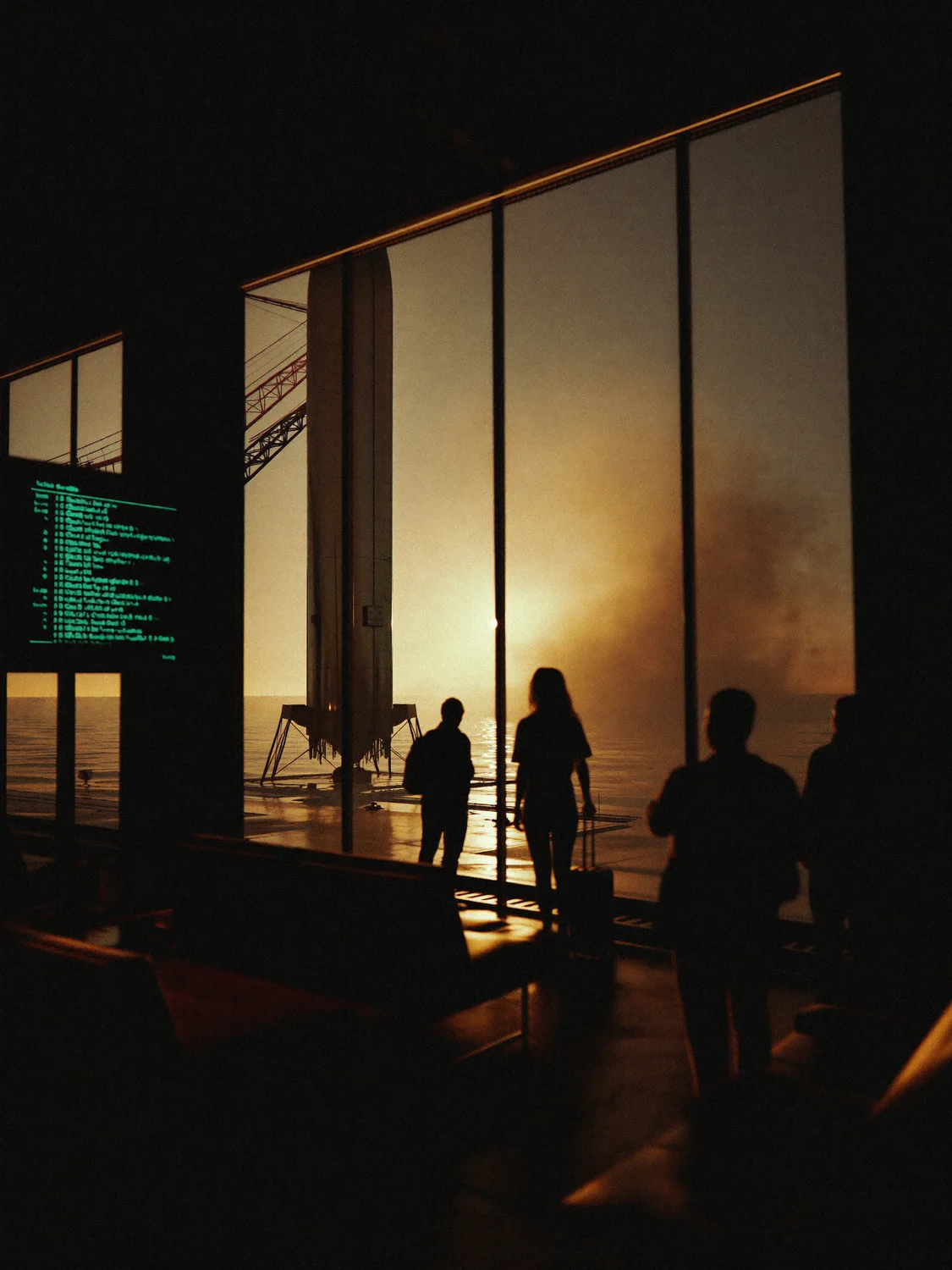
The spaceport still gives her goosebumps. Everyone in the departure lounge pretends to be blasé — reading, dictating messages, complaining about the coffee exactly as their ancestors did at airports; nobody is actually blasé, and the windows facing the pad are always, always crowded. The shuttle sits in its cradle like a patient cathedral, drinking methane made from last summer's sunshine. Boarding is a medical formality — her twin negotiates with the ship's system, clears her for the profile, mutters about her heart rate one last time. Forty-one minutes of flight: three of thunder, twenty of silence and the curve of the Earth — the Timor Sea arriving like a held breath — then the long falling glide, the catch, the tropical air pouring in like warm water.
Total time above the atmosphere: eighteen minutes. Total time in Darwin customs: fifty-five. Some things, her grandmother warned her, no century fixes.
In her bag: a physical gift, absurd and deliberate — Belgian chocolate, the real kind, carried by hand across the planet like contraband from the age of distance. When Noah meets her at the gate, sunburnt and terrified and grinning, the first thing she notices is what the presence rooms never carried.
He is exactly her height. In two months of perfect rendering, nobody's presence room had dared to say so.
// The science behind it
The decade the driver became optional
The 2021 edition of this chapter had to argue that autonomous vehicles would happen. The 2026 edition gets to report where: the robotaxi is a municipal fact — tens of millions of driverless kilometres logged across American and Chinese cities, freeway driving conquered, and the safety statistics doing exactly what the optimists promised, with crash rates per kilometre that human drivers cannot match, because the machine is never drunk, tired, or reading its messages. Whole districts of San Francisco, Phoenix, Wuhan and Shenzhen treat the driverless ride as unremarkably as the elevator — the technology's true finish line.
The decade also delivered the cautionary tale, and it deserves its paragraph: the pioneer that moved too fast, hid an accident's details from regulators, and was executed overnight by its own parent company. The lesson wasn't technical — the technology was adequate — it was institutional: autonomy is a trust business, in which one concealed failure erases a million good miles. The survivors internalised it, expanding city by city with the caution of a utility rather than the swagger of an app. What remains unfinished is everything outside the geofence: the chaotic street, the snowstorm, the unmapped village — solved not yet by better sensors but, increasingly, by the world adapting to the vehicle, as it once adapted to the horseless carriage. Roads legible to machines are becoming public infrastructure, and the timeline to everywhere is measured in road-agency budgets, not model releases.
The electric tide, with Chinese characteristics
Under the autonomy story runs the quieter, bigger one: the drivetrain flipped. Electric vehicles crossed from statement to default across most of the world's growth markets, and the flip has an address: China, where the majority of new cars now plug in and where an industry the West dismissed as subsidy theatre produced the planet's best-selling car brands, seven-euro-per-hundred-kilometre running costs, and city cars priced like scooters. Europe's automakers — this book is written in the shadow of their headquarters — spent the decade oscillating between denial, tariffs and panicked joint ventures; the 2035 combustion sunset survives politically bruised but standing, and the industrial question of the 2030s is not whether the car is electric but whose electric car it is.
The infrastructure argument ended the way infrastructure arguments do: boringly. Charging went from anxiety to amenity along every major corridor; the fleet became the grid's largest battery, as chapter seven described; and the oil demand curve bent measurably because a hundred million daily commutes stopped burning anything at all. The romantic loser deserves its nod: the hydrogen car, the 2021 edition's darling, retreated to the same niches as the rest of its molecule — heavy, long, industrial — while the battery took the driveway. The pattern by now needs no italics.
The sky's slow taxi
The flying car — mobility's oldest IOU — made real progress by giving up on being a car. Electric vertical-takeoff aircraft flew through certification's long tunnel: type certificates issued, the first commercial passenger routes opened in China, air-taxi trials shuttling between airports and financial districts from the Gulf to the Bay. And yet the honest report from 2026 is modesty: each aircraft carries a handful of people, costs like a helicopter, and serves — for now — the same clientele helicopters always served. The revolution's economics await scale that certification-grade manufacturing yields slowly; the bankruptcies along the way (including the sector's German pioneer) mark the distance between render and revenue.
Meanwhile the unmanned sky scaled ferociously — the delivery drones of chapter three fly millions of routine missions — and therein lies the decade's aerial lesson: the sky industrialised bottom-up, parcels before people, exactly inverse to the brochure. By 2051 the passenger AAV will be a normal instrument of the city — the fiction's rooftop capsules stand — but it arrives as the last course of the aerial meal, not the first.
Rails, risen and fallen
The terrestrial hero of the era is the least futuristic machine in this chapter: the train. China finished the largest high-speed network in human history — more fast rail than the rest of Earth combined — and kept building; Europe rediscovered the night train, relaid the sleeper routes it had torn up, and found them booked out by a generation that counts carbon; Japan's floating maglev crawls toward service through geology and litigation, still the fastest scheduled thing on land. The great American exception continued to except: the California line, symbol of a continent that forgot how to build, its budget a punchline, its first segment perpetually imminent.
And this chapter owes its 2021 self a funeral. The vacuum tube — the hyperloop, the maglev-in-a-pipe that the original essay lovingly detailed — died commercially in the very decade it was supposed to conquer: the flagship venture liquidated, its test tube dismantled, its patents scattered. The physics always worked; the economics never did — a sealed steel vacuum across seismic continents, competing against a mature train that does 350 km/h in the open air. Engineering succumbs to spreadsheets more often than to impossibility. The tube survives where this book now files it: as freight fantasy, niche demonstrator, and a monument to the difference between a rendering and a right-of-way.
The boom comes back
Higher and faster, the news is better. Civil supersonic flight — dead since Concorde folded its wings — restarted its engines: an independent American company broke the sound barrier with a privately built demonstrator, airliner orders on its books, betting on a generation of quiet-boom aerodynamics that NASA's X-plane has been proving over test ranges — sonic thumps instead of window-rattling booms, the regulatory key that grounded Concorde's successors for fifty years. Transatlantic in three and a half hours is now a certification schedule, not a memory.
Hypersonics, meanwhile, advanced the way the 2020s advanced everything fast: militarily first. The glide vehicles and scramjets of the great-power arsenals prove daily that Mach 5+ flight is engineering, not fantasy; converting that proof into a passenger cabin — thermal management, engine cycles, tickets civilians can buy — remains the 2040s' assignment. The 0.8-day world of this chapter's title does not need it to arrive on schedule; it has a stranger vehicle waiting.
The rocket route
Because the true endgame of "around the world in 0.8 day" was always ballistic. The reusable super-heavy rocket — caught by its own launch tower, reflown, its cost curve pointed the way cost curves in this book always point — exists; its point-to-point promise (any two cities on Earth, under an hour of flight) has moved from conference slide to funded military cargo programme, which is how every aviation revolution in history began. The arithmetic is the fiction's: the flight is trivial; the system is the challenge — offshore spaceports (no city tolerates orbital-class thunder), weather margins, medical screening, turnaround, and a safety record that must earn, launch by launch, the boring reliability that lets grandmothers board.
This book's forecast, offered with its 60/100 humility intact: by 2051, suborbital point-to-point exists as scheduled service on a handful of oceanic trunk routes — the Darwins, the Dubais, the coastal megacities — priced like business class of the 2020s, carrying the urgent, the wealthy and the freight that cannot wait, while the great mass of humanity crosses the world the slow way: in nine hours, on sustainable fuel, complaining. Both facts will be true at once. They usually are.
The street takes it back
The most consequential mobility revolution of the decade cost two hundred euros and had pedals. E-bikes outsold cars across Europe year after year, quietly re-engineering the commute; cities pedestrianised, congestion-priced (New York finally dared, survived the lawsuits, and watched traffic melt exactly as modelled), and re-allocated the curb — the era's most contested strip of real estate, fought over by robotaxis, delivery bots, bike lanes and the vanishing parked car. The fifteen-minute city, a planner's commonplace, achieved the strange honour of a global conspiracy theory before settling into what it always was: the way cities were built for five thousand years before the car.
The pattern connecting chapter three's dissolved shops to this chapter's streets: as machines take over moving things, humans reclaim being somewhere. The street of 2051 carries fewer vehicles and more life; traffic — in the twentieth-century sense of steel queued at lights — is remembered the way coal smoke is remembered, as the price a century paid for not yet knowing better.
Moving less, arriving more
One 2021 hope deserves its audit: did presence technology replace travel? Half-yes — and the halves are instructive. Business travel never recovered its old volume; the routine meeting moved permanently to the screen, and the corporate travel budget of 2026 buys deliberate presence: the deal signing, the crisis, the team ritual. But leisure travel came roaring back beyond every forecast, tourism taxes and entry caps spreading from Venice to Kyoto as the world's honeypots buckled — because the same remote work that killed the commute freed the calendar, and because, as every chapter of this book keeps concluding, when digital abundance makes everything reproducible, humans pay premiums for the unreproducible: the humidity, the crowd, the gravity the renderers never get right. Jolene's hop is the pattern's purest case: presence didn't replace travel. It advertised it.
Freight goes first
As always in this book, the machines conquered cargo before people. Driverless trucks run scheduled freight on the American interstate network — the industry's demographic cliff made the case that no lobby could resist; autonomous ships thread Scandinavian fjords and cross oceans crewed like server rooms; ports load themselves; and the drone networks of chapter three knit the last mile. The 2051 freight system visible from here is a nervous system more than a network — goods moving like packets, routed, priced and re-routed in real time, with human hands touching cargo about as often as human voices route phone calls. Passenger transport inherits each layer a decade later, once the freight has debugged it. It is the oldest sequence in transportation, and it is holding.
The mind at the wheel
And the original essay's most cinematic image — the car unlocked and driven by thought — landed, as this book's wildest predictions keep landing, in medicine first. Brain–computer interfaces went from primate demos to implanted human patients steering cursors, games and robotic limbs by intention; for drivers with paralysis, thought-and-gaze control of vehicles is in genuine trials. For everyone else, the car simply learned to recognise its human the boring way — face, gait, voice — and then made the question moot: a vehicle that drives itself doesn't much care who's holding the wheel that isn't there. The 2021 image survives as this book's recurring moral, one chapter early for the neurotechnology that will need it later: interfaces built for the excluded end up redesigning the world for everyone.
The interior frontier
A note the car industry's own centenarians make with wonder: the last time the automobile changed this much, the change was the automobile. A century of product identity — engine note, gearbox, driver's seat as throne — dissolved in a decade, and what rushed into the vacuum was software culture with all its gifts and pathologies: over-the-air updates that improve the vehicle while it sleeps, subscription heating in cars that shipped with the hardware installed (the consumer revolt over that one wrote case law), feature flags, app stores, and the uneasy discovery that a car is now hackable the way anything with an IP address is hackable. The automotive recall — once a mechanic's appointment — became a patch note; the used-car market learned to price software support windows; and "my car got worse overnight" entered the language of consumer protection. The vehicle of 2051 is best understood as a device that happens to weigh a tonne — with everything that implies about who really controls it, long after the sale.
Who pays when nobody drives
Autonomy's deepest rewiring is institutional. A century of road law rests on one load-bearing fiction — someone was driving — and the machines removed it. The settlement taking shape follows the aviation model, not the automotive one: liability migrating from driver to manufacturer-operator, incidents investigated like crashes of record with flight-recorder disclosure, insurance repriced from actuarial guesses about humans to engineering audits of fleets. The philosophical set-pieces of the 2010s aged badly: the trolley problem, that seminar-room favourite, turned out to be an event so vanishingly rare in fleet data that the real ethics were elsewhere — in deployment maps (whose neighbourhoods get served), in data retention (a robotaxi is a camera on wheels, and police noticed), and in the labour ledger.
That ledger is heavy. Driving is among the most common male occupations on Earth; the truck, taxi and delivery seats now emptying were the last mass employment refuge requiring no degree. The transition politics this book met on the farms of chapter six returns at highway scale: driver unions negotiating attrition-only automation, licence-holder buyouts, and the remote-operator profession — one human shepherding a dozen vehicles from a control room — as the bridge occupation. Handled well, it is a generation-long glide; handled badly, it is the rust belt with wheels. The technology no longer decides which. Parliaments do.
Aviation's carbon bill
Flight remains the hardest passenger kilometre to clean, and the decade's accounting was sobering. Sustainable aviation fuel — the industry's official salvation — is real, certified and scaling, yet still a low single-digit percentage of the tank: feedstocks are finite, e-fuels (kerosene synthesised from captured carbon and chapter seven's cheap noon power) are chemically elegant and eye-wateringly expensive, and every credible roadmap shows the gap between pledge and production stretching into the 2040s. Meanwhile the science sharpened an inconvenient discovery: much of aviation's warming isn't CO₂ at all but contrails — and rerouting a small fraction of flights around ice-supersaturated air, a software fix costing almost nothing, may cut aviation's climate impact faster than a decade of fuel chemistry. Expect contrail avoidance to be as standard as turbulence routing by 2030, and expect the fact that a flight-planning patch outperformed the fuel revolution to enter every engineering syllabus as a parable.
Demand met policy too: France's short-haul flight ban where the train wins anyway was symbolic; the night-train renaissance and rail-substitution clauses spreading through Europe are structural. The synthesis for 2051 is stratified like everything in this chapter: rail eats the continent's short haul, SAF and e-fuels carry the long haul at honest prices, and the era of the €19 weekend flight is remembered as the aviation equivalent of leaded petrol — marvellous, and mispriced.
The maritime turn
Ninety percent of everything still arrives by sea, and the sea changed masters quietly. The great container lines placed their bets on green methanol and ammonia, and the first dual-fuel giants are on the water; rotor sails — Flettner's century-old spinning cylinders — sprouted on tankers as fuel prices and carbon rules made every percent matter; port automation completed its conquest from Rotterdam to Shanghai. But the decade's real maritime story was geographic: climate redrew the map faster than engineering. Drought throttled the Panama Canal to rationed convoys; missiles priced the Suez route's insurance beyond reason for months at a time; and the melting Arctic opened summer passages that cut Asia–Europe distances by a third — a "benefit" of warming that everyone uses and nobody celebrates. Shipping's 2051 is visible in outline: slower, cleaner, more automated, and routed by a climate and a geopolitics that treat the map as negotiable. The cheap, stable, ignorable ocean of the twentieth century was, it turns out, the anomaly.
Borders at machine speed
Jolene's fifty-five minutes in Darwin customs is this chapter's deliberate joke, and it is only half a joke. The physical journey compresses; the administrative one resists. The decade digitised the border — biometric corridors where your face is the passport, digital travel credentials issued to phones, pre-cleared "trusted traveller" lanes expanding into whole treaty systems — and simultaneously thickened it: pandemic-era health gates left permanent plumbing, migration politics hardened everywhere, and the same verified-identity stack of chapter eight that smooths the frequent flyer walls out the unwanted with unprecedented precision. Travel friction is becoming, like everything else in this book, stratified: seamless for the credentialed, biometric-smooth for the tourist, and harder than any point in living memory for those without the right passport in the right database. The technical capacity for a borderless journey exists end to end. The political appetite runs, if anything, the other way — and no spaceport shortens that queue.
The moving room
One consequence of autonomy is habitually underestimated: when nobody drives, the vehicle stops being a cockpit and becomes a room. The robotaxi fleets already run sleeper configurations on overnight intercity routes — berth, blackout, breakfast, arrive; the office pod (chapter three's countryside commuters know it well) converts the occasional two-hour journey from dead time into a working morning; families spec the school run like a small living room. An entire design discipline — motion UX, the art of reading, meeting and sleeping at highway speed without turning green — matured from carsickness folklore into peer-reviewed practice.
The deeper shift is temporal: when travel time becomes usable time, distance stops being subtracted from life. The commute — the twentieth century's great daily theft — either disappears (chapter three's villagers) or converts into the day's quietest hour. By 2051, "how far is it?" will draw the modern answer as often as the ancient one: two episodes. One nap. A finished report. The vehicle's last transformation is the humblest: from the thing that takes your time to the place that gives it back.
The operating system of movement
Beneath every mode runs the layer the 2021 edition could name but not yet see shipping: movement as software. The multimodal journey — Jolene's pod-maglev-rocket-pod — is technically four vehicles and administratively one object: priced together, guaranteed together, replanned together when the weather moves. The agents of chapter three did to transport what they did to shopping: nobody under thirty "checks schedules"; they state an intention — Darwin, Friday, gentle on the heart rate — and adjudicate between the options their agent has already negotiated. Mobility-as-a-service, the 2010s' most abused slogan, finally arrived the only way it could: not as an app with every timetable, but as an agent with every contract.
The consequences compound quietly. When journeys are objects, they can be insured (arrival-time guarantees, paid out automatically like chapter six's crop policies), traded (peak slots auctioned, off-peak rewarded), and optimised at city scale — the traffic-light era's guesswork replaced by demand actually negotiating with supply before anyone leaves the house. Congestion, the twentieth century's defining urban failure, is not being solved in 2026 so much as scheduled out of existence, journey by pre-cleared journey. The street of 2051 is calm for the same reason the power grid of chapter seven is stable: because a million negotiations settled invisibly, in the night, before the demand ever arrived.
What the century keeps
Amid the machinery, an inventory of what refuses to be disrupted — and why that is the good news. The bicycle, mechanically perfect for a century, absorbed a motor and conquered the city without needing a single line of code. Walking — the mode every futurist forgets — got its infrastructure back as streets emptied of parked steel, and the pedestrianised centre turned out to be the era's most reliable urban-happiness intervention. The sailboat, the sleeper train, the road trip: each thrives precisely because faster options exist, migrating — like the vinyl records of chapter one and the Sunday pizza of chapter two — from necessity to meaning.
Because that is this chapter's real finding, visible only when the speed race is over: transport was never one market. It was always two — getting there, which the machines are duly compressing toward zero friction and zero attention; and going, the human act of being in motion through the world, which no compression touches. The 2051 traveller teleports through the first market and savours the second, sometimes in the same afternoon. The century's achievement will not be that the world became 0.8 days wide. It will be that, once crossing it became trivial, humans finally got to choose — every single time — which kind of journey they were on.
The road to 2051
Door-to-door replaces mode-by-mode. The trip becomes one negotiated object — pod, maglev, flight, pod — booked, priced and rerouted as a whole by the agents of chapter three. Nobody "catches a connection"; the connection catches them.
The city street demotes the vehicle to guest. Movement below ground and above the rooftops; life at street level. Traffic engineering's successor discipline is called, without irony, place engineering.
Speed stratifies. Nine-hour sustainable flight for the many; three-hour supersonic for the impatient; forty-minute ballistic for the few and the urgent — the same journey, three prices, one planet width. The 0.8-day world arrives, boards by income, and waits together at customs.
Freight becomes invisible physics — routed like data, cheap like data, and as unremembered as the water main.
And distance completes its long inversion. For all of history, far meant hard. By 2051, far means chosen — and the measure of caring about someone is no longer writing, or calling, or rendering into their living room, but the oldest tribute there is: crossing the world, carrying chocolate, to find out how tall they really are.
// 2021 → 2026 verdict
2021 verdict: Probability 60/100 — hedged, correctly, on the exotic hardware. 2026 reality: the driver left the car, the tube died, the boom returned, and the rocket route is on the military's calendar. The world is not yet 0.8 days wide — but for the first time since Concorde, it is measurably narrowing. The last mile, undefeated, remains the longest part of every journey.
This chapter was rewritten in 2026 by Brice × Claude Fable5. Read the original 2021 edition — written entirely by humans, published one year before ChatGPT existed.