12Smart homes· 2026 edition
Digital Butler
// A story from 2051
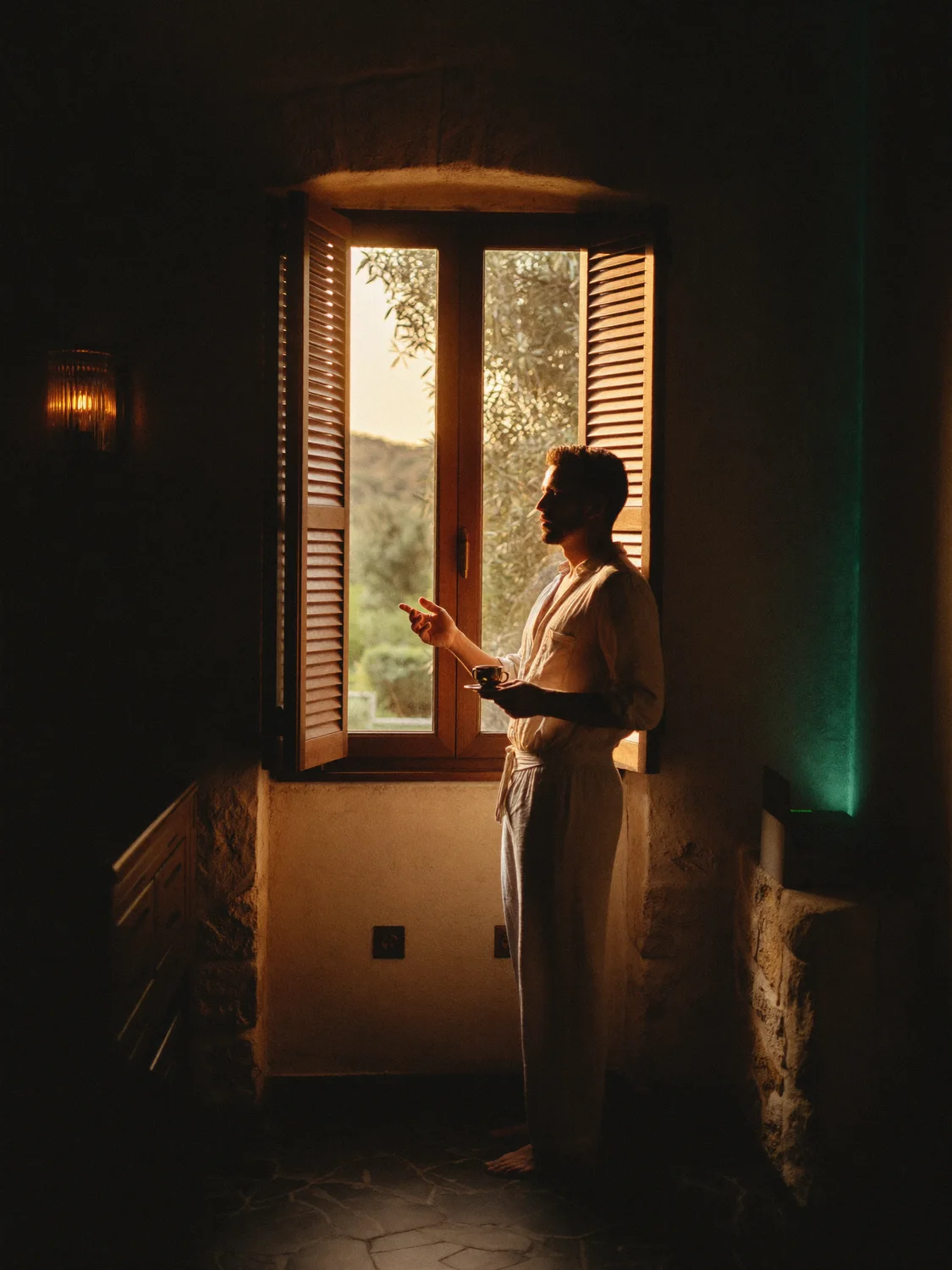
Cillian has been working hard to launch his own business, and after two years he has granted himself two weeks of dolce vita at his second home in Tuscany. Now, waiting for his flight back to the Emerald Isle, he does the thing his grandparents would have found unremarkable and he finds faintly magical: he says goodbye to his house.
Not to a screen. To Bram — the household's mind, named by his daughter after a great-uncle nobody remembers, running on the grey box in the Tuscan cellar and its twin in Ireland, the two of them syncing his family's entire life between them, and belonging to no one but the Byrnes.
"Bram, we're heading home. Close up here."
There is no menu, no app, no list of devices. Bram simply understands what "close up" means for this house in May: draw the shutters against the afternoon heat but leave the study cracked for the fig tree's scent, run the greywater cycle, drop the pool to caretaker temperature, tell the olive-grove irrigation it's on its own for a fortnight, and — because it noticed the forecast — pre-cool the Irish house for their midnight arrival into weather that, this year, is somehow also warm.
On the drive to the airport, Bram mentions three things, in the order a good butler would. The Irish house flagged a slow leak under the kitchen; a plumber-drone is booked for Thursday, approve? Approved. Cillian's mother's house — she lets Bram check on her, within limits she set herself — reported a fall-risk pattern in her night movements; nothing alarming, but worth a human call. He'll ring her from the gate. And the business: while Cillian was swimming, his company's agent and Bram had quietly negotiated next quarter's supplier contracts; there's a summary when he wants it. Later, Bram. I'm still on holiday for six more hours.
"Understood," says Bram — not offended, never offended — and does the most butlerish thing of all. It goes quiet, dims the car's ambient glow a shade, and leaves him to his last Italian coffee and the olive light coming through the window.
What Cillian never thinks about — the reason he sleeps well — is where Bram isn't. Not in a company's cloud, not monetising his kitchen conversations, not for sale. The Byrnes own their butler the way his grandparents owned their house keys. It was, his father always said, the best appliance they ever bought. It just happened to be the one that ran all the others.
// The science behind it
The assistant finally grew up
The 2021 edition of this chapter looked at Alexa, Google Home and Siri and saw the future's servants in their infancy — "intimidating," it admitted, and it was right. Those first assistants were glorified remote controls: set a timer, play a song, mishear the rest. Their fatal flaw was that they could not actually understand, and everyone knew it — which is why, by the mid-2020s, the smart-speaker boom had curdled into disappointment, the manufacturers were writing off billions, and the devices mostly played music and lied about the weather.
Then the same wave that runs through every chapter of this book hit the living room. Large language models gave the assistant the one thing it always lacked: genuine comprehension. Amazon rebuilt Alexa around generative AI; Apple rebuilt Siri (badly, publicly, late — a humbling that became a case study); Google folded its assistant into Gemini. Overnight the difference between "set a timer" and "close up the house for a fortnight" became possible, because the machine finally grasped intent instead of matching keywords. The digital butler of this chapter's title stopped being a metaphor for a smart speaker and became an accurate description of a capable one. The 2021 essay's Cillian talked at his house. The 2026 trajectory lets him talk with it.
From gadgets to agent
The deeper shift is architectural, and it is the throughline of this entire book: the home is getting a mind, not more gadgets. For a decade, "smart home" meant a drawer of incompatible apps — a bulb that spoke one language, a lock another, a thermostat a third, none of them to each other. The long-promised truce finally shipped: Matter, the industry's common standard, arrived to let the devices interoperate, and while its rollout was rockier than the press releases (this book will not pretend otherwise), the principle held — the home's dumb objects can now share one nervous system. And onto that nervous system moves the agent of chapter three: not an app you poke, but a household intelligence that holds context, remembers preferences, and acts.
This is the reunion of three threads this book keeps braiding. The agent that shops (chapter three), the vault that guards your data (chapter eight), the mind that runs the home (this chapter) — they are one thing: the household server, bought like an appliance, private by construction, orchestrating a family's digital and physical life from the utility room. The industry's centre of gravity is visibly shifting from selling devices to hosting the assistant that runs them, and the strategic prize of the late 2020s is ownership of that layer — which is precisely why it matters, as the fiction insists, whether your butler works for you or for the company that made it.
The house that watches back
Every gift in this chapter arrives shadowed by its inverse, and the smart home's shadow is the longest in the book. A house that understands you is a house that surveils you: the microphones that hear "close up" also hear everything else; the cameras that spot an intruder also log every arrival; the patterns that let Bram care for Cillian's mother are the same patterns that, in the wrong hands, describe exactly when a home is empty. The 2020s supplied the cautionary canon — doorbell footage handed to police without warrants, hacked baby monitors, an employee caught watching customers through their own cameras, an insurer angling to price you on your sleep. The smart home became the most intimate surveillance apparatus ever installed, and people installed it themselves, for convenience, by the hundred million.
Which is why this chapter's quiet argument — the local, owned, private butler — is not nostalgia but the emerging answer. The regulatory tide turned: right-to-repair and interoperability laws, security-labelling schemes, bans on the worst data practices, and a dawning consumer preference — visible in every survey — for devices that process at home rather than phone home. The technical enabler is chapter three's local model: capable AI running on the household server means the microphone's understanding never has to leave the house. The 2051 settlement this book bets on: the home mind is powerful and local, its intelligence yours, its memory sovereign — because the alternative, a family's entire life narrated to an advertising company, is a bargain societies are, slowly, deciding not to make.
The climate-armored house
The 2021 edition led with the building itself, and it read the weather right. Construction is being re-engineered for a planet that no longer behaves: reflective roofs and radiative-cooling materials that dump heat to the sky; the return of ancient passive design — thick walls, shade, cross-ventilation, the wisdom every hot culture had before air conditioning let us forget it; heat pumps as standard (chapter seven); and the "living walls" the original essay loved, greening facades to cool cities and soak up the floods that now arrive on a schedule. Building codes are being rewritten around resilience — flood-raised foundations, fire-hardened materials, backup power assumed — as insurers, the real regulators of the climate age, simply refuse to cover what won't adapt, redrawing the map of where humans can affordably live.
And the home became a node in chapter seven's grid. Rooftop solar, a home battery, an EV in the drive, a heat pump humming — the house of 2051 generates, stores, and trades energy, and the butler is its dispatcher, buying power at the cheap noon tide and selling it back at the dusk peak while the family sleeps. The smart home's first genuinely indispensable job turned out not to be convenience at all. It was survival: keeping humans cool, dry, powered and safe on a planet that stopped cooperating.
The materials revolution in the walls
Beneath the software, the house itself is being reinvented at the molecular level, and the 2020s accelerated it. Concrete — the single most-used material on Earth after water, and a climate villain responsible for a staggering share of emissions — is finally under assault: low-carbon and carbon-cured formulations that lock CO₂ into the pour, and a global revival of building with engineered timber, the "mass timber" high-rises that store carbon in their beams instead of emitting it to make them. Self-healing concrete laced with bacteria seals its own cracks; "smart glass" tints on command to block the sun that chapter seven's heatwaves deliver; phase-change materials tucked into walls store the cool of the night to spend in the afternoon. The wall of 2051 is not a passive barrier but a working system — insulating, generating, storing, tinting, healing — and the DIY shops the 2021 essay imagined selling reflective paint now stock the humbler front of a genuine materials revolution.
Construction itself, famously the least-digitised major industry, is being dragged into the century by the same labour shortage that automated the farm and the warehouse. 3D-printed houses went from novelty to neighbourhoods — whole communities printed in concrete in Texas and Mexico, walls extruded in a day; robotic bricklaying and prefabricated modular construction attack a housing crisis that afflicts nearly every rich city, where the real barrier to shelter is less technology than the politics of who may build what, and where. That political knot — zoning, permits, NIMBY courtrooms — is the true bottleneck, exactly as it was for the wind farms of chapter seven and the driverless cars of chapter ten. The machines can print the house. Whether society lets them put it anywhere is, once again, not an engineering question.
The office, disappeared and reinvented
The 2021 edition devoted its final section to the smart office — printers left on, heaters beside open windows, lights in empty rooms — and imagined the building learning to manage itself. Then the pandemic detonated the premise. Chapter three emptied the shops; the same shock half-emptied the office, and the smartest building-management system in the world cannot optimise a floor nobody comes to. The commercial-property reckoning became one of the defining economic stories of the decade — towers half-lit, valuations halved, downtown tax bases hollowed — and the surviving office had to justify its existence for the first time since the elevator. The winners rebuilt around the one thing home can't offer: not desks, but gathering — the workplace as clubhouse, studio and ritual space, engineered for the collaboration and belonging that video calls leach away. The building's intelligence pivoted with it, from thermostat to concierge: booking the hybrid week, balancing the days people actually show up, turning a fixed cost into a flexible amenity.
And the office's real intelligence went digital anyway. The agent of chapter three has a work uniform: the enterprise copilot that drafts the memo, joins the meeting, remembers the decision, and increasingly does the task — the "digital worker" that firms now onboard beside human hires, with logins, permissions and, unnervingly, performance reviews. The building got smart; the work got an assistant; and the boundary between "my home butler" and "my work agent" blurred into the single question this chapter keeps circling — whose is it, where does it run, and what does it remember? Cillian's company agent negotiating supplier contracts while he swims is not a fantasy of 2051. It is a product roadmap of 2026, and the governance of it — what an autonomous agent may sign, spend and promise in your name — is the compliance department's fastest-growing nightmare.
The robot finally comes home
For fifty years, the humanoid robot butler was science fiction's most broken promise — always ten years away, forever stuck vacuuming in a circle. The 2020s finally moved the needle, and from an unexpected direction: the same AI that gave the house a mind gave the machine a body it could think with. Robots that once needed every motion hand-programmed can now learn tasks by watching, generalise from example, and understand a spoken instruction — and a gold rush of humanoid robots, funded like the early car industry, is marching them out of the demo reel and onto the factory floor first, exactly where every technology in this book earns its keep before it comes home. Four-legged robot dogs already patrol warehouses; the first humanoids stack shelves and haul totes; and the cost curve, subsidised by the world's largest manufacturers treating the humanoid as the century's defining product, points the familiar way.
The honest 2026 caveat is large: the home is the hardest environment, not the easiest — cluttered, unpredictable, full of children, pets, stairs and irreplaceable objects, with zero tolerance for the robot that drops the heirloom or steps on the cat. The machine that thrives in a structured warehouse is years from folding your laundry reliably, and the graveyard of over-promised home robots is well tended. But the direction is set, and it rhymes with this whole chapter: the physical butler arrives limb by limb, task by task — the vacuum that already roams, the arm that loads the dishwasher, the mobile helper that fetches and carries for the ageing — long before the tuxedoed android of the posters. By 2051, Bram will have hands: not one gleaming humanoid, but a household of quiet specialised machines, orchestrated by the same mind that runs the shutters and the olive grove, doing the physical drudgery humans were always glad to hand to a servant. The butler stops being only a voice. It learns to carry the coffee.
The house that cares
The smart home's most consequential job is turning out to be one the 2021 edition barely mentioned: keeping the old at home. Every developed society is ageing at once, the ratio of carers to cared-for is collapsing, and the alternative to the assisted-living facility — expensive, scarce, and dreaded — is the house that quietly watches over its elder. This is the tender edge of the surveillance blade, and it is where families make their peace with it: the passive sensors that notice a fall without a camera; the gait analysis, buried in the floor, that flags a stroke or a decline weeks early; the medication reminders, the fridge that notices grandma stopped eating, the reassuring nightly "all's well" to a daughter three time zones away. Cillian's mother, letting Bram check on her within limits she set herself, is the whole ethical settlement in one sentence: dignity is consent plus locality — she chose the watching, and the watching stays in her house.
The prize is enormous and humane: ageing in place, in the home a life was built in, instead of the ward. And it reframes the privacy argument one final time. The same data stream is a violation when an insurer harvests it and a blessing when a family holds it; the difference is not the sensor but the ownership. Which is why the sovereign, local butler of this chapter is not a luxury or an ideology — for the century's greatest social challenge, the ageing of humanity, it is the difference between a machine that cares for you and one that merely watches, and reports. The home that understands you will, by 2051, be the one that lets you grow old in it.
The interface disappears
There is a quieter revolution threaded through all of this, and it is the disappearance of the screen. For forty years, "using technology" meant looking at a rectangle and poking it; the smart home is the leading edge of technology that has no rectangle at all. You speak, and the house acts; you gesture, and the light dims; you simply arrive, and the room adjusts — the interface dissolving into the environment, exactly as the field's prophets promised in the 1990s and the hardware could never quite deliver until the AI understood intent. The smart speaker was the clumsy first draft; ambient, conversational, anticipatory computing is the fair copy. Screens do not vanish — the wall still shows the film, the fridge still displays the calendar — but they stop being the place you go to command the machine. The command moves into ordinary life: a sentence, a glance, a habit the house has learned.
This is, in the end, why the butler is the right metaphor and not the robot or the app. A great butler is defined by absence — by anticipating the need before it is spoken and vanishing once it is met, leaving no interface between you and your own life. The technology of 2051, at its best, aspires to the same invisibility: not a house full of gadgets demanding attention, but a home that quietly works, watched over by a mind that is yours, and mostly, blessedly, silent. The 2020s spent themselves adding intelligence to everything. The 2050s will be spent teaching that intelligence the hardest lesson of all — when to disappear.
The road to 2051
Every home runs a mind, and owns it. The butler is standard infrastructure, like plumbing — local, private, inherited, orchestrating everything from the olive grove's irrigation to the quarterly supplier contracts. Renting your household intelligence from a surveillance company comes to seem as quaint as renting your telephone.
The devices vanish into the walls. No apps, no hubs, no drawer of remotes — just intent, spoken or sensed, and a house that acts on it. Interoperability, fought over for a decade, becomes as invisible as it should always have been.
Privacy is architectural. The home mind is powerful because it is local; its memory of your life is an asset you hold and bequeath, not exhaust you leak. The great data settlement of the 2020s made the private home its showcase.
The house becomes the family's climate ark and power plant — cooling, drying, generating, storing, defending — the first line of adaptation for a species learning to live on a hotter world.
And the best butler stays quiet. The measure of the mature machine, here as everywhere in this book, is restraint: it does the thousand invisible things, mentions the three that matter, and then leaves you to your last Italian coffee. The digital butler's final skill is the most human one — knowing when to say nothing at all.
// 2021 → 2026 verdict
2021 verdict: Probability 80/100 — the voice-assistant home coming of age. 2026 reality: it stalled, then leapt. The first assistants disappointed so badly the industry nearly gave up — right before large language models handed the house an actual mind. The butler is arriving, more capable than the fiction dared. The only question left is the one the fiction cares about most: whose butler is it?
This chapter was rewritten in 2026 by Brice × Claude Fable5. Read the original 2021 edition — written entirely by humans, published one year before ChatGPT existed.