13Communication· 2026 edition
Beam me up Scotty
// A story from 2051
It's early Tuesday and Lauv Vandenberg is already on the warpath, which is a private joke, because he hasn't raised his voice in years. He doesn't need to. He's preparing his 2051 New Year address to Lauv Ltd's executives, and in ninety seconds forty of them will be standing in his Lyon study — really standing, breathing, casting shadows — without one of them leaving home.
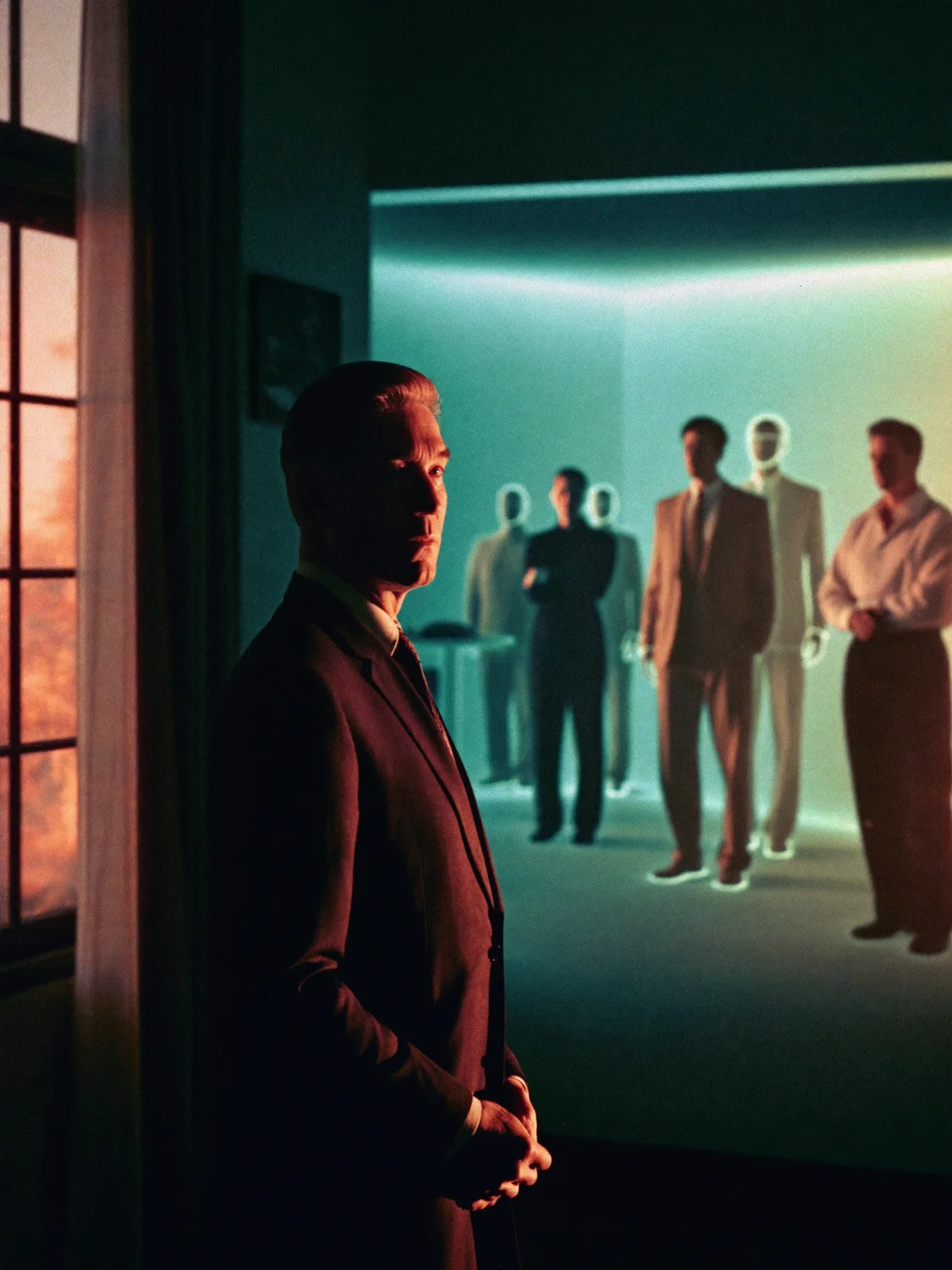
The far wall dissolves. Where his garden was, a room now extends: a warm, impossible room that is partly in Lyon, partly in São Paulo, partly in Lagos, stitched together in real time so that everyone present sees the same space from their own true angle. Amara in Lagos turns her head and the light on her face moves correctly; when Lauv steps toward her to shake her hand, the haptic field lets him feel the pressure of her grip, warm and firm, though she is four thousand kilometres away and it is raining on her actual roof. Nobody wears goggles. The room simply renders, from a hundred cameras and a ceiling that is also a display, and the uncanny valley that made this unbearable in the 2020s was crossed so gradually that no one remembers the last awkward hologram.
He gives the speech. It is a good speech; his agent drafted three versions and he rewrote the ending himself, because the ending is where a human still has to mean it. As he talks, a soft band across his vision translates for the six who don't speak French — not subtitles, but their own faces, subtly re-timed so their lips match the language each listener hears. Amara experiences Lauv speaking fluent Yoruba. Lauv experiences Amara answering in fluent French. Neither speaks a word of the other's tongue. The tower of Babel, his grandmother used to say, took five thousand years to fall. It fell, in the end, over a long weekend, and nobody noticed because everyone was busy talking.
The meeting ends. The room folds back into a garden. And Lauv sits for a moment in the sudden, total quiet, because presence technology has given him everything — every colleague, every city, every collaborator, summoned to his study at a word — everything except the one thing it still cannot carry across the wire.
At four o'clock his grandchildren arrive. The real ones. He can smell the cold on their coats, and when they climb onto his lap he feels the specific, irreplaceable weight of them, and he understands, as he does every Tuesday, exactly which of his two worlds is the copy.
// The science behind it
The office that never came back
The 2021 edition of this chapter opened on a prophecy that the pandemic had just made plausible: the office would dissolve, and presence would move into the home. Five years on, the verdict is a decisive half. Remote and hybrid work became permanent facts, not emergency measures; the physical office survived but shrank and changed jobs, from the place where work happens to the place where people gather on purpose — the reckoning chapters three and twelve already traced through empty shops and half-lit towers. What did not happen was the goggles. The 2021 essay bet the future on the VR headset — the Oculus, the workroom, the avatar with no legs — and that bet, honestly assessed, lost. The metaverse of virtual meetings, launched with a fortune and a renamed company, became the decade's most expensive punchline; people, it turned out, would rather see a colleague's real face in a flat window than inhabit a cartoon of a conference room. The destination in this chapter was right. The vehicle was wrong.
Presence without the goggles
What actually delivered "presence" was subtler and arrived from three directions at once. First, the flat video call simply got good enough and then quietly magical: AI now corrects your eye contact so you seem to look into the camera, relights your face, cancels the dog, and — the feature that matters most — erases the language barrier. Real-time translation, science fiction when the 2021 essay name-dropped it, is now built into the phone, the earbud and the meeting: speak French, be heard in Yoruba, in your own voice, with your own lip movements re-rendered to match. The most consequential communication technology of the decade is not a headset. It is the disappearance of translation — the tower of Babel falling, as the fiction says, over a long weekend.
Second, the hardware that is winning is the one that adds a layer to the real world rather than replacing it. The industry's centre of gravity shifted decisively from virtual reality to augmented — lightweight smart glasses that display, translate, and whisper, worn in daylight among people, the direct descendants of the industrial AR the 2021 essay correctly flagged. The winning form factor turned out to be the pair that looks like ordinary spectacles and quietly captions the world, not the ski-goggle that seals you into a cartoon. Immersion, the 2020s learned the hard way, is not what people want from a workday. Augmentation is.
Third, and further out, the true "beam me up" — volumetric telepresence, the room that renders remote people at human scale without anyone wearing anything — moved from research to premium reality. The light-field booths that project a life-sized, three-dimensional colleague you can look around; the "holoportation" demos that put a breathing person in your room: these exist, expensively, and their cost curve points where every cost curve in this book points. The 2051 boardroom of the fiction — shared, embodied, goggle-free — is a straight extrapolation of hardware shipping in 2026. It just isn't cheap yet.
The presence dividend, and its debt
The deeper story is what abundant presence does to a society, and the ledger has two columns. In the credit column: the death of distance as a career sentence. Talent anywhere can now work for anywhere; the rural renaissance of chapter three runs on exactly this; a surgeon mentors an operation across an ocean; grandparents attend a birthday on another continent. Collaboration decoupled from geography is a genuine expansion of human possibility, and this book will not undersell it.
In the debit column: presence is not the same as contact, and the decade measured the difference in loneliness. The same technologies that let us be everywhere let us be nowhere in particular — the epidemic of isolation that public-health officials now name as a mortal risk grew alongside our infinite connection, not despite it. Remote work frayed the weak ties that offices wove by accident; the young, raised on screens, report record loneliness in a world of record connectivity. The lesson threading every chapter of this book returns here in its purest form: when presence becomes infinite and free, physical presence becomes the scarce, premium good. The office reinvents itself as a reason to gather; the conference persists because the hallway matters more than the talk; and families, like Lauv's, learn to ration the copy and protect the original.
The synthetic in the room
Presence technology inherited, at birth, the trust crisis of chapters one, eight and eleven — and it lands here with a special sting, because the whole point of presence is to believe someone is really there. The same rendering that puts Amara believably in Lauv's study can put a fraud there just as believably. The deepfaked video call became the decade's signature corporate crime — the twenty-five-million-dollar theft by a meeting of synthetic executives; the cloned voice of a boss authorising a transfer — and it forces the paradox this book keeps meeting: the more convincing presence becomes, the more we need cryptographic proof of who is actually present. The 2051 boardroom that renders forty colleagues in three dimensions will, necessarily, verify all forty first — device attestation, liveness, signed identity — because a room where anyone can appear as anyone is a room where no one can trust their own eyes. Presence and provenance become inseparable: to be there will require proving you are you, every time, automatically. The magic of the dissolving wall depends entirely on the invisible handshake that precedes it.
Presence for one
The strangest frontier is the one the 2021 edition could not have imagined: presence with people who aren't people at all. The companions of chapter nine — the AI that talks, remembers, and increasingly appears — are acquiring faces and bodies in exactly these presence rooms, and millions have begun to feel, genuinely, in the company of an intelligence rendered across the table. The video call to a human colleague and the rendered conversation with a synthetic one use the same technology, and the boundary between them blurs a little more each year. This is the tenderest and most dangerous application in the chapter: a balm for the loneliness the same decade created, and a trap that could deepen it — the perfectly attentive presence that never has a bad day, never leaves, and never, quite, exists. Societies are only beginning to legislate it, and this book takes no comfortable position except the one it holds everywhere: presence with the real is the irreplaceable good, and a civilisation that lets the rendered substitute for it entirely has mistaken the map for the territory. Lauv, choosing his grandchildren's actual weight over any room he can conjure, has the whole ethic in his lap.
The next interface
And beyond the glasses waits the endgame this chapter's title always implied. The 2021 essay imagined ear implants and neural links; the 2020s made the first real ones — brain–computer interfaces (chapter ten's, chapter twenty-seven's) that already let paralysed patients type, speak and move by thought, and that will, in time, make the ultimate communication technology possible: sending not words but meaning, not a rendered face but a shared thought. That is decades away and fraught with every peril this book catalogues. But the direction is set: communication has spent its whole history shortening the distance between one mind and another — smoke to letter to telephone to video to presence — and its final destination is the abolition of the gap entirely. "Beam me up" was never really about moving bodies. It was about the oldest human wish: to be, fully, with someone who is somewhere else.
The road to 2051
Distance dies as a barrier to work and word. Real-time translation and goggle-free presence make geography a preference, not a limit; the global team, the remote village and the cross-continental family become the default, not the exception.
Augmentation beats immersion. The winning device layers information onto the real world — glasses, earbuds, ambient rooms — rather than sealing you out of it. The sealed VR headset survives for games and training; daily life is lived in reality, annotated.
Volumetric presence goes mainstream as its cost falls: the life-sized, embodied, goggle-free colleague in your room becomes the 2040s' video call. The uncanny valley of telepresence is crossed and forgotten.
And the value of the physical inverts. As virtual presence saturates, in-person contact becomes the luxury, the ritual, the thing worth travelling for — the cuddle from the grandchildren that no bandwidth carries. Loneliness becomes a design problem societies must solve on purpose, because abundance did not solve it by accident.
// 2021 → 2026 verdict
2021 verdict: Probability 90/100 — virtual presence as the new normal. 2026 reality: the presence arrived; the goggles didn't. The office dissolved, translation vanished as a barrier, and "beam me up" is becoming literal in the light-field booth — but the metaverse headset lost to a pair of ordinary-looking glasses and a very good video call. Presence is now infinite. Which is exactly why a child's real weight on your lap became priceless.
This chapter was rewritten in 2026 by Brice × Claude Fable5. Read the original 2021 edition — written entirely by humans, published one year before ChatGPT existed.