04Film & TV· 2026 edition
The Uncanny Valley
// A story from 2051
Day 25 of shooting Lake Kolyma, in the year 2051 — and the entire set is one woman in an empty room.
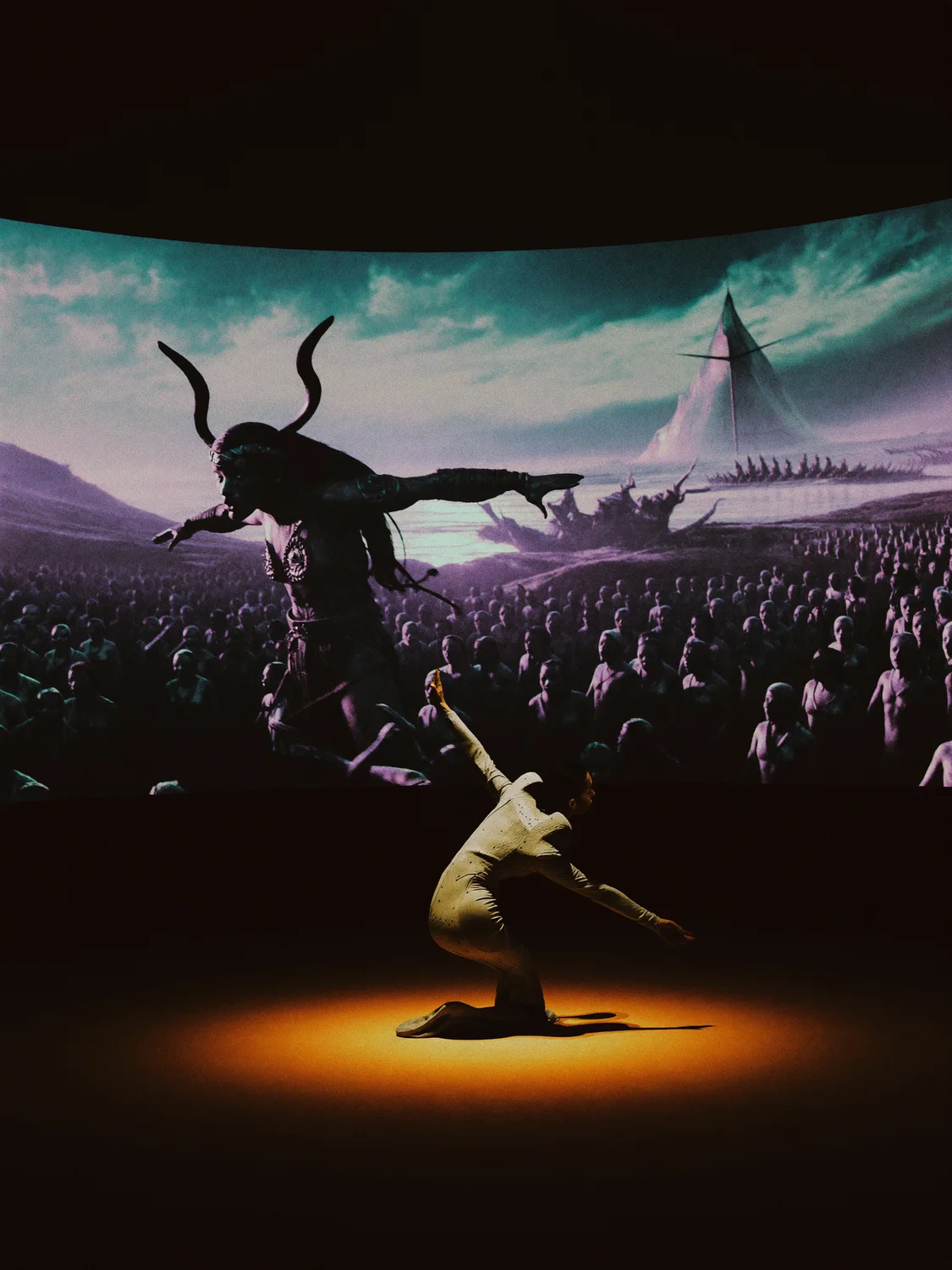
Actress South West stands alone on a bare volume stage the size of a tennis court, wearing a grey suit stitched with sensors, playing a two-headed tribal leader in love with an explorer who isn't there. The thousand-strong crowd cheering her fight-dance doesn't exist either. Neither does the eerie shoreline, the second head, or the weather. On the production wall, the film assembles itself in real time around her performance: the model ingests every flick of her wrists, every catch in her breath, and renders the epic — armies, storms, close-ups — eleven seconds behind her body.
Joel, the last director of photography in the hemisphere still credited under that title, watches the wall and not the woman. His job stopped being about cameras years ago. He directs the taste of the system: nudging the light toward amber, vetoing a too-perfect sunset, protecting the film from the model's tendency to make everything beautiful.
South West is what the industry now calls a source performer. Her contract is thicker than the script: her likeness licensed for this story-world only, her synthetic double embargoed for seven years, her biometric signature watermarked into every frame she generates. Half her income comes from films she has never heard of — licensed echoes of her twenty-year-old self, performing in languages she doesn't speak, for audiences on three continents. Her union negotiated the reversion clause the year she was born.
Tonight they shoot the final scene, and the director has made his one eccentric demand — the reason this production costs more than any fully generated feature of the season. When the tribal leader weeps over the explorer's body, the tear will be real. One camera — an actual, physical, hundred-year-old Arri — will record it. The shot will carry the certification seal in the corner, the one audiences have learned to look for the way their grandparents looked for "shot on location".
One human tear, one real machine, eight seconds of film. The marketing department has already built the whole campaign around it.
// The science behind it
The set that fits in a sentence
In 2021, the most futuristic thing in filmmaking was a wall. The Mandalorian's LED volume — a curved, 270-degree screen the size of a building, driven by a game engine — let actors stand inside their locations instead of in front of green screens, and the industry rightly called it the biggest invention since the green screen itself. What nobody said out loud was that the wall was a transitional technology: a way to keep pointing physical cameras at physical people while the world around them went digital.
Five years later, the camera itself has become optional. Text-to-video models — Sora, Veo and Runway first, then Seedance 2.5 and Kling 3.0 — generate cinematic, multi-shot, sound-synced sequences with consistent characters from a paragraph of description. What began as eight-second curiosities has become the default production method for advertising, music video and previsualisation, and the fastest-growing tool in episodic television. The cost curve tells the story better than any manifesto: a minute of finished, photoreal footage has gone from a Hollywood budget line to a subscription fee. The one-person film studio — a writer-director with taste, a model stack and a rendering budget — is no longer a thought experiment. Festivals have opened categories for it; streamers commission it; and somewhere right now, the El Mariachi of generated cinema is being made by someone whose entire crew fits in a system prompt.
The wall, meanwhile, did not disappear — it multiplied and got cheaper, from Cape Town to Mumbai exactly as predicted. But its role inverted: the volume stage is now where you put the humans, the last physical element in a pipeline that generates everything else around them.
The actor becomes an asset
The deeper revolution is contractual. In 2021, Unreal's MetaHuman Creator made building a photoreal digital person as easy as designing a Sims character, and this chapter predicted synthetic actors would cross the uncanny valley. They did — and the crossing was so uneventful that the industry's crisis turned out to be legal, not aesthetic.
The actors saw it coming first. The great Hollywood strikes of 2023 were remembered not for their pay demands but for their science-fiction clauses: consent and compensation for digital scanning, limits on synthetic replicas, protection for background performers whose bodies were being captured once and reused forever. Those clauses are now the industry's constitution — and its battleground. De-aged stars carry entire franchises decades past their faces; estates license the dead for new performances, from resurrected crooners to digitally completed final films; an AI-assisted vocal polish on an Oscar-winning performance can ignite a week of controversy; and when a studio unveiled a fully synthetic "actress" with an agent and a press tour, the union's response made the evening news. The scandal is never that the synthetic performer looks wrong. It is that she looks right, and works for free.
So a new profession is consolidating: the source performer — the human whose captured performance seeds and legitimises the synthetic one. The industry is discovering that what it actually buys from a star was never the face. It is the choices: timing, restraint, risk, the ten thousand micro-decisions per scene that models imitate but do not originate. Faces are now free. Judgment still bills by the day.
Hollywood's Napster decade
Behind the artistry, the business is living through its Napster moment — the phase where an industry sues the future while quietly licensing it. The studios' archives, the most valuable training data in entertainment, sit at the centre of lawsuits, licensing deals and mergers; every major catalogue owner has had to decide whether its film library is a museum or a dataset, and the honest answer is both. Meanwhile the streaming economics that squeezed mid-budget cinema into extinction are being squeezed in turn: when competent content is infinite, the scarce commodities are franchises, live events and attention itself — and attention, as the next chapter argues, has become the most contested resource on Earth.
The pessimists' math is brutal: infinite supply, finite eyeballs, collapsing price of production. But the optimists hold the historical high ground. Every technology that "killed" cinema — sound, television, video, CGI, streaming — multiplied the audience for moving images instead. The realistic forecast for 2051 is not fewer films but unimaginably more, sorted into two economies: an infinite, personalised, largely generated stream that functions like weather; and a scarce, witnessed, human-certified cinema that functions like theatre — premieres as events, film stock as pigment, the practical shoot as a luxury genre with its seal in the corner of the frame.
The audience takes the wheel
One more frontier opened faster than the industry wanted: the viewers started making the movies. The same models the studios use are on every teenager's laptop, and fandom crossed the line from commentary to production years ago — recut endings, whole "lost seasons" of cancelled shows, beloved characters continuing in styles indistinguishable from the originals, circulating in the legal twilight between homage and infringement. The studios oscillate between takedowns and licensing programmes, and the smartest of them have understood the historical rhyme: fan fiction was never a threat to publishing, it was its farm system. The showrunners of 2051 are in the comment sections of 2026.
Interactivity is the other door. Games and film, which spent forty years converging, have effectively merged at the technological layer — the same engines, the same virtual humans, the same generated worlds — and the grammar is bleeding across: series that adapt pacing to your attention, thrillers that notice what frightens you, children's films where the hero can be steered by the smallest viewer in the room. The fixed, communal cut survives — cinema's whole social meaning depends on everyone having seen the same film — but it now coexists with versions that fit their viewer like a tailored suit. The premiere becomes the moment the canonical cut is witnessed together; the stream is where the film goes to live a million private lives afterwards.
The valley behind us
And the uncanny valley itself — the eeriness that once guarded the border between human and replica? It is behind us, crossed not with a bang but with a shrug. Digital humans present the news in several countries; virtual idols fill arenas and their fans do not care, or rather, care differently, the way one loves a character rather than a colleague. The valley's ghost survives in one place only: trust. Audiences no longer ask "does it look real?" — they ask "is it disclosed?" Provenance seals, synthetic-media labels and performance certifications are becoming to film what ingredient lists became to food. The eerie thing in 2026 is not a face that is almost human. It is a face that is perfectly human, and unlabelled.
The road to 2051
Every film becomes a system, not an artifact. Master versions ship with licensed character models, alternate cuts, language-native performances and per-viewer grading — the "director's cut" becomes the director's boundaries.
The cast becomes a constellation of licensed IP. Living stars, managed estates, born-synthetic characters and source performers share billing; entertainment law becomes the industry's biggest soundstage.
Production bifurcates. Generated-by-default for the stream; human-certified for the event. The Tarantino of 2051 shoots on film, with actors, in real weather — and the very expense of it is the art form.
And the tear still matters. The industry will spend billions to simulate everything, and the audience will pay a premium for the eight seconds it can't. The uncanny valley was never really about faces. It was about meaning it.
// 2021 → 2026 verdict
2021 verdict: Probability 90/100 — virtual production as the industry standard. 2026 reality: exceeded. The valley was crossed years ahead of schedule — and the film industry's hardest problem stopped being how synthetic humans look, and became what real ones are for.
This chapter was rewritten in 2026 by Brice × Claude Fable5. Read the original 2021 edition — written entirely by humans, published one year before ChatGPT existed.