21Africa· 2026 edition
Africa, the supernation
// A story from 2051
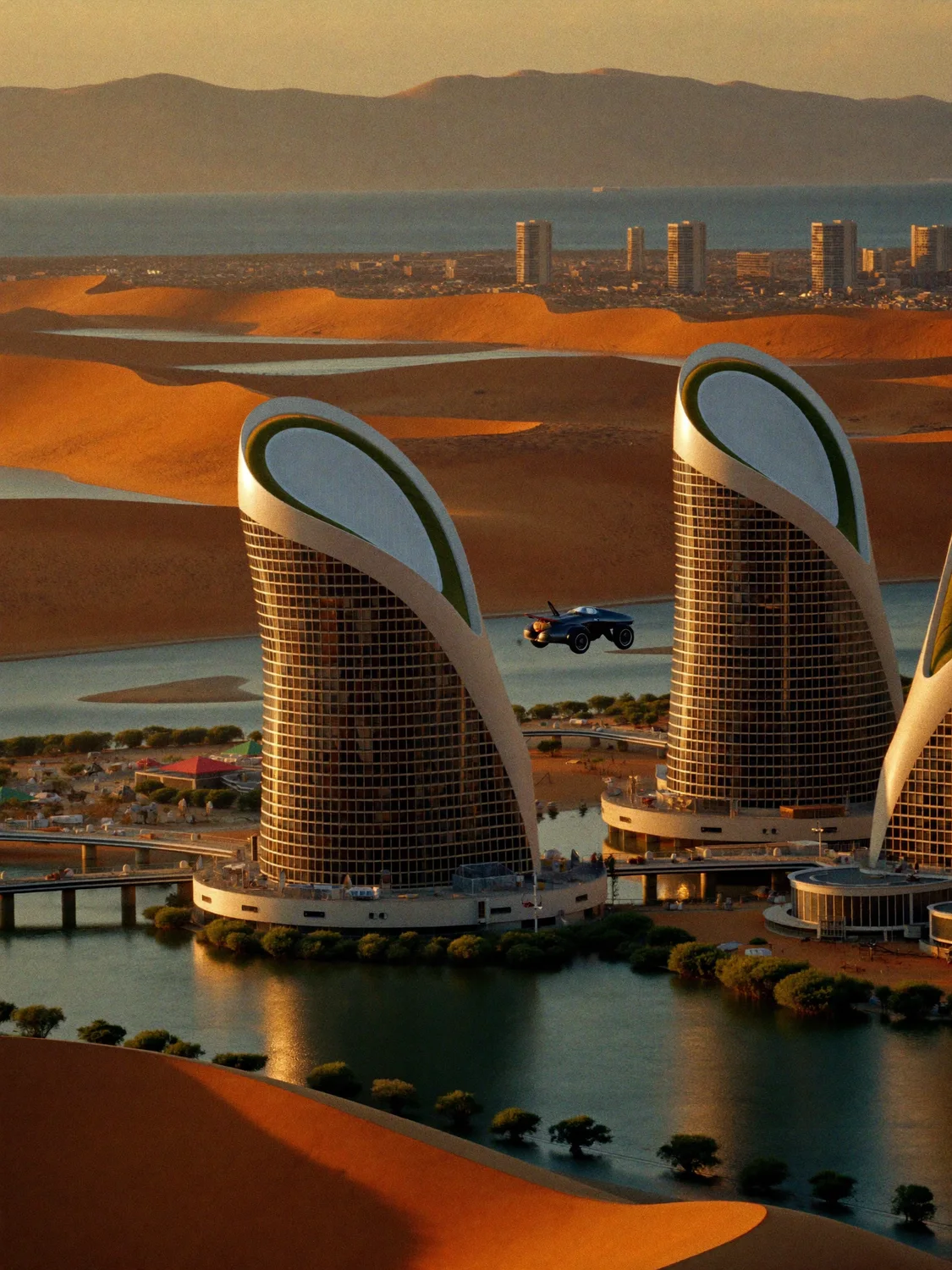
A whirring, jet-black Skyride swoops in and settles softly on the helipad — one of the ride-on flying craft that everyone in Walalapo seems to own now, something between a drone and an air-moped. A deleted scene from Luc Besson? No. Just another ordinary Tuesday in Africa, 2051. Aadi and Loide live in Walalapo, a four-million-soul smart city spun up along the Namibian coast between Walvis Bay and Swakopmund — one of the continent's blue-economy hubs, a Wakanda-shaped skyline of undulating towers and engineered saltwater lakes fringed with new mangrove.
They are heading to a class reunion in Botswana, and they are dressed, as ever, to be noticed: Loide in a sun-reflecting leotard and living-moss trainers, Aadi in a flowing kelp-fabric robe of deep emerald over a smart jacket. At dinner parties, when the wine is flowing, they like to joke that they are both miners. Loide made her first fortune early, mining crypto as a teenager, and styles metaverse looks now for clients across three continents. Aadi mines the ocean — his firm pioneered marine biotech along the Namibian coast, the first African megafarm growing engineered grain in seawater, the first deep-Atlantic sea farms. Their wealth was made from things that in their grandparents' day the continent did not even own the rights to, and often was not paid for at all: its sun, its wind, its sea, its data, its youth.
Loide cues the playlist. They will take the high-speed train across the border into Botswana without a thought for a checkpoint — the long-promised visa-free Africa finally knitted itself together in the 2040s, the common passport honoured now by most of the continent. Five hours to catch up with old friends, argue amiably about the newest protocols, and watch the land change: the savannah woodland near Mount Erongo where they went game-watching as children, greener now than it was then, because the money that greened it stayed home. Somewhere past Gobabis, Aadi looks up from his screen at the passing country and says the thing they both feel and rarely say aloud: we were told, our whole childhoods, that this was where the future did not happen. The train hums on toward Botswana, carrying its cargo of Africans who were nobody's afterthought, past new solar farms and old red hills, into an evening that belongs, at last and entirely, to them.
// The science behind it
The bet, and the honest scorecard
The 2021 edition of this chapter made the boldest and most sprawling wager in the whole book: that Africa — young, mobile, sun-drenched, resource-rich — would become the economic superpower story of the twenty-first century, an "iAfrican" civilisation leapfrogging straight past the industrial age into the digital one. Five years on, the honest verdict is a split decision, and this rewrite owes the reader both halves. The deep structural theses — demographics, energy, culture, mobile finance — are being vindicated, some spectacularly. The utopian financial theses — a crypto monetary union, a continent trading Akoin in flying-car cities — collided hard with reality. And the decade added a column the 2021 essay left nearly blank: the serious headwinds — debt, drought, coups, and a new kind of technological dependency — that stand between Africa and the supernation. The prophecy was not wrong. It was, in places, early, in places over-eager, and in one crucial respect not ambitious enough. Let us go section by section, as the original did, and mark the paper honestly.
The demographic thesis: vindicated, and it is everything
Start with the claim everything else rests on, because it is the one the decade confirmed beyond argument. Africa is the young continent, and getting younger relative to a greying world. Its median age remains around nineteen while Europe's approaches forty-five and East Asia's tips into decline; its working-age population is on track to surpass both China's and India's, and by 2050 roughly a quarter of all humanity — and a still larger share of all young humanity — will be African. Nigeria alone is heading toward being one of the most populous nations on Earth. As the rest of the world ages into a labour shortage, Africa will hold the largest reservoir of working-age people on the planet. This is not a forecast anymore; it is demographic momentum already locked into the age pyramid, and it is the single most important fact about the twenty-first century that most of the twenty-first century's commentary ignores. The 2021 essay was right to build the whole chapter on it.
But the decade sharpened the double edge the original underplayed. A youth bulge is an asset only if it is employed; unemployed, it is a crisis. The same young millions who could staff the world's factories and fill its innovation labs will, if the jobs do not come, become the largest cohort of frustrated, connected, mobile young people in history — and frustrated youth is the raw material of both migration pressure and political upheaval. The Sahel coups, the youth-led protest movements that toppled governments across the decade, are early readings of what happens when the demographic dividend is not paid out. The prophecy of Africa's people as its greatest asset stands. Whether it is realised as prosperity or as unrest is the open question of the age, and it turns entirely on jobs — which turns, increasingly, on the AI that this book keeps returning to.
And the "iAfrican" leapfrog the original built its portrait on has, if anything, deepened. The essay's central image — a continent that skipped landlines and bank branches to run its entire life on the mobile phone, "mobile-only" rather than merely mobile-first — is more true in 2026 than in 2021. Smartphone penetration climbed, data got cheaper, and a generation now conducts its banking, its schooling, its healthcare, its politics and its commerce through a device in the hand, with no expectation that the physical institutions of the twentieth century will ever arrive. This is not poverty making do; it is a genuinely different, in some ways more advanced, architecture of daily life, built on the newest layer because there was no old layer to defend. That is the deep engine under every specific prediction in this chapter — and it is exactly why the next leapfrog, into AI, could be so consequential: a population already living natively on the phone is a population ready to live natively with an intelligence inside it.
The energy thesis: vindicated, and Namibia is the proof
The original bet heavily on African sun and wind, and here reality has, if anything, outrun the optimism — while also exposing the gap the essay glossed. The vindication first: solar and wind are now, as chapter seven established, the cheapest power humanity has ever built, and Africa has more of the raw resource than any continent on Earth. Solar is being deployed across the continent at a pace that was fantasy in 2021; Morocco's giant plants, South Africa's build-out, and above all the green-hydrogen boom the original specifically predicted for West Africa have become real, enormous projects. And here is the detail that should make any reader of the 2021 fiction sit up: it set its story in Namibia, on the Walvis Bay coast — and Namibia has since become one of the world's most watched green-hydrogen frontiers, host to a multi-billion-dollar project to turn its desert sun and wind into green fuel for export to Europe, exactly the "nations reaching out to Africa for cost-effective green fuel" the essay foresaw. The continent that Europe once mined for coal and oil is being courted for the clean fuel of the next century, from the very stretch of coast the fiction chose. That is a genuinely startling piece of prophecy.
There is a deeper leapfrog buried in the energy story, too, and it echoes the mobile-money one exactly. Just as Africa skipped the landline and went straight to the mobile, much of it can skip the twentieth-century model of huge centralised power stations and national grids — the infrastructure that took the West a century and a fortune to build — and go straight to distributed solar: rooftop panels, village mini-grids, pay-as-you-go solar-and-battery kits sold on the same mobile-money rails, bringing a household its first electricity without ever waiting for a wire from a distant plant. This is the model quietly electrifying rural Africa now, and it is the energy equivalent of the mobile leapfrog — newest layer first, no legacy to defend. Combine it with the continent's unmatched sun and the collapsing price of batteries (chapter seven), and the path to universal power runs not through mega-projects alone but through millions of small, smart, locally owned systems. The colossal green-hydrogen plants will export fuel to Europe; the little solar kits will bring light to the village. Africa's energy future is being written at both extremes of scale at once.
The honest other half: some 600 million Africans still lack access to electricity at all, and closing that gap is now the explicit goal of a major international push to connect hundreds of millions by 2030. Africa can be simultaneously the planet's greatest green-energy opportunity and its largest population without power — and which of those facts wins is a matter of finance and infrastructure, not sunshine. The sun shines brightly on Africa, as the original said. Getting its light into every home is the unfinished work.
The money thesis: half-right, and humbled
Now the section where the 2021 essay's exuberance met the hardest reality check, and honesty demands the full accounting. The essay bet enormously on crypto — a pan-African cryptocurrency, a monetary union on the blockchain, Akon's Akoin powering a Wakanda-esque smart city rising from the Senegalese desert. That specific vision largely did not happen. The crypto market crashed spectacularly in 2022, taking its most utopian promises with it; central-bank digital currencies rolled out and mostly flopped — Nigeria's eNaira, launched with fanfare, achieved almost no adoption; and Akon City, the literal flying-car metropolis the original cited as its emblem, remains, years later, largely empty desert, a symbol now of the gap between crypto's promises and its deliveries. The 2021 chapter, written at the absolute peak of crypto optimism, mistook a bubble for a foundation. It is important to say so plainly.
And yet — this is what makes the money story fascinating rather than simply a cautionary tale — the underlying insight was sound, and one piece of it came true in a form the essay half-saw. Africans genuinely do lead the world in the practical, unglamorous use of digital money, and where inflation ravages the local currency — Nigeria, and others — people turned in real numbers not to speculative coins but to stablecoins, dollar-pegged tokens used as a shelter for savings and a rail for cross-border payments, precisely the "bypass the banks, hedge the currency, move money by phone" behaviour the essay described. Mobile money, meanwhile, did exactly what the original said, only more so: M-Pesa and its kin remain the beating heart of African finance, and the continent's fintech scene — the "Silicon Savannah," the payment giants — became one of the few places on Earth genuinely reinventing money from first principles, unburdened by legacy banks. The dream of a single African currency and a borderless money market remains aspirational. But the deeper claim — that Africa, precisely because it lacks legacy financial infrastructure, would leapfrog into new forms of money — is true. The essay just backed the flashy horse instead of the sound one.
The trade-and-union thesis: real, but slower than the dream
The African Continental Free Trade Area — the largest free-trade zone on Earth by membership — is real, launched, and trading, exactly as the original celebrated. But the decade taught the lesson that founding a thing and realising it are different labours. Progress toward genuinely frictionless intra-African trade has been slower and stickier than the 2021 optimism implied; the common passport and free movement remain more aspiration than fact; infrastructure gaps, non-tariff barriers, and national self-interest slow the machine. The vision — a continent that trades richly with itself, two of every three new-activity dollars staying in Africa, a bloc powerful enough to set terms rather than take them — is the right destination and a plausible one. The fiction's casual border-free train ride is a reasonable 2051. It is simply a longer road than the original, in its enthusiasm, marked it. Integration is happening in decades, not years.
The culture thesis: under-predicted, and it exploded
Here the 2021 essay, for all its ambition, actually under-shot — and the correction is the most joyful part of this rewrite. The original nodded at Nollywood and youth creativity, but it could not have foreseen how completely African culture would conquer the global mainstream in the years that followed. Afrobeats went from regional genre to planetary phenomenon, filling the biggest arenas on Earth, topping Western charts, minting global superstars, winning the awards the industry had gatekept for a century; Amapiano spread from Johannesburg townships to the world's clubs; African fashion, film, literature and design became coveted global exports rather than curiosities. This matters far beyond entertainment, because cultural power is the leading edge of every other kind of power — it shifts how the world sees a place, which shifts where money and talent flow. A generation of non-Africans now associates the continent, first, with the coolest music on the planet. The 2021 essay was right that youth culture would drive Africa. It simply could not imagine how fast the world would start dancing to it. The soft-power supernation arrived ahead of the economic one — and is helping to pull it into being. Nollywood grew into one of the world's most prolific film industries; African streamers and studios began telling African stories to global audiences on their own terms; African athletes, models, chefs and designers moved from the margins to the centre of global taste. Soft power is not a consolation prize for the economic kind; historically it is its herald. The countries the world finds cool are the countries the world's talent and capital eventually chase. Africa became cool first. The rest, if the other engines fire, tends to follow.
The headwinds thesis: the column the original left blank
And now the debt the earlier optimism owed the reader. The 2021 essay treated Africa's obstacles almost as afterthoughts — corruption, organised crime, a nod to climate — and the decade insisted on a fuller reckoning. Three headwinds in particular hardened. First, debt: a wave of borrowing, much of it from China during the infrastructure boom the original cheered, curdled into a genuine debt-distress crisis across the continent, with governments spending more on servicing loans than on health or education, and Chinese lending itself sharply pulling back. Second, climate: the continent that did least to cause warming is suffering it most, and the decade delivered the proof — the worst Horn of Africa drought in generations, devastating floods, an El Niño that scorched Southern Africa's harvests — turning the original's breezy "smart people will find a way around it" into a matter of survival for millions. Third, instability: a belt of coups across the Sahel, catastrophic wars in Sudan and Ethiopia, and the fragility that turns a demographic dividend into a demographic emergency. None of this cancels the supernation thesis. But a 2026 telling that omitted it would be propaganda, not prophecy. Africa's rise is real and its obstacles are real, and pretending otherwise serves no one on the continent.
The breadbasket thesis: the right prize, the harder road
The original devoted its longest passages to food and water — Africa as the future breadbasket of the world, holding the majority of the planet's remaining uncultivated arable land, poised to feed its own billions and export the surplus as other continents exhaust their soil. The prize is real and the logic is sound: as chapters two and six established, the world must grow far more food this century on a warming, crowded planet, and Africa is where much of the room to do it physically exists. The technologies the essay named have all advanced — precision agriculture guided by satellite and AI, drought-resistant and salt-tolerant crops (chapter six's gene-edited staples), ocean and saltwater farming of the kind Aadi pioneers in the fiction, and the algae and kelp foods the original promised would migrate from novelty to staple. The direction is right. Kelp burgers and algae protein are no longer a joke; seawater agriculture is a real and growing field; genetically improved, climate-hardy African crops are moving from lab to field.
But the decade insisted on the two truths the 2021 enthusiasm rushed past. First, climate is not a footnote to African agriculture; it is the whole game, and it is turning against the continent's farmers faster than the technology is arriving to help them — the droughts and floods of the mid-2020s destroyed harvests and lives on a scale that "smart people find a way" does not begin to cover. Second, the "unparalleled transfer of land ownership" the original noted approvingly is the same phenomenon others call land grabbing — foreign states and funds buying African farmland to feed their populations, a dynamic that can as easily entrench a new extractive colonialism as build African food security, depending entirely on who captures the value. The breadbasket future is achievable. But it will be built by African farmers keeping the gains of their own land and labour, with climate-adapted technology arriving at the speed of the crisis — not by a land rush that grows food on African soil for everyone but Africans. The prize is worth the whole chapter. The road runs straight through the hardest problems in the book.
The urbanisation thesis: the cities are the century
The original saw it clearly: Africa is urbanising faster than anywhere on Earth, and its cities — already richer per capita than the continental average — are where the growth, the markets, and the future concentrate. This has only accelerated. Lagos, Kinshasa, Nairobi, Dar es Salaam, Abidjan and a dozen others are swelling toward megacity scale, and by mid-century Africa will hold a remarkable share of the planet's largest urban agglomerations. The Walalapo of the fiction — a purpose-built coastal smart city of four million — is the aspirational extreme of a real and unstoppable trend, and the "new city" projects that have proliferated (some visionary, some vanity, some — like Akon City — stalled) are attempts to leap straight to the built environment of the future rather than retrofit the past. Here is Africa's leapfrog logic applied to concrete and grid: a city built new can be born solar-powered, digitally governed, and mobility-smart, skipping a century of legacy infrastructure the way its people skipped landlines. The opportunity is enormous. The risk, equally, is the megacity that outruns its jobs and services and becomes a vast informal settlement rather than a Wakanda — the same jobs question that haunts the demographic dividend, rendered in skylines. How Africa's explosive urbanisation is financed, powered, and employed is, quite literally, where the supernation will be built or lost. It will be an urban century, and it will be, more than any other continent's, an African urban century.
The new thesis the decade wrote: the AI leapfrog, and the AI trap
Finally, the force that did not exist when the original was written, and that now overhangs every other thesis in this chapter: artificial intelligence. It is, for Africa, the ultimate double-edged sword. On one edge, the greatest leapfrog opportunity yet — AI tutors that could educate a generation the schools cannot reach; AI doctors (chapter nine) for a continent desperately short of physicians; AI tools that let a young Lagos or Nairobi founder build what once took a corporation. The mobile-only leapfrog the essay celebrated could repeat, an order of magnitude larger, with intelligence itself as the thing leapfrogged into. On the other edge lies the gravest new dependency: the compute, the models, the data centres, and the capital of the AI revolution are overwhelmingly concentrated outside Africa, and a continent that consumes AI built elsewhere, trained on other languages and other lives, its own languages and data underrepresented, risks a twenty-first-century version of the oldest story — value and power extracted, dependency deepened, a new colonialism of the cloud. Which edge cuts depends on choices being made right now: whether Africa builds its own compute, trains models in its own thousand languages, and keeps the value of its data and its youth at home. This is the true stakes of Aadi and Loide's world. They are rich because, in their century, the continent's sun and sea and data and intelligence were finally owned and monetised by Africans, for Africa. That outcome is possible. It is not automatic. It is the central fight of the coming decades, and the 2021 essay, written before the machines, could not have named it.
There is a specific, urgent front in this fight worth naming, because it decides whether the AI age includes Africa at all: language and data. The large models that now mediate the world's knowledge were trained overwhelmingly on English and a handful of wealthy languages; Africa's roughly two thousand languages — spoken by a fifth of humanity by 2050 — are, in the machines' minds, nearly invisible, underrepresented in the data and therefore underserved by the intelligence. An African child asking an AI tutor a question in Wolof or Amharic or Yoruba deserves an answer as fluent as the one it gives in English, and building that requires African-led effort to gather the data, train the models, and own the result. A growing movement of African researchers is doing exactly this work — assembling datasets, training local-language models, arguing for data sovereignty — and it is among the most important quiet battles of the decade. Whether the intelligence of the century speaks Africa's languages, and whether Africans own the models that do, will determine whether AI is the continent's greatest leapfrog or its subtlest new dependency. The sun and the sea Africa can hardly lose. Its data and its languages it could still be talked out of. Keeping them is the work Aadi's generation will have been thanked for.
The verdict on the vision
So: expect everything, expect nothing, watch this space — the original's closing incantation still fits, but the 2026 reading is wiser than the 2021 one. Africa's rise is not the smooth, crypto-lubricated ascent the first edition imagined; it is a contested, uneven, genuinely epochal transformation, with the demographic, energy, cultural and financial-leapfrog engines all firing, and the debt, climate, governance and AI-dependency brakes all dragging. The supernation is not guaranteed. But the raw materials — the youngest population, the strongest sun, the coolest culture, the least legacy baggage, and, if it can seize it, the leapfrog into intelligence itself — are more clearly assembled in 2026 than they were in 2021. The century's single biggest question may simply be whether the world, and Africa's own leaders, let the continent keep the value it is about to create. Aadi and Loide, on their train through a greener savannah, are the answer if it goes right. Making it go right is the work of a generation — and it has already begun.
// 2021 → 2026 verdict
2021 verdict: Probability 80/100 — Africa becomes the economic superpower story of the century: mobile-native youth, crypto union, solar abundance, breadbasket of the world. 2026 reality: a split decision, trending up. The deep theses — demographics, cheap solar and green hydrogen (from the very Namibian coast the fiction chose), mobile finance, and a global cultural explosion the original under-predicted — are vindicated and accelerating. The crypto-utopia — Akoin, blockchain monetary union, the flying-car city — collided with the 2022 crash and mostly failed, though stablecoins and fintech carried the sound half of the idea forward. And the decade added the headwinds the original glossed: debt distress, climate shocks, coups, and above all a new AI dependency that could be the greatest leapfrog or the newest extraction. The supernation is not inevitable. But its raw materials are more clearly on the table than ever — and the fight now is over who gets to keep what Africa is about to build.
This chapter was rewritten in 2026 by Brice × Claude Fable5. Read the original 2021 edition — written entirely by humans, published one year before ChatGPT existed.